Crypto Card Tax: What You Owe When You Spend
Contents
- Is Spending Crypto with a Debit Card a Taxable Event?
- How to Calculate Crypto Card Tax
- Record Keeping: What You Need to Track for Every Card Transaction
- Tax Treatment of Cashback and Rewards from Crypto Cards
- Country-Specific Rules: US, UK, and Beyond
- Which Crypto Card Issuers Provide Tax Help?
- 5 Mistakes to Avoid When Reporting Crypto Card Taxes
- Frequently asked questions
Quick answer
Yes, crypto card tax applies when you spend crypto with a debit card. The conversion to fiat at purchase is a disposal. You may owe capital gains tax on any increase since acquisition. Keep records to calculate your gain or loss.
Key takeaways
- Every crypto card purchase is a taxable disposal. You must report it even if you don't sell to fiat yourself.
- Capital gains equal fair market value at spending minus cost basis. Short term gains may be taxed at higher rates.
- Cashback rewards in crypto are usually taxed as income when received. Factor that into your return.
- Tax rules vary by country. The US and UK tax spending as disposals, while Germany offers an exemption after one year.
This article covers crypto card tax rules in the US, UK, Germany, and Portugal. You will learn how to calculate capital gains, what records to keep, and how cashback is taxed.
Is Spending Crypto with a Debit Card a Taxable Event?
The IRS treats crypto as property. That has a direct consequence. Every time you use a crypto debit card, you dispose of property. The card provider converts your crypto to fiat at the point of sale. That conversion is a taxable event under US federal tax rules. You recognise a capital gain or loss on the difference between the crypto's value when spent and what you paid for it.
The same logic applies to stablecoin cards. Stablecoins are designed to hold a $1 peg, but they can trade at $0.999 or $1.001. If you bought USDC at $1.00 and later spend it when the card values it at $1.002, you realise a small gain. Most people ignore that. Tax law does not.
The UK follows a similar approach. HMRC treats cryptoassets as property. A card payment that converts crypto to fiat is a disposal for capital gains tax. You do not need to sell to fiat yourself to owe tax. The card issuer does it for you.
For the IRS position, see the official IRS Virtual Currency Transactions FAQ.
How to Calculate Crypto Card Tax
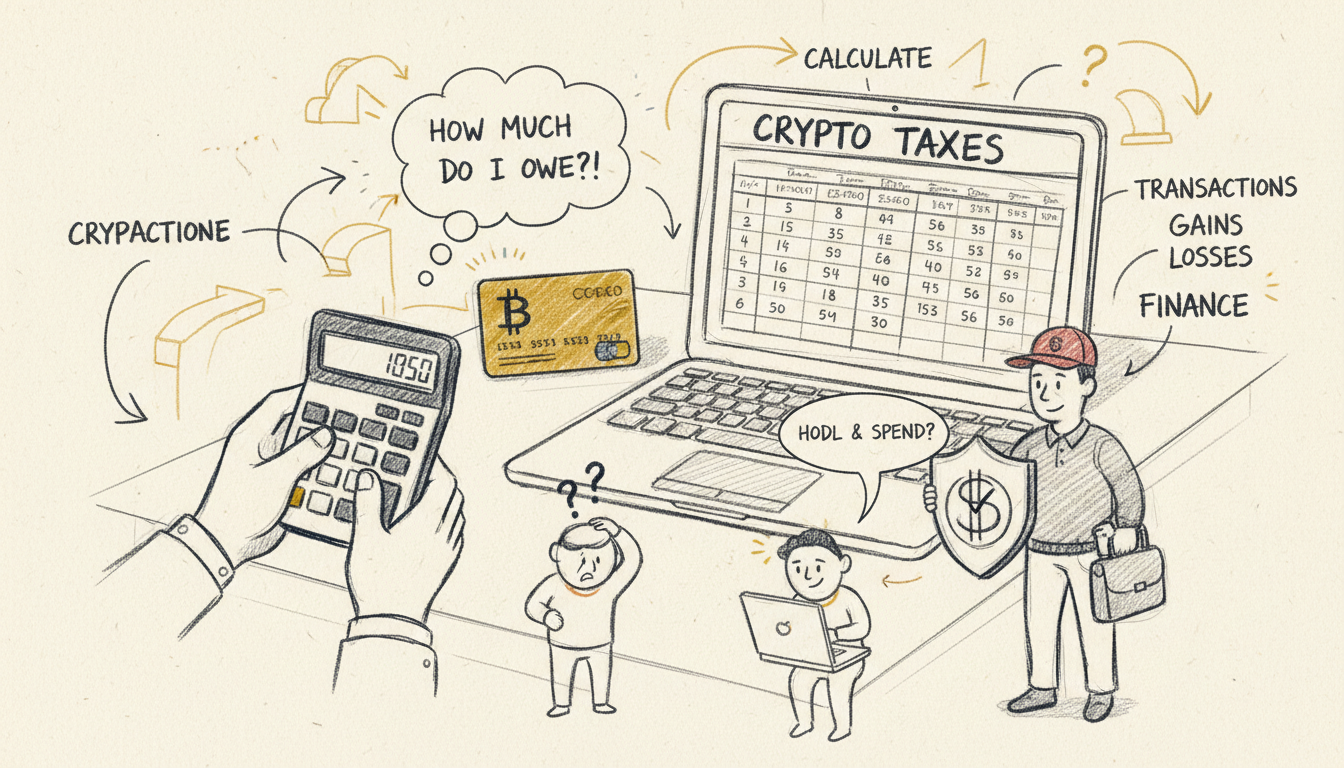
The basic crypto card tax calculation starts with two numbers. Take the fair market value of the crypto at the moment you spend it. Subtract your cost basis in that crypto. Cost basis is the original value you paid for the asset. The result is your gain or loss.
Say you bought 1 ETH for $2,000. Three months later you use a crypto debit card to buy a laptop. At that moment the card values 1 ETH at $4,000. You spent the equivalent of $4,000 worth of ETH. Your gain is $2,000. You report that gain.
Holding period determines the rate. In the US, if you held the crypto for one year or less, the gain is short term. Short term capital gains are taxed as ordinary income. Your marginal income tax rate applies. If you held for more than one year, the gain is long term. Long term rates are 0%, 15%, or 20% depending on your income. The difference can be large.
You also need a consistent accounting method. FIFO means first in, first out. The oldest coins are treated as spent first. LIFO means last in, first out. Specific identification lets you choose exactly which coins you sold. Each method can produce a different gain. Pick one and apply it to every card transaction. Changing methods later creates audit risk.
IRS Notice 2014-21 first applied general property tax rules to crypto. That notice is the foundation for treating card spending as a disposal.
Record Keeping: What You Need to Track for Every Card Transaction

HMRC sets out the minimum records for crypto card tax in its Cryptoassets Manual. For every disposal you need four things. Date you acquired the crypto. Your cost basis. The date you spent it. The fair market value at spending, in fiat, and the amount of crypto used. If you do not keep these records, you cannot calculate an accurate gain.
Exchange and card provider statements are your first source. Most issuers let you export transaction history. The Binance Card guide explains what that card reports and how to read its statements. Download CSV files monthly. Do not rely on memory.
Crypto tax software can automate the heavy lifting. Tools like Koinly, CoinTracker, or TaxBit pull data from wallets and exchanges, match disposals to cost basis, and generate tax forms. They are not perfect. You still need to review every card transaction.
Keep records for every card transaction, including those under $1. Tax authorities reserve the right to ask for them years later. Good crypto card tax records prevent problems.
If you cannot show records, the tax authority estimates your gain. That estimate is almost never in your favour. Penalties and interest follow. HMRC's Cryptoassets Manual CRYPTO22200 lists exactly what to keep.
Tax Treatment of Cashback and Rewards from Crypto Cards
Crypto cashback is income, not a capital gain. For crypto card tax purposes, report it as income in the year you receive it. When your card pays you 2% back in CRO or another token, the fair market value of that token is taxable income. You report it in the year you receive it.
Suppose you spend $100 and earn 2% in cashback. You receive tokens worth $2. Report $2 of income. If you later sell or spend those tokens, you will also owe capital gains on any increase from that $2 basis.
Fiat cashback is different in many jurisdictions. If the card pays cashback in dollars or euros, it is usually not taxable income when received. It may be treated as a rebate or discount. When you convert that fiat into crypto, normal capital gains rules start.
Track cashback separately from purchases. If you fold cashback into your purchase records, you will double count. The purchase is a disposal. The cashback is income. They are two separate tax events. The Crypto.com Visa card review covers how that card reports rewards.
Country-Specific Rules: US, UK, and Beyond
Rules differ sharply by country. If you have crypto holdings in more than one tax home, treat each separately. Crypto card tax rules vary by jurisdiction.
The US requires Form 8949 for every disposal. Total gains flow to Schedule D. Short term gains are taxed at ordinary income rates. Long term gains use 0%, 15%, or 20% brackets. The form asks for date acquired, date spent, proceeds, and cost basis for each card transaction.
In the UK, card spending counts as a disposal for capital gains tax. Individuals get an annual exempt amount, which reduces or removes tax on smaller gains. Above the £3,000 annual exempt amount, capital gains tax is 18% for basic rate taxpayers and 24% for higher and additional rate taxpayers. The annual exempt amount is applied after netting gains and losses.
Germany stands apart. If you keep crypto for more than one year, spending it is tax free. That exemption removes capital gains tax on long term holdings. Short term holdings are taxed at your personal income tax rate, unless your total private sale gains for the year stay below €1,000. The rule also applies to card spending because the card disposal is still a disposal.
Portugal taxes gains on crypto held for less than 365 days at a flat 28%, or you can choose to add them to your other income. Crypto held for 365 days or more is exempt, unless the counterparty is in a jurisdiction on Portugal’s tax-haven list. Spending crypto with a card counts, so the holding period of the coins you spend decides the tax.
| Country | Tax on card spending | Holding period rule | Main reporting form |
|---|---|---|---|
| United States | Capital gains tax on disposal | Short term <1yr, long term >1yr | Form 8949, Schedule D |
| United Kingdom | Capital gains tax on disposal | No special holding rule | Self Assessment |
| Germany | Tax only if held <1yr | Tax free after >1yr | Anlage SO |
| Portugal | 28% on gains, or added to other income | Exempt after 365 days | Annual IRS tax return |
For a broader view of moving crypto to fiat, see our guide to crypto offramp options. Germany's official Federal Ministry of Finance guidance covers the holding period exemption.
Which Crypto Card Issuers Provide Tax Help?
Not every issuer gives you what you need at tax time. Some are better than others.
Binance Card provides annual statements with full transaction history. You can export data from the card dashboard. That history includes timestamps, crypto amounts, and fiat values at spending. You can use it directly for cost basis matching.
Crypto.com offers CSV exports and integrates with several crypto tax tools. The export includes card purchases, rewards, and other card activity. You can import that file into Koinly or CoinTracker. The card review linked earlier goes into what the export contains.
ReDotPay and MetaMask Card have limited tax reporting. They may show transaction history in the app but do not generate formal tax documents. You will need to export raw data and build your own records.
Always check whether the issuer provides a Form 1099 or equivalent. Some US issuers report certain activity to the IRS. Others report nothing. The absence of a form does not mean the transaction is not taxable. Your obligation is separate from the issuer's reporting.
5 Mistakes to Avoid When Reporting Crypto Card Taxes
These are the mistakes auditors see most often in crypto card tax returns.
- Omitting small transactions. A $3 coffee purchase with a crypto card is still a disposal. Every gain, no matter how small, must be reported.
- Assuming stablecoins are tax free. Stablecoins can drift a fraction of a cent from their peg. That creates small gains or losses. The obligation does not disappear because the number is tiny.
- Forgetting to report crypto cashback as income. Cashback is not a gift. It is income at fair market value when received.
- Using inconsistent cost basis across exchanges. If you use FIFO on Coinbase and specific ID on a card, the tax authority may challenge your whole calculation. Pick one method and stick with it.
- Ignoring foreign issued card tax obligations. A card issued in another country does not move your tax residency. You report worldwide income in your home country.
Our ranking of the best crypto cards ranked helps you compare issuers before you add another card.
Frequently asked questions
Do I need to report crypto card tax on purchases under $100?
Yes. Every card purchase is a disposal, no matter how small. The tax authority expects each one to be reported. You must include it in your crypto card tax filing. Some jurisdictions offer de minimis exemptions, but you cannot assume one applies.
Are there any countries that exempt crypto spending from capital gains tax?
Germany exempts crypto spending from capital gains tax if you held the asset for more than one year. For crypto card tax, that exemption applies when you spend crypto after holding it over a year. Portugal also exempts crypto held for 365 days or more, and taxes shorter holdings at 28%.
How do I handle taxes if my card auto-sells crypto at a loss?
A loss is still a reportable event. You calculate fair market value at spending minus cost basis. If the result is negative, you have a capital loss. You may use that loss to offset gains or, in some countries, other income. Do not skip it.
Can I use a crypto card for business expenses and deduct the fees?
Business use does not remove the disposal. The card still converts crypto to fiat when you pay. You must report the capital gain or loss on that conversion. Card fees may be deductible depending on your location and business structure. Confirm with a tax advisor.
What happens if I fail to report crypto card transactions?
The tax authority can estimate your gain if you have no records. That estimate is usually unfavourable. Penalties and interest may follow. You can fix omissions by filing an amended return or voluntary disclosure in many jurisdictions. Better to report correctly from the start.
Frequently asked questions
Do I need to report crypto card tax on purchases under $100?
Are there any countries that exempt crypto spending from capital gains tax?
How do I handle taxes if my card auto-sells crypto at a loss?
Can I use a crypto card for business expenses and deduct the fees?
What happens if I fail to report crypto card transactions?
Related tools
Keep reading
How Does a Crypto Debit Card Work? Fees, Taxes, and Flow
How does a crypto debit card work? Learn the conversion flow, hidden fees, best assets to spend, and tax rules before signing up.
Crypto Debit Card Risks: 7 Checks Before You Spend
Crypto debit card risks include volatility, counterparty failure, hidden fees, and tax events. Use a regulated issuer, stablecoins, and small balances.
Best Crypto Card Europe: 7 Options Compared for 2026
Discover the best crypto card Europe offers in 2026. We compared fees, rewards, and KYC for 7 cards to find your ideal match.