Best Crypto Offramp in 2026: How to Cash Out Crypto Without Losing Money
Contents
Some links in this article are affiliate links. We may earn a commission if you sign up through them, at no extra cost to you. How we handle affiliate links.
Crypto only pays your rent, your suppliers or your holiday once it becomes money your bank or a shop will accept. A good offramp does that conversion quickly, legally and for less than 1% of the amount.
There are more ways to cash out than ever. You can sell on an exchange and withdraw to your bank, or trade with another person on a P2P market. You can also spend through a crypto card or take cash from an ATM.
Each route charges in a different place. Some of those charges never appear on the screen where you press Sell.
A friend's exchange advertised 0.5%. After the spread, the withdrawal fee and his bank's charge for an incoming international wire, he lost almost $300, close to 4% of what he cashed out.
If you have ever watched a withdrawal arrive smaller than you expected, you know how that feels.
But the map changed in 2025 and 2026. KuCoin left the US, Binance closed EU sign-ups and RedotPay no longer serves India. Advice from a year ago can now send you to a platform you can't use.
Quick answer: The cheapest way to cash out crypto is usually to sell on a regulated exchange and withdraw by domestic bank transfer. ACH, SEPA and Faster Payments keep the total to roughly 0.4% to 1% on $1,000.
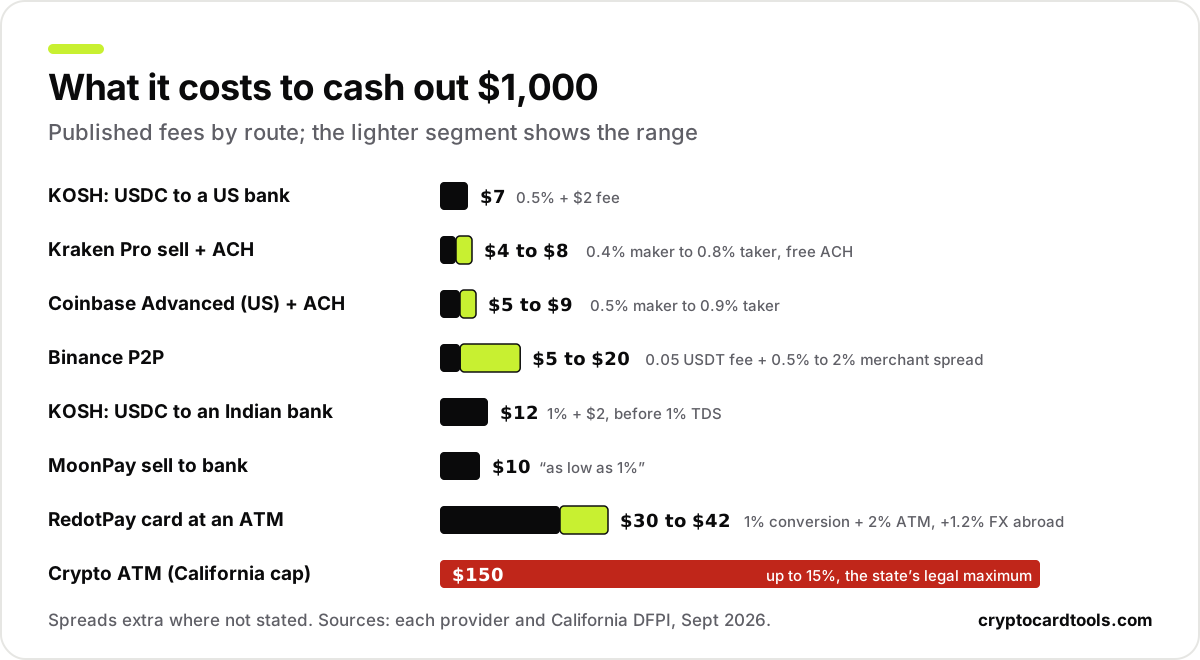
In the US, Kraken Pro and Coinbase Advanced charge the least. In India, KOSH (formerly CopperX) pays out stablecoins to Indian bank accounts for 1% plus $2. P2P markets work where banks are difficult, and a crypto card is the fastest way to get local cash.
Crypto ATMs are the most expensive option by far. California had to cap their fees at 15%.
What a Crypto Offramp Is
An offramp is any service that turns crypto into ordinary money you can spend or deposit. The name comes from motorways: it's the exit from the crypto network back to the banking system.
Five kinds of offramp cover almost every situation. An exchange buys your crypto and sends the proceeds to your bank. A P2P market matches you with a buyer who pays you directly, while the platform holds your crypto in escrow.
A crypto card converts your balance at the moment you pay or withdraw cash. An OTC desk handles large trades privately, usually from about $100,000. A crypto ATM gives you cash for coins on the spot, at a steep price.
The right one depends on three things: how much you're cashing out, how fast you need it and where you live.
What Cashing Out Really Costs
The fee a platform advertises is usually just its trading fee. Your real cost is the sum of every step between your crypto and your bank balance.
Six costs can stack on a single cash-out:
- Spread: the gap between the market price and the price the platform gives you. Simple "Sell" buttons build it into the quote.
- Trading fee: the platform's charge for the sale itself.
- Network fee: the blockchain cost of moving coins to the platform first. Kraken, for example, charges about $1 to withdraw USDT on Tron, and Ethereum costs more when the network is busy.
- Withdrawal fee: the charge for sending money to your bank. Kraken's range from free for ACH to $14 for a SWIFT wire, and Coinbase charges $25 for a US wire.
- Bank receiving fee: what your own bank charges for an incoming transfer. Mine charges $15 for international wires and nothing for domestic ACH.
- Currency conversion: a charge, often a few percent, if your bank converts dollars into your local currency.
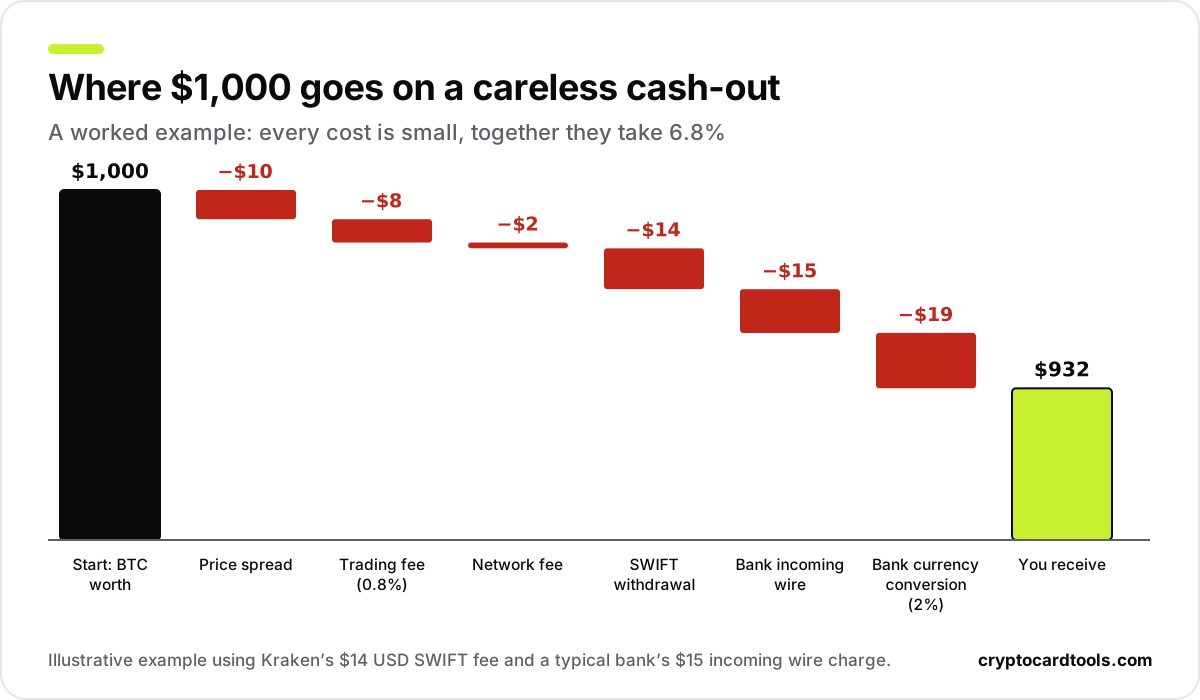
In the example above, no single fee looks alarming. Together they take $68, or 6.8% of the amount.
A domestic transfer in your account's own currency avoids both wire fees and the conversion, which removes most of that loss.
Our cash-out calculator adds up every step for your own amount and route, so you can compare options before you move anything.
How to Cash Out Crypto to Your Bank Account
The steps are the same on most regulated exchanges, and doing them in this order avoids the usual delays:
- Complete full identity verification on the exchange before you need the money.
- Add a bank account in your own name, in the same currency you plan to withdraw.
- Deposit your crypto, choosing a network the exchange supports for that coin.
- Sell with a limit order on the pro trading screen rather than the instant Sell button.
- Withdraw by your domestic transfer: ACH in the US, SEPA in Europe, Faster Payments in the UK or Osko in Australia.
- Keep the trade confirmation and withdrawal receipt for your tax records.
Choosing the Right Network for USDT and USDC
Stablecoins exist on several blockchains, and the exchange must support the one you send on. USDT sent on Tron (TRC-20) to an address that only accepts Ethereum (ERC-20) may never arrive, or may need a costly manual recovery.
The deposit screen lists the networks each exchange accepts for a coin. Matching the network on both sides, and sending a small test amount first, prevents almost every lost deposit.
Bitcoin is simpler, with one main network, but a transfer needs several confirmations before most exchanges credit it. That usually takes 30 to 60 minutes.
The Best Crypto Offramps in 2026
No single platform is best everywhere, because availability and banking rails differ by country. Every fee here was re-checked against the provider's own pages in September 2026.
Kraken: Best for Bank Withdrawals in the US, Europe and Australia
Kraken is a long-running exchange that is regulated in the US, the EU and the UK. It suits anyone cashing out a few thousand dollars or more who wants a regulated route to a bank account.
Instant sells on its simple Buy/Sell screen cost 1% plus a spread. Kraken Pro charges 0.40% as a maker and 0.80% as a taker at the entry tier.
Placing a limit order at your chosen price makes you the maker and pays the lower rate.
Kraken's withdrawal fees are low on domestic rails. US ACH and Australian bank transfers are free, SEPA costs €1 and UK Faster Payments costs £1.95.
International SWIFT withdrawals are the expensive exception, at $14 for dollars.
On $10,000 sold with a limit order and withdrawn by ACH, you would pay about $40. The same sale at market price costs about $80.
My one complaint is support: replies have taken more than five days in my experience. Kraken also holds withdrawals for 72 hours after ACH, card or PayPal deposits, and for seven days after ACH deposits linked through Plaid.
Coinbase: Best for US Beginners
Coinbase's app links directly to your bank, which makes it the simplest regulated offramp in the US. On September 16, 2026, it cut its Advanced trading fees.
US users now pay 0.50% as a maker and 0.90% as a taker at the entry tier. In the EU, the UK and Canada, the rates are 0.25% and 0.50%.
The simple Sell button costs more because a spread is built into the price. Switching to Advanced before selling is the easiest saving available on the platform.
US bank withdrawals by ACH take one to five business days. Coinbase can also send money instantly to an eligible bank or debit card, for a fee it doesn't publish but shows before you confirm.
Coinbase also supports PayPal cash-outs in the US, which suits smaller amounts you want in your PayPal balance.
In Europe, SEPA withdrawals are free and take one to three business days.
KOSH (formerly CopperX): Best for Stablecoins to Local Bank Accounts
KOSH, formerly CopperX, turns USDC or USDT into a bank payout in dollars, euros, pounds, dirhams, rupees or Singapore dollars. It serves both individuals and businesses.
When I set up my account as CopperX, verification took about 30 minutes. It suits freelancers who are paid in stablecoins and want the money in a local bank account without trading on an exchange.
For individuals, a US bank payout costs 0.5% plus $2, and a euro payout costs 1% plus $2. Indian rupee payouts cost 1% plus $2 up to $17,000 per transaction, and 1.25% above that.
On $1,000 of USDC, that works out to $7 to a US bank or $12 to an Indian one. Rupee payouts usually arrive in one to three business days, and pound payouts often within minutes.
The minimum withdrawal is $50. KOSH isn't a bank itself: it relies on licensed payment partners, which it doesn't name publicly.
You can open a KOSH account, and our KOSH Card page covers its card fees and limits.
Binance P2P: Best Where Banks Make Crypto Difficult
Binance P2P connects you with a buyer who pays you by bank transfer or a local payment app, while Binance holds your crypto in escrow. I have used it around 50 times. It works smoothly when you follow its rules.
It isn't completely free. Since 2024, takers on USDT pairs in more than 95 markets pay a flat 0.05 USDT per order.
The merchant's price is the bigger cost. In my trades, it has usually sat 0.5% to 2% below the market, which means $5 to $20 on $1,000. Most of those trades finished within 15 to 45 minutes.
Availability is the main limit. Binance hasn't accepted new UK customers since October 2023, and press reports say it stopped EU sign-ups from July 1, 2026. In the US, the separate Binance.US exchange offers free ACH withdrawals instead.
The bigger risk is the counterparty. Payments from a buyer can later be reversed or flagged by your bank, which is why the safety rules later in this guide matter most for P2P.
If you already have an account, you can find Binance P2P in the app under Trade.
KuCoin P2P: A Backup P2P Market
KuCoin's P2P market works like Binance's, and KuCoin says it charges no fees on P2P trades. It has fewer merchants, so a match can take longer, although I have sometimes found better prices there.
I mostly use it for altcoins Binance handles poorly, or when Binance's rates aren't competitive that day.
KuCoin left the US after pleading guilty to running an unlicensed money transmitting business in January 2025. In the EU, it now operates through KuCoin EU, which holds a MiCA licence from Austria. It is registered with India's Financial Intelligence Unit and offers rupee P2P there.
The UK's Financial Conduct Authority lists KuCoin on its warning list, so UK residents are safer with another platform. You can open a KuCoin account if it serves your country.
Crypto Cards: Best for Cash in Hand, Fast
A crypto card skips the bank entirely. You spend your balance in shops or withdraw local cash at an ATM, and the card converts it at that moment.
When I travel and need local cash quickly, RedotPay is my go-to card. It charges a 1% conversion fee and 2% for ATM withdrawals up to $10,000 a month, plus 1.2% when the currency differs from your card's.
A $1,000 withdrawal therefore costs about $30, or $42 in a currency other than your card's. That's more than a bank transfer, but you have cash in minutes.
RedotPay works in about 200 countries and territories, though not in the US, India, Indonesia or Turkey. Its virtual card costs $10 and the physical card $100, and our RedotPay review covers it in depth.
Several other cards include free ATM allowances. The Binance Card gives two free withdrawals a month, and the Crypto.com Visa Card in Europe is free up to €200 a month on its entry plan.
Our list of crypto cards for ATM cash withdrawals compares every card's ATM fee side by side.
Cards work best for spending money you would spend anyway. For moving a large balance to your bank, a transfer is far cheaper.
MoonPay: Best for Selling Straight From a Wallet
MoonPay sells crypto directly from a self-custody wallet such as MetaMask or Exodus, without depositing to an exchange first. It quotes fees "as low as 1%" for bank payouts and 4.5% for Visa cards.
It serves more than 80 countries. US payouts go by ACH, PayPal or Venmo, with ACH taking three to five business days. SEPA payouts take two to four days, and UK Faster Payments one to two.
MoonPay costs more than an exchange for large amounts, but it saves an extra transfer and network fee for small ones.
OTC Desks: For Six-Figure Amounts
A very large order on a public exchange can move the price against you. OTC desks agree a fixed price for the whole amount in advance and settle it by bank transfer.
Kraken, Coinbase and most large exchanges run OTC services for verified customers with six-figure trades. They usually ask about the source of your funds before the trade.
Crypto ATMs: The Most Expensive Option
Crypto ATMs are convenient, but they are the costliest way to cash out and a favourite tool of scammers.
California now caps their charges at 15% or $5, whichever is greater, with a $1,000 daily limit per customer.
The US Federal Trade Commission reported more than $110 million lost to Bitcoin ATM scams in 2023, with a median loss of $10,000. People over 60 were more than three times as likely to report a loss.
The FBI counted more than $388 million in crypto kiosk losses in 2025.
In the UK, no crypto ATM is authorised, and the Financial Conduct Authority treats any that operate as illegal. If someone on the phone tells you to deposit cash or crypto at an ATM, it is almost certainly a scam.
Choosing the Right Offramp
Fixed fees hurt small cash-outs, while percentage fees and price impact hurt large ones. That makes your amount the first filter, and your deadline the second.
By Amount
Under $1,000: a crypto card, MoonPay or a P2P trade keeps things simple. Fixed withdrawal fees weigh more on small amounts, so avoid SWIFT.
$1,000 to $10,000: Kraken Pro or Coinbase Advanced with a domestic bank withdrawal. For stablecoins going to a bank in India, the UAE or Europe, KOSH is often simpler.
$10,000 to $100,000: a regulated exchange with limit orders, where the gap between maker and instant-sell fees adds up quickly.
Over $100,000: an OTC desk, so the price is fixed before you commit the full amount.
By Speed
For cash today, crypto card ATM withdrawals and P2P trades are the fastest options. SEPA Instant, UK Faster Payments and Australia's Osko also land within minutes on Kraken.
If you can wait one to three days, ACH and standard SEPA are free or nearly free, and the savings grow with the amount.
The Best Offramp in Your Country
Local banking rails and local rules change the answer more than any platform feature.
United States
Coinbase Advanced and Kraken Pro with a free ACH withdrawal are the default choices, with Binance.US as another ACH option.
European Union
Kraken and Coinbase both pay out over SEPA, and Kraken also supports SEPA Instant for €0.90 to €1. KuCoin EU is licensed under MiCA across most of the EEA.
Binance no longer onboards EU customers.
Wherever you cash out in the EU, the Travel Rule applies. Since December 30, 2024, exchanges must attach sender and recipient details to every crypto transfer, whatever its size.
Transfers over €1,000 from your own wallet also require proof that you control it, so expect an extra verification step.
United Kingdom
Kraken pays out by Faster Payments within minutes, while Coinbase takes one to three business days. Neither Binance nor KuCoin is a realistic option in the UK.
Crypto ATMs are illegal in the UK, so a bank withdrawal or a crypto card are the realistic options.
India
KOSH pays out USDC and USDT to Indian bank accounts for 1% plus $2, and KuCoin offers rupee P2P.
India deducts 1% TDS on crypto transfers above ₹10,000 a year (₹50,000 for some individuals), and taxes gains at a flat 30%. The Income-tax Act, 2025 replaced the old law on April 1, 2026, so the section numbers on your tax forms have changed.
Canada
Kraken pays out by EFT for 0.35% or by Interac e-Transfer for C$10. Coinbase Advanced charges 0.25% and 0.50% for Canadian users.
KuCoin restricts users in Ontario and British Columbia.
Australia
Kraken's Australian dollar withdrawals are free, including instant Osko transfers. Capital gains tax applies to crypto sales, with a discount for individuals who held the asset for more than 12 months.
Common Cash-Out Problems
A Withdrawal Stuck for Days
Stuck withdrawals usually mean an identity or compliance review, a hold after a recent deposit (see Kraken's holds above) or a mistake in the bank details.
Completing the highest verification level before you need the money avoids most delays. If a withdrawal stalls, contacting support with the transaction ID is faster than waiting.
A Bank That Rejects the Transfer
Some banks still flag transfers from crypto exchanges as high risk. Telling your bank in advance, keeping records of where the funds came from and using a crypto-friendly online bank all reduce the chance of a rejection.
Questions About Where the Money Came From
Larger withdrawals often trigger a source-of-funds request. Exchange statements, the original purchase records and tax filings usually answer it.
Under the EU Travel Rule, you may also need to name the owner of a wallet you send from or to.
A Platform That Doesn't Serve Your Country
Using a platform licensed where you live protects you far better than routing money through another country, which can also create tax problems.
Our crypto card finder shows which cards are offered in your country, and the best crypto cards guide compares them by region.
Cashing Out Safely
I once sent a $500 "test" withdrawal that sat in verification for three days. Since then, I always send about $50 first to a new platform or bank account.
A few habits prevent most losses:
- Use an authenticator app for two-factor authentication rather than SMS, which can be hijacked.
- Turn on withdrawal allowlists so money can only go to accounts you approved in advance.
- Double-check bank details, because a wrong digit can send money somewhere you can't recover it from.
- Check a platform's licence with your national regulator before depositing.
P2P Safety Rules
P2P trades carry the most risk because the payment comes from a stranger. The platform's escrow protects you only if you stay inside it.
- Never agree to finish a trade outside the platform, even if the merchant asks.
- Trade with merchants who have a completion rate above 95% and hundreds of completed trades.
- Release crypto only after the money shows in your own account, not when the buyer says it has been sent.
- Keep screenshots of the order, the payment and every message in case of a dispute.
- Start below $500 with any new counterparty.
Our guide to crypto card risks covers the separate risks of keeping a balance with a card provider.
Tax When You Cash Out
Selling crypto is a taxable event in most countries. The gain is usually the difference between what you paid and what you sold for, minus fees.
If you bought 1 BTC for $30,000 and sold it for $45,000, you would typically owe tax on a $15,000 gain. In the US, the IRS treats crypto as property, so capital gains rules apply.
US brokers now report your gross sale proceeds to the IRS on Form 1099-DA for sales from 2025, and add your cost basis for many sales from 2026.
Keeping the purchase date, cost, sale date, proceeds and fees for every sale makes filing straightforward. Our crypto tax guide covers the rules, and the crypto tax calculator estimates what you owe.
The Bottom Line
The best offramp is the cheapest one that is licensed where you live and fits your deadline. In most countries, that means a regulated exchange and a domestic bank transfer. These are my picks for 2026:
- US bank withdrawals: Kraken Pro or Coinbase Advanced, using limit orders and ACH
- Europe, UK and Australia: Kraken with SEPA, Faster Payments or Osko
- Stablecoins to a bank in India, the UAE or Europe: KOSH
- Countries with difficult banking: Binance P2P or KuCoin P2P, following the safety rules
- Cash while travelling: a crypto card such as RedotPay
- Avoid: crypto ATMs
Verification can take days, so it helps to set up two or three platforms early. If you are wondering about cards that skip verification, our guide to no-KYC crypto debit cards explains what still works.
Get cash fast with a crypto card
RedotPay turns stablecoins into local cash at ATMs in about 200 countries and territories. Our RedotPay page keeps its fees, limits and country list up to date.
Get the RedotPay card RedotPay fees and limits
The cash-out calculator compares every route for your own amount.
Frequently asked questions
What is the cheapest way to cash out crypto?
How do I cash out crypto to my bank account?
Can I cash out crypto to PayPal?
How long does it take to cash out crypto?
Can I cash out USDT or USDC directly to a bank?
What is the best crypto offramp in India?
Is Binance P2P free?
Are crypto ATMs a good way to cash out?
Do I pay tax when I cash out crypto?
Can I cash out crypto without KYC?
Why is my crypto withdrawal taking so long?
Sources
- Kraken fee schedule
- Kraken fiat withdrawal fees and minimums
- Coinbase: lowering fees on Coinbase Advanced
- Binance P2P fee announcement
- KOSH withdrawal fees
- MoonPay: sell crypto
- FTC: losses to Bitcoin ATM scams
- California DFPI: Digital Financial Assets Law FAQ
- FCA: illegal crypto ATMs in the UK
- Income Tax Department: TDS on virtual digital assets
- Regulation (EU) 2023/1113 (Travel Rule)
- IRS: Form 1099-DA
Related tools
Keep reading
Best USDC Wallets in 2026: Where to Hold, Spend and Earn on USDC
The best USDC wallets in 2026: physical vs digital, the best USDC network, yield rules in the US, EU and Australia, and the wallets hit by recent hacks.
OKX Card Review 2026: Fees, Cashback, Countries and Limits
OKX Card review for 2026: 0.1% spread, 2% to 10% USDG cashback and its real monthly caps, every country it works in, and who should skip it.
Cheapest Crypto Onramp in 2026: Cut Fees to 0.1%
Cheapest crypto onramp: bank transfers beat cards. Binance and Kraken Pro cost 0.1% to 0.80%, cards charge 3% to 5%. Compare all fees before buying.