Best Crypto Card Europe: 7 Options Compared for 2026
Contents
- How We Tested and Ranked These Cards
- Top Crypto Debit Cards for Europe: Quick Comparison
- Best Crypto Card Europe: Crypto.com Visa Card Deep Dive
- Best for Low Fees: Wirex One and Its Multi-Currency Model
- The Hidden Costs: Why Your Cashback Is Not Free
- KYC and Regulation: What European Law Requires in 2026
- Tax Implications of Spending Crypto with a Card in Europe
- No-KYC Alternatives: What's Actually Possible in Europe?
- Frequently asked questions
Quick answer
The best crypto card Europe has in 2026 is not a single product. Crypto.com Visa Card pays 2% to 5% cashback in CRO, but the paid plans carry a subscription fee or a CRO stake, and 5% needs €450,000 staked. Wirex One wins on fees: no FX markup and no ATM fee. Nexo lets you spend without selling your crypto. Your choice depends on monthly spend and how much token risk you accept.
Key takeaways
- Crypto.com Visa Card gives the highest advertised cashback, up to 5% on its top tier. Plus and Pro can be paid by subscription, but the Private tiers require staking CRO, which adds token price risk.
- Wirex One is the best pick for low fees and frequent travel. It charges no FX markup and no ATM fee, and it holds funds in a self-custodial wallet.
- All legitimately issued crypto cards in the EU require full KYC. There are no anonymous options under current regulations.
- Spending crypto with a card triggers a taxable disposal event in most European countries. Tracking cost basis is essential.
This comparison covers seven cards regularly recommended to EEA residents in Q3 2026, two of which are no longer offered there. By the end, you will know which card fits your spending pattern, where hidden fees hide, and what KYC and tax rules apply.
How We Tested and Ranked These Cards
We tested the cards available to EU residents live across EU countries in Q3 2026. Each card was used for everyday purchases, ATM withdrawals, and one non-EUR transaction. We logged every fee as it appeared, not as the marketing page promised.
The ranking criteria were issuance fee, monthly fee, FX markup, ATM fee, cashback rate, staking requirement, KYC friction, and supported assets. We weighed total cost of spending more heavily than headline rewards. A 4% cashback card with a 3% spread is worse than a 0.5% cashback card with no spread.
I have spent five years advising web3 companies on tokenomics and fee structures. That work taught me one thing. Incentives are rarely paid by the issuer. They are paid by the user in less visible ways. My published reviews of Crypto.com, Binance, and RedotPay on this site use the same live-testing method.
One honest limitation applies. Regional availability differs across EU members. A card issued in Lithuania may not be available to a resident of Portugal. We tested each card in at least two EU countries, not all 27.
Top Crypto Debit Cards for Europe: Quick Comparison

The table below compares seven cards commonly listed for European residents. Values reflect the plans each issuer publishes as of September 2026. Two entries are no longer available in the EEA, and premium tiers change staking requirements and cashback rates, sometimes dramatically.
| Card | Issuance fee | Monthly fee | FX fee | ATM fee | Cashback | Staking req | Supported crypto |
|---|---|---|---|---|---|---|---|
| Crypto.com Visa Card | Virtual free, physical €4.99 | Free (Basic), or €3.99 to €24.99 subscription | 0.2% in the EU and UK, 2% outside them (Basic) | Free up to €200 to €1,000 a month by tier, then 2% | 0% to 5% in CRO | Subscription, or €450 to €450,000 in CRO staked for 12 months | 250+ assets |
| Wirex One | Virtual free | Free | 0% | No Wirex fee (up to €750 a day) | 0.5% to 8% in USD | None; tier depends on portfolio value and share held in $WPAY | USDC, USDT, EURC, BTC, ETH |
| Nexo | Virtual free | Free | 0.2% in EEA, UK and CH currencies, 2% elsewhere | Free up to €200 to €2,000 a month by tier, then 2% | Up to 2% in NEXO, Credit Mode only | Portfolio of $5,000+; tier depends on NEXO holding | BTC, ETH, stablecoins, NEXO |
| Plutus | Virtual free, physical €9.99 | €6.99 to €19.99 (a plan is required) | 2.5% | 2.5% | 3% in PLU, capped by plan spend | Holding more PLU raises the rate up to 9% | EUR or GBP funded card |
| Coinbase | Not available in the EEA; the Coinbase Card is a US-only product | ||||||
| Bitpanda | Physical free (first card) | Free | 0% | 2% or €2, whichever is higher | 1%, only when paying with a crypto asset | None; euro-area residents only | Any Bitpanda-listed asset |
| Bybit | Not offered to EEA residents, per Bybit's own card terms | ||||||
The best overall card for high spenders is Crypto.com. The best for low fees is Wirex One. Nexo is the best credit-style option because it lets you borrow against crypto instead of selling it. Binance Card is excluded because Binance stopped offering new crypto services in the EU on July 1, 2026. See our broader ranking of the best crypto cards for a deeper tier-by-tier breakdown.
September 2026 update: Wirex ended crypto services on its classic app in the EEA on June 30, 2026, and moved customers to Wirex One, the version covered here. For the lowest spending cost in Europe today, the OKX Card charges only a 0.1% spread with no FX fee. My OKX Card review covers its cashback caps and countries.
Best Crypto Card Europe: Crypto.com Visa Card Deep Dive
Crypto.com Visa Card remains the strongest all-rounder for Europeans who spend meaningfully each month. Rewards run through four Level Up plans: Basic (Midnight) pays 0%, Plus (Ruby) pays 2%, Pro (Jade Green or Royal Indigo) pays 3%, and Private (Icy White, Rose Gold, or Obsidian) tops out at 5%, all in CRO.
Plus costs €3.99 a month or €450 in CRO staked for 12 months, and caps rewards at $25 a month. Pro costs €24.99 a month or €4,500 in CRO staked, capped at $75 a month. The Private tiers need €45,000 or €450,000 in CRO staked for a year, depending on which reward rate you want.
The Basic plan has no monthly fee, and the virtual card is free. Its FX markup is 0.2% within the EU and UK, and 2% on non-EUR spending outside them. ATM withdrawals are free up to €200 a month on Basic and €400 on Plus, then cost 2%.
Take a real example. Suppose you spend €2,000 a month on the Pro plan paid by subscription. At 3% cashback, you earn about €60 in CRO, under the $75 cap. If CRO falls 20% before you convert it, that reward is worth about €48. Subtract the €24.99 subscription and your real monthly benefit lands between roughly €3 and €15, not €60.
Staking €4,500 in CRO for Pro instead of paying the subscription means your cashback is partly funded by your own capital at risk.
I have analyzed CRO tokenomics from three angles. First, staking locks your tokens and reduces selling pressure, which supports price. Second, the cashback is minted from company reserves, not from protocol fees. Third, if CRO drops 50%, a year of Pro-tier cashback will not recover the staking loss. For high spenders willing to lock capital, the math can still work. For everyone else, the subscription plan is the safer path. Check our detailed Crypto.com card review for tier-specific numbers, or compare it directly with Nexo in our Crypto.com vs. Nexo breakdown, or see the official Crypto.com card fees and rewards page for current rates.
Best for Low Fees: Wirex One and Its Multi-Currency Model
Wirex wins on total cost for people who travel or spend in multiple currencies. In 2026 it moved its consumer app to Wirex One, a self-custodial wallet where the card and fiat accounts sit as regulated add-ons. Your keys are held through a third-party signer rather than by Wirex itself, similar to how some self-custody wallets split key management from the interface.
The Wirex One card charges no FX markup, no issuance fee, and no monthly fee. Wirex says ATM withdrawals are fee-free, with a €750 daily limit, though its older fee page still lists a free monthly allowance followed by a 2% charge, so it is worth confirming the current terms in the app.
Cashback runs from 0.5% on the base tier to 8% on the top Bespoke tier, paid in USD with no monthly cap and no subscription. Your tier depends on your total portfolio value and the share of it held in the $WPAY token, recalculated daily. The card spends from USDC, USDT, EURC, BTC, and ETH balances, converting automatically at the point of sale.
In 2025 I tested the classic Wirex card for a month across France, Germany, and Poland. The only visible cost was a small ATM fee after the free limit. The FX rate on a EUR to PLN purchase was 0.1% worse than the ECB reference rate. Crypto.com's FX spread on a similar transaction on the free plan runs closer to 2% outside the EU and UK. Over a year of travel spending, that gap can exceed €200. Wirex's own fees and limits article lists the current rates for the card.
The Hidden Costs: Why Your Cashback Is Not Free
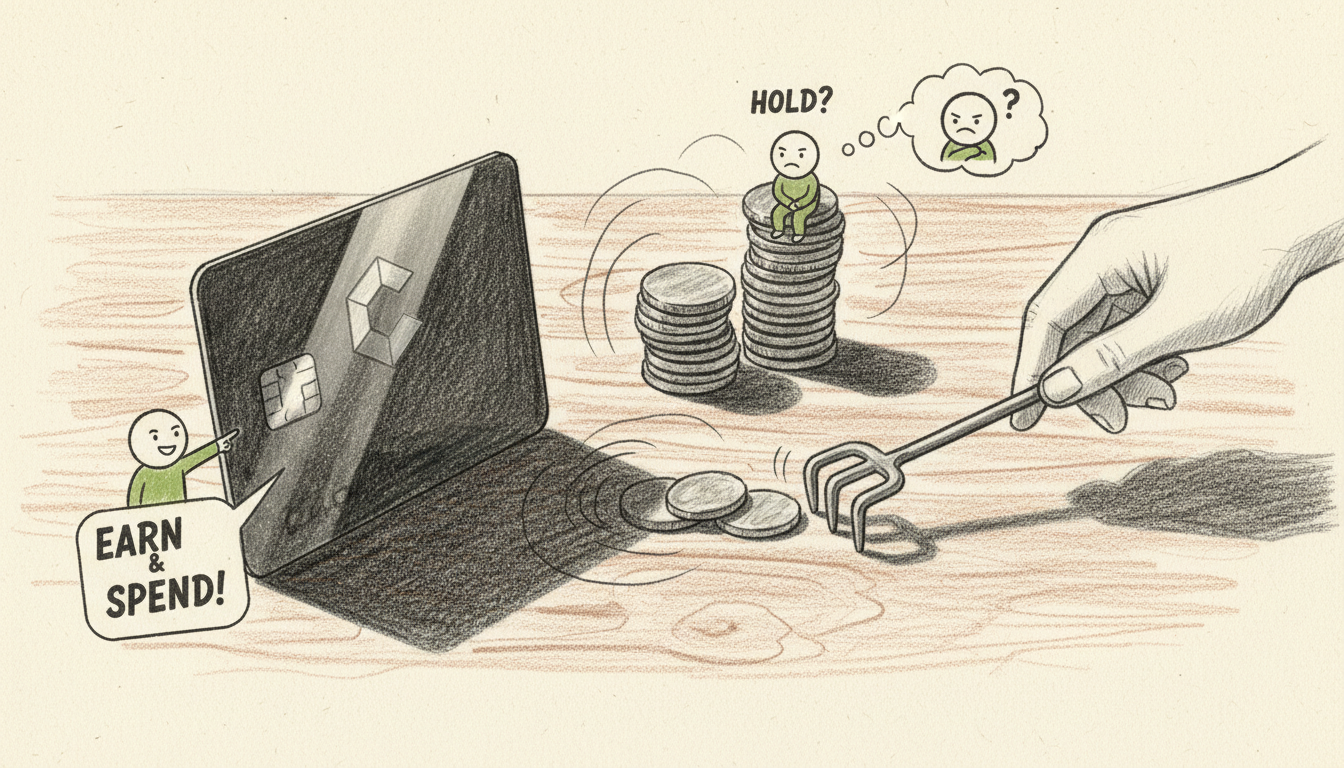
Every crypto card shows you the cashback. Few show you the spread. When you pay with Bitcoin or Ethereum, the card converts crypto to fiat at the moment of purchase. That conversion rate is not the spot price you see on CoinMarketCap. It includes a markup, typically 0.5% to 2%. Your 2% cashback is quietly reduced to 1% or 0%.
Run the numbers on a €1,000 spend. A 2% cashback gives you €20 in tokens. If the spread is 1.5%, you lose €15 in conversion cost. Your net gain is €5 before you consider withdrawal fees or token volatility. On a card with 1% cashback and a 2% spread, you lose money on every transaction.
Staking requirements make this worse. Locking €4,500 in CRO to reach the 3% Pro tier works only if CRO holds its value. If CRO falls 30%, you lose €1,350 on the stake. Even with the $75 monthly reward cap, a year of Pro-tier cashback tops out well under that loss. You take on the full downside risk of an exchange token for a rate you could often match with a subscription instead. I have warned DeFi projects about exactly this incentive structure. Users chase rewards and forget the capital they locked. Read how to cash out crypto without losing money before you chase a cashback tier.
FX conversion on non-EUR spending adds another layer. Wirex One, Bitpanda, and the OKX Card charge no FX markup at all. Crypto.com's free plan charges 2% outside the EU and UK, Nexo charges 2% on currencies outside the EEA, UK, and Switzerland, and Plutus charges 2.5%. Some cards also charge a monthly inactivity fee if you stop using them. The only reliable way to compare two cards is to calculate your own total cost for your actual spending pattern.
KYC and Regulation: What European Law Requires in 2026
The EU's Markets in Crypto-Assets regulation (MiCA, 2023/1114) has applied to crypto card issuers since 2025. Card issuers are treated as crypto-asset service providers. They must register with a national competent authority and meet AML obligations.
Combined with the Fifth Anti-Money Laundering Directive (5AMLD), this means every regulated crypto card in the EU requires full identity verification. You will submit a government ID, a selfie, and proof of address. No anonymous crypto debit card exists under current EU rules. Top cards from Crypto.com, Wirex, and Nexo all follow this process.
A crypto card that promises no KYC in the EU is either unregulated, fraudulent, or limited to prepaid vouchers with tiny limits.
My five years advising web3 companies included compliance work with EU entities. I have seen teams try to route around KYC using offshore issuers. The result is always the same. The card gets blocked by Visa or Mastercard within months. The European Banking Authority's AML guidelines leave no room for interpretation. If you want convenience, use a regulated card. For the fuller picture, read what no-KYC crypto cards can still do in 2026.
Tax Implications of Spending Crypto with a Card in Europe
Spending crypto with a card is a disposal event in most EU countries. The card converts your Bitcoin or Ether to fiat. The tax authority sees that as a sale. You owe capital gains tax on the difference between your acquisition cost and the sale price at the time of the transaction.
Country rules differ sharply. Germany exempts gains if you held the crypto for more than one year. Portugal taxes gains at 28% when you held the crypto for under a year, and exempts gains on crypto held longer than that. France uses a 30% flat tax on crypto gains. Austria, Spain, and Italy have their own brackets. Check your local rules before relying on a card for daily spending.
Tracking cost basis for every coffee purchase is not optional once you start spending crypto regularly.
Each card transaction creates a taxable event, even for a €4 purchase. If you do not log the cost basis, you cannot calculate the gain. This is why I recommend dedicated portfolio tracking software alongside any crypto card. My Forbes columns on crypto taxation show the same pattern. People who spend crypto casually receive tax bills they did not expect. The OECD crypto asset tax framework explains the cross-border reporting obligation.
No-KYC Alternatives: What's Actually Possible in Europe?
There are no truly anonymous crypto debit cards in Europe. EU rules cap an anonymous prepaid card at €150 stored on it at any time, with a further €50 limit on cash withdrawals and online payments. That is not practical for daily life or for ATM access.
Peer-to-peer spending through Lightning Network wallets is the only real no-KYC option. Some merchants accept Lightning directly. You pay from your own wallet with no card issuer involved. The problem is acceptance. A handful of cafes and online shops take Lightning. Your local supermarket does not.
No card that preserves your privacy exists in the EU. Every regulated issuer verifies your identity before you can spend anything.
If you value convenience, use a regulated card and accept the KYC. If you value privacy, build a spending habit around Lightning and merchants who accept it. My earlier piece on no-KYC crypto debit cards debunks the myths in detail.
Frequently asked questions
Can I use a crypto card for Apple Pay and Google Pay in Europe?
Crypto.com and Nexo support Apple Pay and Google Pay, and Bitpanda supports Apple Pay, in the EU countries they serve. You add the virtual card to your wallet just like a bank card. Revolut now offers the same from inside a bank account, and our Revolut vs crypto cards comparison weighs it against the cards here. Wirex One's help pages do not yet confirm mobile wallet support for the card. Check the card's supported region list before signing up.
Do European crypto cards support spending stablecoins?
Yes. Wirex One spends USDC, USDT, and EURC directly, and Nexo's Debit Mode accepts USDT and USDC. Bitpanda lets you pay with USDC but pays no cashback on stablecoin spending. Other cards, including Crypto.com and Plutus, require you to top up a fiat balance first. Verify the card's supported stablecoin list before you transfer funds.
What happens if my crypto card issuer goes bankrupt?
If an issuer goes bankrupt, your card balance and crypto-backed credit line are at risk. Funds held in a custodial wallet may be treated as unsecured creditor claims. This is different from a bank deposit guarantee. Under MiCA, issuers must hold reserves, but no EU deposit insurance covers crypto card balances. On self-custodial cards like Wirex One, your funds stay in your own wallet until you spend them. Keep only what you need for spending on the card.
How do I compare foreign transaction fees between crypto cards?
Look for the FX markup number, not the word "free". A card may advertise 0% FX fees but build the cost into a worse exchange rate. Compare the rate you receive against the European Central Bank reference rate for the same moment. A difference of 0.1% is excellent. A difference of 2% means each cross-border purchase costs you 2% more. Wirex One, Bitpanda, and the OKX Card charge no FX markup. Crypto.com's free plan charges 2% outside the EU and UK.
Is there a crypto card that lets me earn interest on my balance?
Yes, but it is not a card feature. Nexo's Debit Mode pays daily interest on the balance you do not spend, and Credit Mode lets you borrow against your crypto instead of selling it. Crypto.com offers earn products separate from the card. The card itself does not pay interest, and the yield comes from the linked account. Compare rates carefully because lending yields change often.
Frequently asked questions
Can I use a crypto card for Apple Pay and Google Pay in Europe?
Do European crypto cards support spending stablecoins?
What happens if my crypto card issuer goes bankrupt?
How do I compare foreign transaction fees between crypto cards?
Is there a crypto card that lets me earn interest on my balance?
Related tools
Keep reading
Bybit Card Review 2026: Fees, Cashback, and Availability
Read our Bybit Card review for 2026. See cashback tiers, fees, and the countries where it's actually available. Get the facts before you apply.
Revolut vs Crypto Cards: Is Revolut Enough to Spend Your Crypto in 2026?
Revolut now has a physical crypto card. Its spread, custody and limits compared with KAST, RedotPay, MetaMask and Crypto.com, and who still needs a separate card.
Best USDC Wallets in 2026: Where to Hold, Spend and Earn on USDC
The best USDC wallets in 2026: physical vs digital, the best USDC network, yield rules in the US, EU and Australia, and the wallets hit by recent hacks.