Top Perp Exchanges of 2026: Where to Trade Perpetual Futures Now
Contents
- Quick answer
- What Separates the Top Perp Exchanges From the Rest
- The Best Centralised Perp Exchanges in 2026
- The Best Perp DEXs in 2026
- Order Types, Margin Modes and Tools That Change Outcomes
- Trading Perps With Bots and AI Agents
- Perp Exchanges to Approach With Care in 2026
- Can You Legally Trade Perps Where You Live?
- How to Choose Between the Top Perp Exchanges
- Trading Perps Safely in 2026
Perpetual futures are the largest market in crypto. They let you go long or short with leverage and hedge a spot position without selling it. A trade can stay open as long as you like, with no expiry date. In 2025 they turned over about $85 trillion on centralised exchanges and another $6 trillion on-chain, according to CoinGecko's research, more than every spot market combined.
The venues behind that volume changed more in the past year than in the five before it. Hyperliquid became the second-largest perpetuals venue in the world by open interest. A single day in October 2025 liquidated around $20 billion of positions. Regulated perps returned to the United States through Coinbase, Kraken and Kalshi. One of the largest Solana venues lost $295 million to an exploit.
If you trade perps, you have probably felt each of those shifts in your own account. A venue that was fine in 2024 may now carry a breach on its record or a country block on your login. Its volume figure may be one no outside party can verify.
But the top perp exchanges of 2026 are not simply the ones with the biggest numbers. Volume can be bought with points and rebates. Leverage headlines hide the risk engine that decides whether your stop fills during a crash. And the right venue depends on where you live, because a trader in Texas, Vienna and Singapore now faces three different legal menus.
We compared 15 venues on fees, open interest, funding, custody, incident history and legal access as of October 3, 2026. Eight earned a place. The rest appear so you know why they didn't.
Quick answer
Centralised
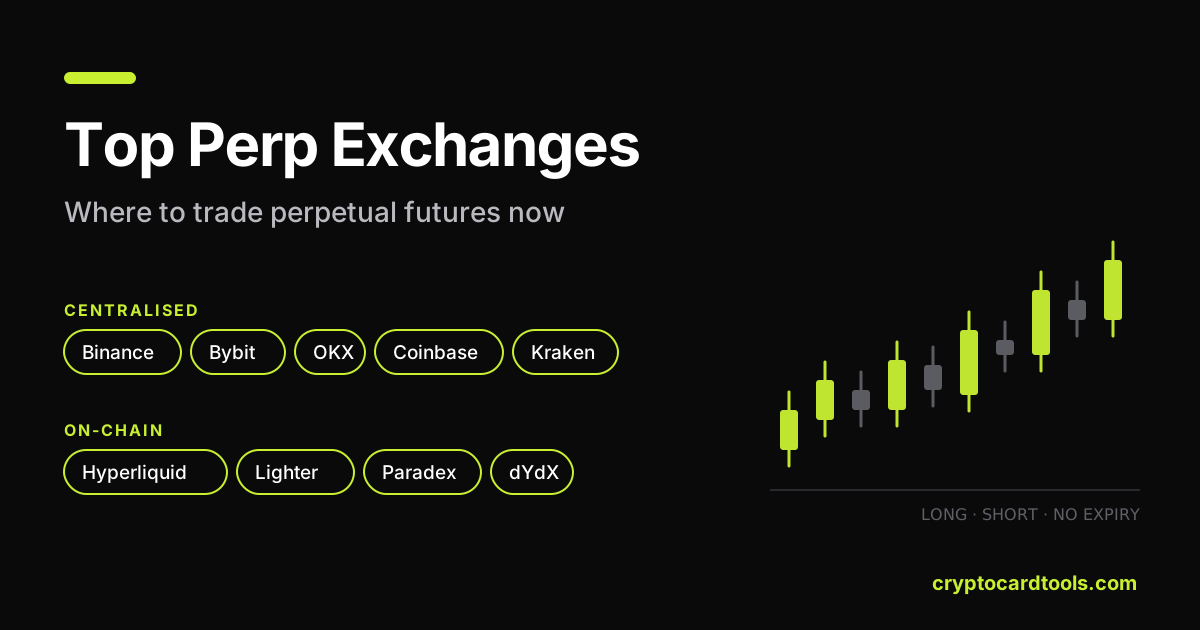
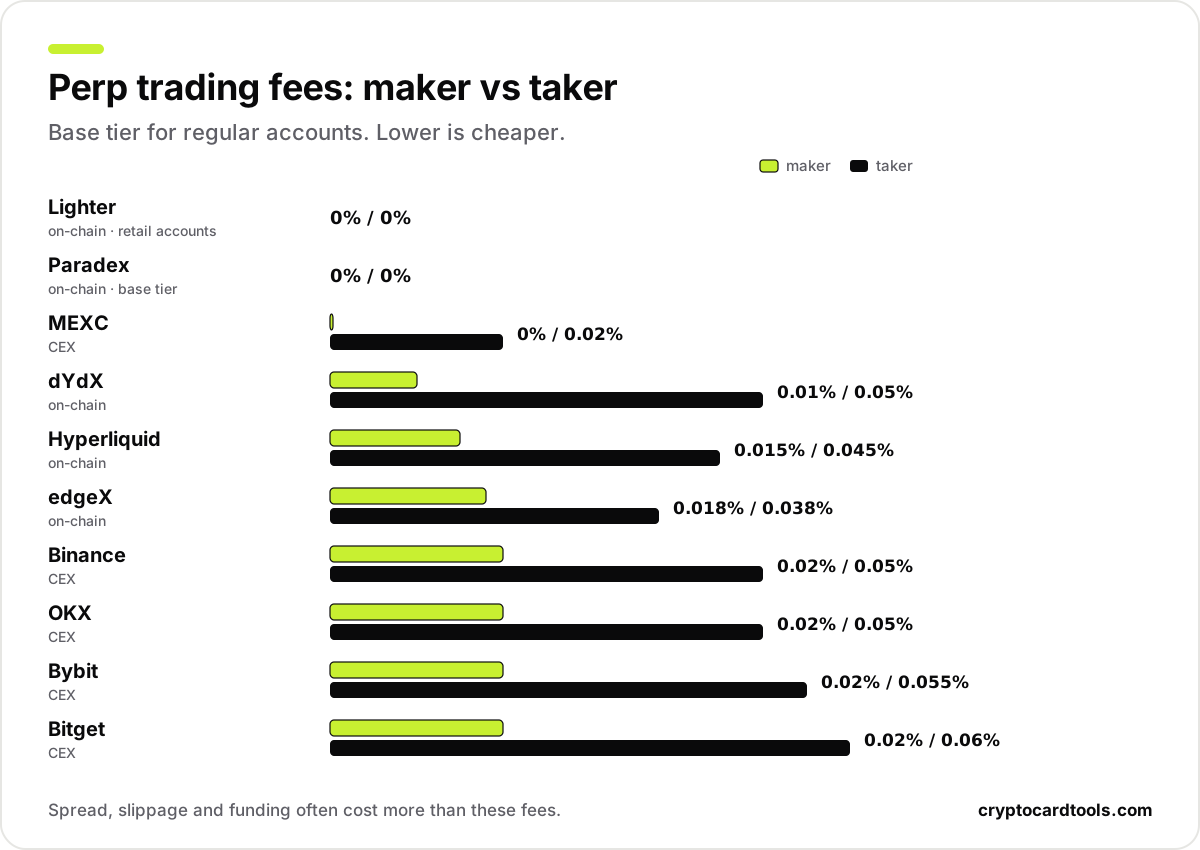
- Binance Futures: still the deepest book anywhere, with about a third of centralised perp volume. Fees 0.02% maker / 0.05% taker.
- Bybit: the strongest challenger on execution and fees (0.02% / 0.055%), fully recovered from its February 2025 hack.
- OKX: the regulated pick for Europe, holding both a MiCA licence and a MiFID II licence in Malta.
- Coinbase and Kraken: the two places US retail traders can now hold perpetual-style futures under CFTC oversight, at 10x or less.
On-chain
- Hyperliquid: the best perp DEX and the second-largest perps venue of any kind by open interest. Fees 0.015% / 0.045%, funding every hour.
- Lighter: zero fees for retail accounts on an Ethereum zk-rollup, with about $55 billion in monthly volume.
- Paradex: zero base fees and perps, options and spot in one margin account.
- dYdX: the longest-running order-book perp DEX, with hourly funding and 0.01% / 0.05% fees.
For bots and AI agents: Binance and Bybit on the centralised side, Hyperliquid and Paradex on-chain.
Handle with care: Aster (volume integrity questions), Bitget (September 2026 breach), MEXC (500x leverage, weaker transparency). Avoid for now: Drift, after its $295 million exploit in April 2026.
What Separates the Top Perp Exchanges From the Rest
A perpetual futures exchange earns your deposit with four things. The headline fee is the least of them.
The four tests
- Liquidity at your size: open interest and order-book depth.
- A risk engine that survives a crash: how the venue handled October 10, 2025.
- Honest volume: open interest is harder to fake than turnover.
- Legal access where you live: a venue you can't use isn't the best venue for you.
Liquidity at your size. Open interest and order-book depth tell you whether a $200,000 position moves the price against you. Hyperliquid carried about $8.2 billion in open interest at the start of October 2026, more than every other perp DEX combined. Binance alone held roughly twice that in BTC contracts.
A risk engine that survives a crash. On October 10, 2025, about $20 billion of positions were liquidated in 24 hours, the largest day on record. Binance saw its own wrapped collateral tokens lose their peg and paid $283 million in compensation. Hyperliquid processed more than $10 billion of those liquidations and triggered auto-deleveraging, where profitable positions are closed to cover losing ones, for the first time in two years. Every venue here was tested that day. Each profile notes how it came through.
Honest volume. Points programmes and rebates can manufacture turnover. DefiLlama removed Aster's volume from its rankings in October 2025 after its founder showed the figures tracked Binance's too closely and Aster declined to share order-level data. Open interest is harder to fake than volume, so we lean on it.
Legal access where you live. US residents can't use Hyperliquid, Binance or Bybit. EU traders can only use perps from firms with a MiFID II licence, because MiCA doesn't cover derivatives. UK retail traders remain banned from crypto derivatives entirely. A venue you can't legally use isn't the best venue for you.
Fees beyond the maker and taker rate
Every exchange quotes a maker and taker fee. Three other costs usually decide what you pay.
Funding is the periodic payment between longs and shorts that keeps a perp's price near spot. Most centralised exchanges settle it every eight hours. Hyperliquid and dYdX settle hourly, which smooths the cost but changes how long you can hold a crowded trade. The baseline interest component is 0.01% per eight hours almost everywhere.
Spread and slippage are what you pay when the order book is thin. A zero-fee venue with a wide spread costs more than a 0.05% venue with a tight one.
Liquidation fees and auto-deleveraging only appear when things go wrong, which is when they hurt most.
The Best Centralised Perp Exchanges in 2026
Centralised exchanges still handle around 85% to 90% of perp volume. They hold your collateral, run their own matching engines and set their own rules. The trade-off is custody risk, which 2025 and 2026 made concrete.
Binance Futures: the deepest book in crypto
Binance carried about 33% of all centralised perp volume between January and April 2026, according to CoinGecko, and about 370,000 BTC of open interest in early October. Nothing else comes close on size.
Base fees are 0.02% maker and 0.05% taker on USDT-margined perps, with a 10% discount for paying in BNB. Funding settles every eight hours with the standard 0.01% interest component.
Binance's weak points are regulatory. It withdrew its MiCA application in Greece in June 2026 and holds no EU licence for crypto services. Bloomberg reported in September 2026 that the US Department of Justice is examining possible sanctions evasion. The October 2025 cascade exposed its collateral design when USDe and wrapped tokens depegged on its own platform.
Best for Traders outside the US and EU who need the deepest liquidity and the widest list of markets
Weak spots No EU licence, an open US investigation and collateral that failed under stress
Bybit: the execution-first challenger
Bybit has built its reputation on matching-engine speed and a clean derivatives interface. Base fees are 0.02% maker and 0.055% taker, slightly above Binance on the taker side.
In February 2025, Bybit lost about $1.5 billion of ETH when attackers compromised the Safe wallet interface its signers used. It covered client balances within days, kept withdrawals open and rebuilt its custody process. The recovery turned a disaster into one of the stronger security records in the industry.
Bybit holds a MiCA licence through Austria, which covers spot and custody in the EU. We found no MiFID II licence, so its EU perps access remains limited.
Best for Active traders who prioritise execution quality and a derivatives-focused interface
Weak spots EU perps access, plus a hack on the record even though clients were made whole
OKX: the regulated choice for Europe
OKX is the one large global venue that can legally offer perps to EU retail traders. It holds a MiCA licence and a MiFID II licence through Malta, which together cover spot, custody and derivatives across the EEA.
Fees match Binance at 0.02% maker and 0.05% taker, with eight-hour funding and up to 100x leverage. OKX's order books are among the deepest tracked on Lyra's exchange data. It publishes proof of reserves.
Its history includes a February 2025 guilty plea in the US for operating as an unlicensed money transmitter, with more than $504 million in penalties. The plea covered conduct up to early 2024. OKX has since launched a licensed US business.
Best for EU traders who want full-size perps from a regulated firm
Weak spots A US criminal plea in its past, plus the same custodial risk as every centralised venue
Coinbase and Kraken: regulated perps for US traders
For most of the past decade, a US resident who wanted perps had to break the rules. That changed in 2025 and 2026.
Coinbase launched "perpetual-style" nano Bitcoin and Ether futures in July 2025 through its CFTC-registered derivatives arm. They mimic a perp with a five-year expiry, up to 10x leverage and fees from 0.02%. In May 2026 the CFTC also approved Coinbase to route true perps through its Bermuda entity. Outside the US, Coinbase International offers stock and ETF perps on Mag-7 names, SPY and QQQ at up to 20x.
Kraken launched CFTC-regulated US perps on June 15, 2026 through Bitnomial, the exchange it acquired, covering BTC, ETH, SOL, XRP and five other assets with eight-hour funding. In Europe, Kraken offers perps through a MiFID-licensed entity in Cyprus.
Both venues cap leverage well under offshore levels. Their market lists are shorter too. For a US trader, they are the only options that don't require a VPN and a lie.
Best for US residents who want perps without legal exposure
Weak spots Low leverage caps and limited markets compared with offshore venues
MEXC and Bitget: cheap and wide, with caveats
MEXC charges 0% maker and 0.02% taker on perps and offers up to 500x leverage on BTC and ETH. It lists more small-cap perps than almost anyone. It publishes no proof of reserves and holds no major licence, which is why it rates lower than the venues above despite the fees.
Bitget charges 0.02% maker and 0.06% taker and publishes monthly proof of reserves. On September 24, 2026 it disclosed a breach later reconciled at about $388 million, with XRP the largest loss. Its $464 million protection fund covered users and withdrawals resumed in phases over the following week.
A breach two weeks old belongs on the record
Bitget handled the aftermath well, and users were covered. It still sits in the "handle with care" group until the record lengthens.
The Best Perp DEXs in 2026
On-chain perps grew from a niche to roughly 10% to 15% of all perp volume by 2026. You trade from your own wallet with no account. The venue can't freeze your collateral. In exchange, you take on smart contract, oracle and bridge risk. A bad validator decision can hurt you as much as a bad exchange decision.
Hyperliquid: the best perp DEX, and a top-two venue overall
Hyperliquid runs its own layer-1 blockchain with a fully on-chain order book. In early October 2026 it carried about $8.2 billion in open interest and $208 billion in 30-day volume, about a third of all tracked DEX perp volume. By open interest it ranks second in the world behind Binance.
Fees start at 0.015% maker and 0.045% taker, with maker rebates for high-volume accounts. Funding settles hourly. Maximum leverage is 40x, lower than most centralised venues, which is one reason its risk engine has held up.
Two events define its record. In March 2025 an attacker manipulated the thinly traded JELLY market and left the protocol's liquidity vault facing a $13.5 million loss. Validators voted to delist the market and settle positions at a favourable price, which saved the vault and raised fair questions about how decentralised the venue really is. In October 2025 it processed more than $10 billion of liquidations in a day without downtime.
Hyperliquid also changed what a perp DEX can list. Its HIP-3 standard lets builders deploy their own markets, which brought single-stock perps on Nvidia, Tesla and Apple, an S&P 500 index and gold against COMEX prices. By mid-2026 those markets held more than $3 billion in open interest. The protocol spends 99% of its fees buying back its HYPE token, which has given it about $1.3 billion in cumulative revenue.
The venue blocks US users. The CFTC said in 2026 it was studying how to bring it onshore.
Best for Anyone outside the US who wants the deepest on-chain liquidity and the widest market list
Weak spots US block, a validator set small enough to intervene, and 40x maximum leverage
Lighter: zero fees for retail
Lighter is a zero-knowledge rollup on Ethereum whose matching engine can be verified on-chain, built by a former Citadel engineer and backed by Founders Fund and Ribbit. Standard retail accounts pay no trading fees at all. High-frequency and premium accounts pay fees instead.
In early October 2026 it held about $810 million in open interest and $55 billion in 30-day volume, fourth among perp DEXs. Its LIT token launched at the end of December 2025 with a 25% airdrop, and much of its earlier volume came from traders farming points for it.
The zero-fee model is real, but it changes who pays. Spreads and funding carry the cost that fees would otherwise cover, so the order book deserves a look before any large order.
Best for Retail traders who want Ethereum-secured perps without paying per trade
Weak spots 50x maximum leverage, plus volume that is still partly incentive-driven
Paradex: perps, options and spot in one account
Paradex runs on a Starknet appchain and charges 0% maker and 0% taker at the base tier, with market makers and high-frequency traders paying small fees instead. Its distinguishing feature is unified margin across perpetuals, options and spot, so a hedge in one product offsets a position in another.
It has no documented hack or regulatory action, publishes a public testnet and runs an official MCP server for AI trading agents. Its DIME token launched in March 2026. Funding settles every eight hours and trades settle in USDC.
Best for Traders who run options and perps together, or who automate strategies
Weak spots Smaller order books than Hyperliquid, plus a younger track record
dYdX: the veteran order book
dYdX moved to its own Cosmos chain in 2023 and remains the longest-running order-book perp DEX. Fees are 0.01% maker and 0.05% taker, with hourly funding and maker rebates at higher tiers. Anyone can list a new market by locking 10,000 USDC for about a month.
Its open interest now trails the newer venues. US users still can't trade perps there. dYdX launched spot trading open to US users in December 2025 and has lobbied the CFTC for a path to onshore perps. It has no hack on its record.
Best for Traders who value a long clean history and permissionless listings
Weak spots Thinner liquidity than the leaders, plus no US perps
edgeX and Jupiter: strong in their lanes
edgeX, incubated by Amber Group, runs on a StarkEx layer-2 with 0.018% maker and 0.038% taker fees and up to 100x leverage. It held about $37 billion in 30-day volume in October 2026 with no token, which makes its volume harder to dismiss as farming.
Jupiter Perps is the default on Solana after Drift's exploit, charging 0.06% to open and close plus an hourly borrow fee. Leverage reaches 250x on its main markets. Its open interest of about $53 million is small, which suits Solana-native traders more than large positions.
Order Types, Margin Modes and Tools That Change Outcomes
Two venues with identical fees can produce very different results, because the tools around the order book decide how a trade behaves under stress.
Margin modes at a glance
- Isolated: a loss stays inside one position.
- Cross: your whole balance defends a position, so one bad trade can take everything.
- Portfolio or unified: risk nets across positions, so a hedge lowers the collateral you need. Paradex offers it across perps, options and spot. Binance offers it to larger accounts.
Order types decide your fees and your fills. Post-only orders guarantee the maker rate or cancel. Reduce-only orders can close a position but never flip it, which protects a stop from opening a new trade by mistake. Hyperliquid, Binance and Bybit all offer time-weighted and scaled orders that split a large position into slices so your own size moves the book less.
Copy trading is where Bybit, Bitget and BingX have built their retail base. You mirror a lead trader's positions automatically and pay a share of profits. The returns shown on leaderboards rarely survive a liquidation cascade. October 2025 wiped out many of the best-ranked accounts.
Vaults and sub-accounts suit people running more than one strategy. Hyperliquid lets you deposit into user-run vaults or its own liquidity vault, which earned about $40 million during the October 2025 cascade. Binance, Bybit and Hyperliquid all offer sub-accounts, so a strategy or a bot can run with only the capital it needs.
Trading Perps With Bots and AI Agents
A growing share of perp volume comes from software rather than people clicking buttons. In 2026 that includes trading bots, AI agents and MCP servers that let an AI assistant place orders through an exchange's API. The venue you choose decides how safely that can be done.
Five controls a bot-ready venue offers
- Trade-only API keys that can place orders but never withdraw.
- IP allowlisting that locks a key to the server your bot runs on.
- Sub-accounts that cap the capital a bot can reach.
- Agent wallets or delegated signing so a bot signs orders without the main key.
- A testnet to run the strategy without real money first.
Binance scores highest on these controls among the venues here. It offers trade-only keys, IP allowlisting, sub-accounts and an official MCP server through its Agent OS, with a REST limit of 6,000 request weight per minute. Bybit matches it on keys, allowlisting and sub-accounts, adds a testnet and runs its own Trading MCP server. OKX publishes an Agent Trade Kit, and Kraken ships a command-line tool for agents. Coinbase offers agentic wallets and an agents programme.
Hyperliquid takes a different route. It has no scoped API keys or IP allowlisting. Instead it offers agent wallets that sign orders without the main key, sub-accounts, order entry over WebSocket and a public testnet. Its REST limit is 1,200 weight per minute per IP. Most bot frameworks, including Hummingbot and the Hyperliquid Python SDK, support it natively.
Paradex is the only perp DEX here with an official MCP server. Its API keys can be locked to an IP range. dYdX publishes a testnet and is supported by Hummingbot, Gunbot and NautilusTrader.
Start small with any agent
Whatever the venue, an agent should start on a sub-account with a small balance and a key that cannot withdraw. The venues that make that setup easy are the ones built for 2026's traders.
Perp Exchanges to Approach With Care in 2026
- Data doubtsAster: launched in September 2025 with backing linked to CZ and quickly reported volumes rivalling Hyperliquid. DefiLlama delisted its figures the following month after they appeared to track Binance's volume, and later relisted them with a warning. Aster launched its own privacy-focused chain in March 2026 and burns 99% of fees. Its $66 billion in reported monthly volume still deserves a discount until the data is auditable. Its 1001x leverage claim comes from marketing rather than documentation.
- ExploitedDrift: lost $295 million on April 1, 2026 when attackers used pre-signed security-council transactions obtained through social engineering, in an attack later linked to North Korea. A recovery pool funded largely by Tether is repaying users through recovery tokens. The protocol relaunched as Velocity DEX in July 2026. Until that relaunch has a record, Solana traders have Jupiter.
- ShrinkingGMX: lost $42 million from its V1 pools in July 2025 and recovered most of it through a white-hat deal. Its V2 was unaffected, but its volume has fallen out of the top 20.
- Left the EUGemini: launched EU perps in September 2025 and then exited Europe entirely in April 2026. Any guide still recommending it for EU traders is out of date.
Can You Legally Trade Perps Where You Live?
Legal access decides your shortlist before fees do.
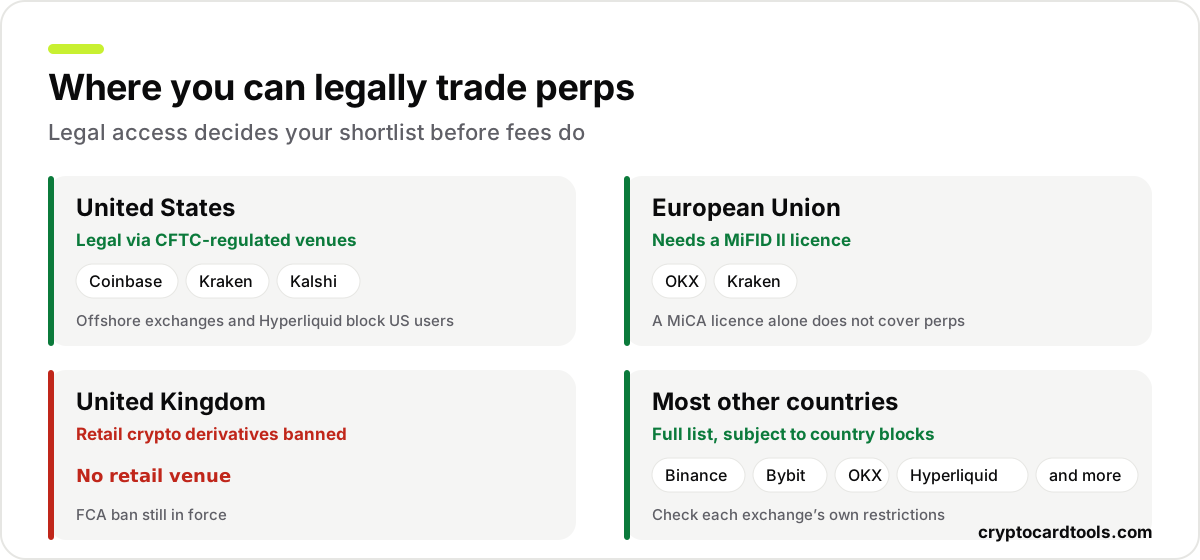
United States. Retail perps are legal only through CFTC-regulated venues. Coinbase, Kraken and Kalshi offer them in 2026. Robinhood has announced its own for launch in the coming months. Offshore exchanges and Hyperliquid block US users. The CLARITY Act, which would set wider rules, failed a Senate vote in September 2026.
European Union. MiCA licences cover spot and custody, not derivatives. Perps need a MiFID II licence, which OKX and Kraken hold. Bybit's Austrian licence doesn't extend to perps.
United Kingdom. The FCA's ban on selling crypto derivatives to retail investors remains in force. Only the ban on crypto exchange-traded notes was lifted in October 2025.
Everywhere else. Most of Asia, Latin America and the Middle East can access the full list, subject to each exchange's own country blocks.
Funding a perp account also depends on your bank. Several UK banks cap or block transfers to exchanges, which our guide to crypto-friendly banks covers bank by bank. Our guide to the cheapest crypto onramp covers the lowest-cost route from cash to an exchange balance.
How to Choose Between the Top Perp Exchanges
Start with legality, then liquidity, then cost.
Shortlist by where you live
- United States: Coinbase or Kraken.
- European Union: OKX for size, Kraken for a familiar brand.
- Everywhere else: Binance or Bybit against Hyperliquid.
That last choice turns on custody. A centralised exchange can freeze a withdrawal, suffer a breach or depeg its own collateral, as 2025 and 2026 showed. A DEX can't freeze you, but its validators or contracts can fail, as JELLY and Drift showed. Splitting capital across one of each is how many professional desks handle it.
For the on-chain side, Lyra Terminal's perp DEX ranking compares 13 venues on fees, leverage and funding interval with volume from DefiLlama. For centralised venues, its exchange ratings grade 41 exchanges on licences, proof of reserves, API quality and incident history.
Position size should follow liquidity. A $1,000 trade is fine anywhere on this list. A $500,000 trade belongs on Binance, Hyperliquid or OKX, where the order book absorbs it.
Fees come last, even on a crypto futures exchange that advertises them first. The difference between 0.045% and 0.05% on a $10,000 trade is 50 cents. The difference between a tight book and a wide one on the same trade can be $50.
Trading Perps Safely in 2026
How you use a venue decides more than which one you pick. Four habits separate the traders who survived October 2025 from the ones who didn't.
- HabitLeverage below the maximum leaves room for a wick. Most liquidations on October 10 hit positions running at or near the cap.
- HabitCollateral in plain stablecoins avoids the depeg trap. Binance's losses that day came from wrapped and yield-bearing collateral, not from USDT or USDC.
- HabitWithdrawing profits regularly limits custody exposure. Bybit and Bitget made clients whole after their breaches. Not every exchange will.
- HabitReading the liquidation and auto-deleveraging rules before the first trade takes ten minutes. Each venue publishes them. They differ more than the fee schedules do.
Profits from perps are taxable in most countries. Our guide to crypto card tax explains how disposals are usually treated. When you cash out, the best crypto offramp guide compares what each route to your bank costs. If you'd rather spend profits than bank them, our crypto card comparison puts the top cards side by side.
The top perp exchanges of 2026 are the ones that stayed open, stayed solvent and stayed honest about their numbers through the hardest year the market has had. Binance, Bybit and OKX did that at scale. Hyperliquid did it on-chain. Coinbase and Kraken brought perps back to the US under rules. The list will change again by this time next year. The venues that publish their data are the ones to keep watching.
Frequently asked questions
What is the best perp exchange in 2026?
What is the best perp DEX?
Can US residents trade perpetual futures legally?
Which perp exchanges are legal in the EU?
Is Hyperliquid safe?
What happened to Drift?
Which crypto futures exchange has the lowest fees?
What is a funding rate?
Is Aster's volume real?
How much leverage should I use on perps?
What is auto-deleveraging?
Which perp exchanges support AI trading agents and bots?
Which perp exchange is best for copy trading?
Are perp DEXs safer than centralised exchanges?
Sources
Related tools
Keep reading
Best USDC Wallets in 2026: Where to Hold, Spend and Earn on USDC
The best USDC wallets in 2026: physical vs digital, the best USDC network, yield rules in the US, EU and Australia, and the wallets hit by recent hacks.
Best XRP Wallet for Investors in 2026: Where to Hold XRP for the Long Term
The best XRP wallets for investors in 2026, from Ledger and Tangem to Xaman, with reserve rules, destination tags and the 2026 wallet hacks long-term holders should know.
Top 5 ZEC Wallets: Where to Store Your Zcash in 2026
The best ZEC wallets in 2026, tested against the Ironwood upgrade: Zodl, Keystone, Ledger, Zingo and Unstoppable, plus the wallets that leak privacy or can't send.