Best USDC Wallets in 2026: Where to Hold, Spend and Earn on USDC
Contents
- Quick answer
- What Makes USDC Different From Other Coins in a Wallet
- Physical vs Digital USDC Wallets
- Best USDC Network: Which Chain Should Your USDC Live On?
- 1. Ledger: The Best USDC Wallet for Long-Term Holding
- 2. Coinbase Wallet: The Best Everyday USDC Wallet
- 3. Phantom: The Best USDC Wallet for Solana
- 4. Rabby: The Best USDC Wallet for DeFi
- 5. Safe: The Best Wallet for Business and Shared USDC
- Other USDC Wallets to Consider
- USDC Wallets to Be Careful With
- USDC Yield, Savings and Staking Programs in 2026
- Spending USDC From a Wallet
- Keeping USDC Safe in Any Wallet
- Choosing Between the Best USDC Wallets
USDC is the dollar most of crypto runs on. Around $74 billion of it was in circulation at the end of September 2026, spread across 38 blockchains. Its reserves sit in short-term US Treasuries and cash, checked monthly by a Big Four accounting firm.
For anyone paid in crypto, saving in dollars outside a bank, or moving money across borders, USDC has become the default. It settles in seconds on Base or Solana for less than a cent. Every large exchange converts it to cash.
If you already hold some, you have probably noticed how many apps want to store it for you. Your exchange offers rewards. A browser extension promises gasless transfers. A hardware wallet company says nothing else is safe.
But the best USDC wallets in 2026 are not simply the safest apps. A dollar stablecoin raises its own questions: which chain to keep it on, whether the version you hold is the one Circle issues, and what happens if an address is frozen. Two wallets that rank highly in older guides suffered serious breaches in the past year.
We compared wallets on custody, chain support, security record and what they let you do with USDC beyond holding it, with a focus on readers in the US, Europe and Australia. Five stand out, each for a different job. Several familiar names did not make it, for reasons that cost real users money.
Quick answer
- Best for holding USDC long term: Ledger. USDC on Ethereum, Base, Arbitrum, Polygon and Solana inside one app, with keys on a secure chip.
- Best everyday USDC wallet: Coinbase Wallet. Self-custody, built around Base, with in-app USDC rewards in supported countries.
- Best for USDC on Solana: Phantom. The default Solana wallet, now covering Ethereum, Base and Polygon too.
- Best for DeFi: Rabby. Open source, simulates every transaction before you sign, and flags scams.
- Best for shared or business USDC: Safe. Multi-signature smart accounts securing about $35 billion.
- Physical or digital: a physical hardware wallet (Ledger, Trezor, Tangem) for savings, a digital app wallet for money you spend.
- Best USDC network: Base or Solana for everyday use, Ethereum for large balances you rarely move. Avoid Tron.
- Skip for large balances: exchange accounts, USDC on Tron, bridged "USDC.e" tokens, and browser extensions with a recent breach.
What Makes USDC Different From Other Coins in a Wallet
USDC behaves differently from bitcoin or ether inside a wallet. Three properties set it apart and shape which wallet fits.
It exists on many chains at once. Circle issues native USDC on 38 networks. The same dollar can sit on Ethereum, where a transfer costs several dollars in busy periods, or on Base and Solana, where it costs a fraction of a cent. Your wallet needs to support the chain you use. It should also make clear which one you are on when you send.
Not every "USDC" is issued by Circle. Bridged versions, often labelled USDC.e, lock real USDC in a bridge contract and mint a copy on another chain. Circle's developer documentation states these tokens are not issued or backed by Circle. If the bridge fails, the copy is only as good as what remains inside it. Native USDC carries no such risk.
Circle can block addresses. Circle's USDC terms reserve the right to block addresses, which it does on-chain through the token contract. A blocked address can't send or receive USDC on that chain, whether the keys sit on an exchange or in your own hardware wallet. Circle says it acts only on court or law-enforcement orders, and 2026 saw several such cases, including funds from the Bitget hack frozen within a day.
Self-custody has a limit with USDC
Self-custody protects you from an exchange failing. It doesn't put your USDC beyond the issuer's reach. No wallet changes that.
Physical vs Digital USDC Wallets
Every wallet on this list is either physical or digital, and the difference decides how safe your USDC is from the most common attacks.
A physical wallet, also called a hardware wallet, is a device that keeps your private key on a secure chip. Ledger and Trezor are small devices with a screen, and Tangem is a card you tap on your phone. To move USDC, you approve the transfer on the device itself, so malware on your phone or computer can't sign for you.
A digital wallet is an app on your phone, a desktop program or a browser extension. Coinbase Wallet, Phantom, Rabby and MetaMask are all digital. They are free, quick to set up and convenient for paying, swapping and using cards, but the key lives on a device that also browses the web and installs updates.
Which type fits your USDC
- Physical (hardware): savings, larger balances, USDC you move a few times a year. Costs about $59 to $399 once.
- Digital (app or extension): spending money, DeFi, payments and card top-ups. Free, but exposed to phishing and fake updates.
- Both: a digital wallet connected to a hardware device, so the app handles the screens and the device signs. Rabby, Phantom and MetaMask all pair with Ledger.
Most people who hold a meaningful amount end up with both: a physical wallet for the balance and a digital wallet with a small amount for daily use.
Best USDC Network: Which Chain Should Your USDC Live On?
Where your USDC sits decides your fees, your speed and your risk, so the chain comes before the wallet.
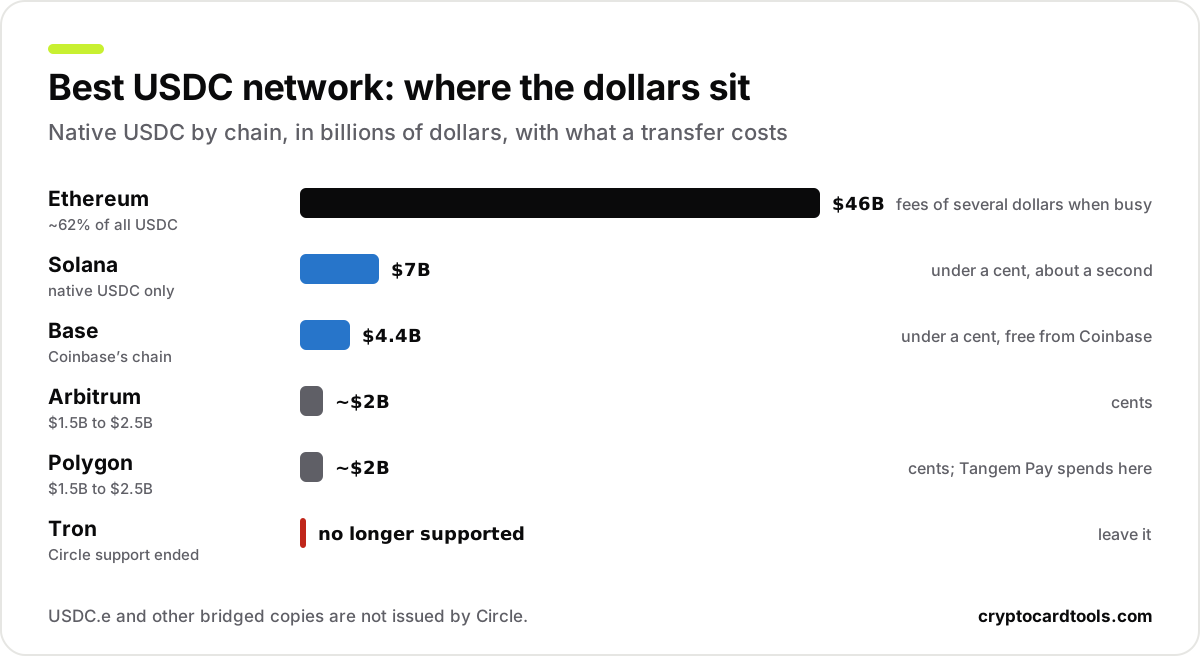
Ethereum holds about 62% of all USDC and is where institutions keep it. It's the most battle-tested chain and the most expensive to use. For a balance you touch a few times a year, the fees barely register.
Base, the Ethereum layer built by Coinbase, has become the everyday chain for USDC. Transfers cost under a cent and native USDC is the standard. Coinbase moves funds between its exchange and Base for free. Around $4.4 billion of USDC sits there.
Solana holds about $7 billion and is the fastest option for payments. Only native USDC exists on Solana, which removes the bridged-token question entirely.
Arbitrum and Polygon each hold between $1.5 and $2.5 billion and suit people already using those networks. Polygon is also where Tangem Pay spends USDC.
Leave Tron
Circle stopped minting USDC on Tron in February 2024 and ended support a year later. Any USDC still there is outside Circle's system. USDT dominates that chain instead.
Our guide to the cheapest crypto onramp covers how to buy USDC on the right chain from the start, rather than bridging afterwards.
1. Ledger: The Best USDC Wallet for Long-Term Holding
Ledger is the right choice when USDC is savings rather than spending money. Its devices keep the private key inside a certified secure chip. Every transfer is confirmed on the device screen before it leaves.
Ledger Wallet, the app formerly called Ledger Live, manages USDC on Ethereum, Base, Arbitrum, Polygon and Solana from one place. You can hold dollars on five chains and see them together, which few hardware wallet apps manage.
The current range starts with the Nano S Plus at $59 and the Bluetooth Nano X at $99. The Nano Gen5, launched in October 2025, costs $179 and adds an E Ink touchscreen and NFC. The Flex and Stax sit at $249 and $399 for people who want a larger screen.
Ledger's Clear Signing shows transactions in plain language for its built-in apps. When you connect a Ledger to a third-party wallet such as Rabby or Phantom, you get hardware security but less readable prompts. Routine transfers are easier to check inside Ledger Wallet itself.
Two limits apply. Ledger's firmware isn't fully open source. The company's 2023 announcement of an optional seed-recovery service still bothers some holders. Neither has led to a device compromise. For a five-figure USDC balance you rarely move, our cold wallet guide explains how to set one up and back it up properly.
Best for USDC you intend to hold for months or years
Weak spots Closed firmware, and fewer chains than a software wallet
2. Coinbase Wallet: The Best Everyday USDC Wallet
Coinbase Wallet is the self-custody app from Coinbase, separate from the exchange. It went through a year as "Base App" before Coinbase changed the name back in September 2026 and refocused it on holding and trading.
For USDC, its advantage is Base. The wallet is built around Coinbase's own chain, where USDC transfers cost almost nothing and move in seconds. Coinbase announced fee-free USDC sends on Base for its smart wallet users in 2024. The exchange also lets you move USDC to Base without a withdrawal fee.
The wallet supports more than eleven chains, including Ethereum, Solana, Bitcoin, Arbitrum, Polygon and Avalanche, so USDC on any of the main networks fits. In supported countries it also pays rewards on USDC held in the wallet, with the rate shown in the app rather than fixed.
Those rewards deserve one caution. They come from Coinbase, not from Circle, because the GENIUS Act of July 2025 bars stablecoin issuers from paying interest to holders. A rate that depends on Coinbase's decisions can change, as it did in December 2025 when the exchange limited its own USDC rewards to Coinbase One members.
Best for People who buy USDC on Coinbase and want a self-custody wallet that fits that flow
Weak spots Rewards vary by country and can change, and the app's direction has shifted twice in two years
3. Phantom: The Best USDC Wallet for Solana
Phantom made Solana usable for ordinary people, and Solana has become one of the two cheapest places to hold USDC. The wallet runs on iOS, Android and as a browser extension. It has added Ethereum, Base, Polygon and Bitcoin support alongside Solana.
Sending USDC on Solana through Phantom costs a fraction of a cent and confirms in about a second. Because Solana only has native USDC, there is no bridged version to mistake for the real one.
Phantom launched a spending product in December 2025, a Visa card that runs on its own dollar token rather than on USDC directly. For most holders the more useful link is to a separate card that accepts USDC top-ups, which we cover later.
Phantom has had no breach of its own systems. It did suffer a three-hour outage in April 2026 that showed zero balances, which alarmed users even though funds were unaffected. It dropped Sui support in September 2026, a reminder that multi-chain wallets change their chain lists.
Best for USDC on Solana, with occasional use on Base or Ethereum
Weak spots A browser extension carries phishing risk, and the chain list changes
4. Rabby: The Best USDC Wallet for DeFi
Rabby is the wallet for anyone who lends, swaps or provides liquidity with USDC. Built by the team behind DeBank, it is open source under the MIT licence and covers Ethereum and every major EVM chain, including Base, Arbitrum, Polygon and Optimism.
Its defining feature is simulation. Before you sign, Rabby shows exactly what will leave your wallet and what will arrive. It also flags contracts and addresses linked to scams. Address poisoning, where an attacker sends you dust from an address that looks like one you use, cost one user $50 million in USDT in December 2025. Rabby's warnings are designed for exactly that trick.
Rabby switches chains automatically to match the site you're using, which removes a common cause of failed transactions. It also pairs with Ledger, Trezor and Keystone, so the keys can stay on hardware while Rabby handles the interface.
Two independent audits in 2025, by SlowMist and Least Authority, found no critical issues. Least Authority left two medium findings open, which Rabby publishes.
Best for Active USDC users on Ethereum and its layer-2 networks
Weak spots EVM chains only, so no Solana USDC
5. Safe: The Best Wallet for Business and Shared USDC
Safe is a smart contract wallet rather than an app. It holds more dollars than any other self-custody option. Its Q1 2026 report counted about $35 billion secured across 61 million accounts, including roughly 2% of the world's stablecoin supply.
The core idea is multi-signature control. A Safe can require two of three signers, or three of five, before any USDC moves. A company treasury, a shared fund or a couple's savings can all be set up so that one lost phone or one phished person can't drain the account.
Safe's biggest lesson came in February 2025. Attackers compromised a Safe developer's machine and injected code into Safe's web interface that tricked Bybit's signers into approving a malicious transaction, taking about $1.5 billion. The smart contracts were never broken. Safe rebuilt its infrastructure afterwards and added transaction hash verification so signers can check what they sign on a hardware device.
The episode shows both sides of Safe. Multi-signature stopped a single key from being enough. A compromised interface still got through because every signer trusted the same screen. Anyone running a Safe should verify transactions on the hardware wallet, not only in the browser.
Best for USDC held by more than one person, or by a business
Weak spots Setup takes work, and each transaction needs multiple approvals
Other USDC Wallets to Consider
Tangem puts the private key in an NFC card that you tap against your phone. A two-card set costs $59.90 and no seed phrase is needed by default. Its mobile SDK passed a Cure53 audit published in March 2026. It supports USDC on Ethereum, Solana, Polygon, Arbitrum, Base and more. Tangem Pay, its Visa card launched in late 2025, spends USDC on Polygon, though that spending balance is custodial.
Zengo removes the seed phrase entirely with multi-party computation, splitting the key between your phone and Zengo's servers so neither half can move funds alone. Recovery uses email, cloud backup and a face scan. It supports USDC on Ethereum, Solana, Polygon, Arbitrum, Optimism and Base. The basic wallet is free.
MetaMask remains the most used wallet on Ethereum and added Solana in 2025. Its US card, launched nationwide in February 2026, pays cashback in MetaMask's own mUSD stablecoin rather than in USDC. Our MetaMask Card guide covers what it costs to spend from the wallet.
Kraken Wallet is the exchange's open-source self-custody app, launched in 2024, covering Bitcoin, Ethereum, Solana, Base, Polygon and Arbitrum. It has had no incidents and suits Kraken customers who want a wallet from the same company.
Trezor supports USDC on Ethereum and, since late 2023, on Solana through Trezor Suite. Its Safe 3 costs less than a Nano Gen5, and its software is fully open source. That makes it the natural alternative to Ledger for people who want to read the code.
Our wallet safety checks score most of these wallets on open source, audits, key storage and incident history.
USDC Wallets to Be Careful With
- BreachTrust Wallet's browser extension: shipped a malicious update on December 24, 2025 after attackers obtained its Chrome Web Store key. Version 2.68 harvested seed phrases and about $7 million was stolen from 2,596 wallets before a fix arrived the next day. Trust Wallet committed to covering losses, and the mobile app was unaffected. Anyone who installed the extension in late December 2025 should move to a fresh seed phrase.
- ShrinkingExodus: still a capable multi-chain wallet, but it removed its dApp browser and WalletConnect from the mobile app in September 2026 and stopped issuing new US cards the same month. Its Trezor integration remains a strength.
- Custody riskExchange accounts: they hold most of the world's retail USDC and remain the easiest place to lose it. Bitget disclosed a breach of about $350 million on September 25, 2026. Its protection fund covered users, but not every exchange has one. Our guide to crypto debit card risks explains why "your" balance on a platform is a claim, not a holding.
- Not Circle'sUSDC on Tron and bridged USDC.e: both fall outside Circle's guarantee. Moving them to native USDC on a supported chain is a one-time job that removes the risk.
USDC Yield, Savings and Staking Programs in 2026
Earning on USDC is legal in most places, but who can pay you, and how, differs sharply between the US, Europe and Australia. In every case, the return comes from a third party doing something with your dollars, never from USDC itself.
There is no real "USDC staking"
USDC doesn't secure a blockchain, so it can't be staked the way ETH or SOL can. Programs sold as "USDC staking" are lending or reward schemes under another name, and they carry the lender's risk.
USDC savings in the US
The interest question changed when the GENIUS Act became law on July 18, 2025. Circle itself can't pay you to hold USDC. Anyone offering a return is a third party taking your USDC and doing something with it.
Exchange savings programs are the simplest. Coinbase pays roughly 3.5% to 3.75%, variable and now limited to Coinbase One subscribers. Kraken pays 1.75% by default and 3.75% for Kraken+ members. Both state that USDC is not FDIC or SIPC insured, because it isn't a bank deposit. The exchange holds your USDC while it earns.
A US regulator proposed in February 2026 that yield arranged between an issuer and its affiliates should count as prohibited. The rule wasn't final at the end of September, so exchange rewards may look different in a year.
USDC savings in Europe
The EU's MiCA rules treat USDC as an e-money token, and Circle issues it in Europe under a French e-money licence. MiCA bars both the issuer and crypto service providers from paying interest tied to how long you hold an e-money token.
That is why European users see far fewer "earn on USDC" offers than Americans. Where they appear, they are usually structured as lending to a third party or as DeFi access, which brings counterparty or smart contract risk instead of a simple savings rate. EURC, Circle's euro stablecoin, falls under the same rules.
USDC savings in Australia
Australia has no stablecoin-specific interest ban like the GENIUS Act or MiCA. Exchanges there set their own reward terms, and ASIC treats many yield products as financial products that need the right licence.
Before using one, it is worth checking that the platform is registered with AUSTRAC and, for yield, whether it holds an Australian financial services licence. Most Australian exchanges accept AUD deposits by PayID, which keeps the on-ramp cheap.
DeFi lending and card rewards
In-wallet rewards such as Coinbase Wallet's are self-custody, but the rate still depends on the company paying it. DeFi lending through protocols such as Aave pays a market rate that moves with demand and adds smart contract risk. Rabby is the natural wallet for it, ideally with a hardware wallet behind it.
Card programmes pay cashback for spending rather than holding. Several cards accept USDC top-ups directly and pay a percentage back on purchases. Our best crypto cards guide compares them, and the card cost calculator shows what each one costs at your monthly spend.
Spending USDC From a Wallet
The point of holding dollars on-chain is usually to use them. Three routes work in 2026.
Cards that top up with USDC convert at the checkout. RedotPay, KAST and others accept USDC on several chains and issue Visa cards that work at ordinary shops. Our ranking of the best USDC cards lists every card that spends it, and our guide to how crypto debit cards work explains the conversion and the fees involved.
Wallet-linked cards spend straight from self-custody. Tangem Pay draws USDC from Polygon. The MetaMask Card spends from the wallet on Linea. You keep the keys until the moment of payment.
Cashing out to a bank still requires an exchange or an off-ramp service. Our best crypto offramp guide compares what each route costs. To spend your crypto instead, our crypto card comparison puts the top cards side by side.
In markets such as India and Nigeria, USDT on Tron is more common than USDC for everyday transfers. Our USDT card ranking covers that side.
Keeping USDC Safe in Any Wallet
USDC losses in 2025 and 2026 came from four patterns. Each has a habit that prevents it.
- HabitFake wallet updates and extensions caused the Trust Wallet theft. Installing wallets only from the official site or app store, and checking the developer name, blocks most of them.
- HabitAddress poisoning relies on you copying an address from your transaction history. Saving addresses you use often in the wallet's address book, and checking the first and last characters against the original, defeats it.
- HabitSigning what you can't read caused the Bybit loss. Wallets that simulate transactions, and hardware devices that display the destination, both help. Anything that asks for a signature with no clear purpose is a reason to stop.
- HabitBridged and unsupported tokens lose value when a bridge or an issuer walks away. Holding native USDC on a chain Circle supports keeps the dollar backed by Circle's reserves. Circle's transparency page shows those reserves and the monthly attestations, and its contract address list marks which tokens it issues.
Choosing Between the Best USDC Wallets
The right wallet follows from what the USDC is for.
Savings you rarely move belong on a physical wallet such as a Ledger or Trezor, or on Tangem cards if you'd rather skip the seed phrase. Money you spend and receive every week suits a digital wallet such as Coinbase Wallet on Base or Phantom on Solana, with a card attached for shops.
USDC that works in DeFi wants Rabby with a hardware wallet behind it. USDC that belongs to more than one person, or to a company, wants a Safe with signers on separate devices.
The wallets on this list have earned their place by keeping funds safe through a year that tested them. Among the best USDC wallets in 2026, the safest is still the one whose keys you hold, on a chain Circle supports, with a backup you have already tested.
Frequently asked questions
What is the best USDC wallet in 2026?
Should I use a physical or digital wallet for USDC?
What is the safest way to store USDC?
What is the best USDC network?
Is USDC in my wallet FDIC insured?
Can Circle freeze USDC in a self-custody wallet?
Can I earn interest on USDC in a wallet?
Can I stake USDC?
Can I earn interest on USDC in Europe?
What is the difference between USDC and USDC.e?
Does Ledger support USDC?
Is Coinbase Wallet the same as Coinbase?
Was Trust Wallet hacked?
Can I use USDC on Tron?
Which wallet is best for spending USDC?
Sources
Related tools
Keep reading
OKX Card Review 2026: Fees, Cashback, Countries and Limits
OKX Card review for 2026: 0.1% spread, 2% to 10% USDG cashback and its real monthly caps, every country it works in, and who should skip it.
Best Crypto Card Europe: 7 Options Compared for 2026
Discover the best crypto card Europe offers in 2026. We compared fees, rewards, and KYC for 7 cards to find your ideal match.
Bybit Card Review 2026: Fees, Cashback, and Availability
Read our Bybit Card review for 2026. See cashback tiers, fees, and the countries where it's actually available. Get the facts before you apply.