Best XRP Wallet for Investors in 2026: Where to Hold XRP for the Long Term
Contents
- Quick answer
- What Investors Need From an XRP Wallet
- XRP Rules That Catch New Holders
- 1. Ledger: The Best XRP Wallet for Long-Term Investors
- 2. Tangem: The Simplest Hardware Wallet for XRP
- 3. Xaman: The Best Mobile Wallet for XRP
- 4. Trezor Safe 3, 5 and 7: The Best Open-Source Hardware Wallet for XRP
- 5. Keystone 3 Pro: The Best Air-Gapped Wallet for XRP
- Other XRP Wallets to Consider
- Where Your XRP Should Not Be
- How to Move XRP From an Exchange to Cold Storage
- Wallet or ETF: Which Suits an XRP Investor?
- Spending XRP Without Selling Your Position
- What to Watch in XRP Custody
XRP settles a payment in three to five seconds for a fraction of a cent, which is why banks and payment firms have tested it for cross-border transfers for over a decade. At the end of September 2026 it ranked fifth by market value, at around $95 billion, with spot XRP ETFs trading in the US since late 2025.
Those ETFs changed who holds XRP. A growing share now sits in brokerage accounts, while the rest lives on exchanges or in wallets that investors set up years ago and rarely open.
If you hold XRP as an investment rather than a trading position, you know the quiet worry that comes with it. The coins sit somewhere, in the hope that somewhere will still be there in five years.
But 2026 has tested that trust. In September alone, a software wallet leaked around 12 million XRP from roughly 6,600 users. A smaller wallet lost 4,000 accounts to weak key generation. An exchange breach took more XRP than any other asset. None of those losses touched a properly stored hardware wallet.
We compared the best XRP wallet for investors by asking one question: where can XRP sit untouched for years with the lowest chance of loss? Five wallets answered it well. Several popular places to keep XRP did not.
Quick answer
- Best overall for investors: Ledger, with the Nano Gen5 as the current mid-range pick. Native XRP support with destination tags in Ledger Wallet.
- Best value hardware wallet: Tangem. A two-card set costs $59.90, needs no seed phrase by default and pairs with Xaman.
- Best mobile wallet: Xaman, built by XRPL Labs. Self-custody, free, with Tangem card support and access to XRPL apps.
- Best open-source hardware wallet: Trezor Safe 3, 5 or 7. XRP is native in Trezor Suite, whose software is fully open source.
- Best air-gapped option: Keystone 3 Pro, which signs XRP transactions by QR code and never connects to a computer.
- Avoid for long-term holding: exchange accounts, custodial "hosted" wallets, browser extensions claiming to be Xaman, and software wallets with a history of key leaks.
What Investors Need From an XRP Wallet
An XRP investor's wallet has a different job from a trader's. It will be opened a few times a year and may hold a serious sum. It has to survive a lost phone, a house move or a forgotten password.
That pushes three requirements to the top. The private keys should live on hardware that never touches the internet. The recovery method should work without the company that made the wallet. And the wallet should handle XRP's own quirks, which the next section covers, without room for a costly mistake.
Everything else is secondary. Swaps, yield products and app stores full of XRPL tools are useful for active users. For an investor, each one is an extra way to lose money.
Our guide to cold wallets explains the general principles. XRP adds a few of its own.
XRP Rules That Catch New Holders
The XRP Ledger works differently from Bitcoin and Ethereum in three ways that affect how you store the coin.
Three XRP rules to know
- Reserve: every account locks 1 XRP, plus 0.2 XRP per token or offer.
- Destination tags: needed when sending to an exchange, never when sending to your own wallet.
- No native staking: any XRP yield comes from a third party.
Every account locks a reserve. Activating an XRP address requires a deposit of 1 XRP, which stays locked as long as the account exists. Each token you hold or offer you place adds another 0.2 XRP. Both figures dropped from 10 and 2 XRP in December 2024, so older guides overstate the cost. At current prices the reserve is trivial, but a wallet showing 1 XRP you can't spend is working as designed.
Destination tags route payments at exchanges. Because an exchange holds all customers' XRP at one address, it uses a numeric tag to know whose deposit arrived. Sending to an exchange without the tag lands your XRP in a pooled account. Coinbase warns the funds can be delayed or lost. Kraken and Binance charge a fee to recover them. Sending to your own wallet needs no tag.
XRP has no native staking. The XRP Ledger reaches consensus without stakers, so any "XRP yield" comes from a third party. In 2026 that means wrapping XRP on Flare, lending it through platforms such as Doppler, or exchange products paying a few percent. Each adds a counterparty that a cold wallet was meant to remove.
1. Ledger: The Best XRP Wallet for Long-Term Investors
Ledger has supported XRP natively for years. That maturity is the reason it leads this list. Every current device handles XRP inside Ledger Wallet, the desktop and mobile app formerly called Ledger Live.
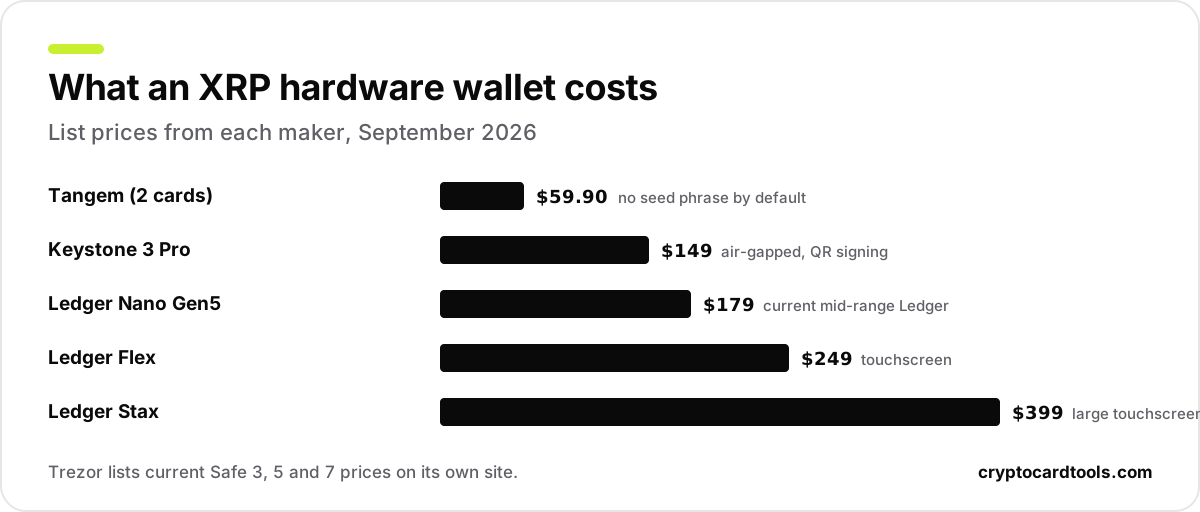
The lineup starts with the Nano S Plus and Nano X, still sold as entry-level signers. The Nano Gen5, launched in October 2025, costs $179, and the touchscreen Flex and Stax cost $249 and $399. All of them keep your private key inside a certified secure chip and confirm each transaction on the device screen.
For XRP specifically, Ledger Wallet includes a destination tag field when you send, so exchange deposits work without a workaround. Receiving to your own Ledger needs no tag at all.
The trade-off is token support. Ledger Wallet doesn't manage XRPL tokens such as RLUSD or trust lines on its own. Investors holding only XRP won't notice. Anyone who wants XRPL tokens with Ledger security has to pair the device with a third-party XRPL wallet as the signer.
Ledger's firmware is partly closed, a sore point for some holders since the company's 2023 controversy over its optional Recover service. Its hardware has never been compromised remotely. It remains the most widely supported device across exchanges and wallets.
Best for Investors who want the broadest support and a mature, battle-tested device
Weak spots Closed-source firmware, and no XRPL token management in Ledger Wallet
2. Tangem: The Simplest Hardware Wallet for XRP
Tangem takes a different route to the same destination. Instead of a device with a screen, you get credit-card-sized cards with a secure chip inside, tapped against your phone to approve transactions.
By default there is no seed phrase to write down. The private key is generated inside the chip on first use and never leaves it. A second or third card acts as the backup, so losing one card doesn't lose the XRP. If you prefer a seed phrase, Tangem also lets you create or import one.
A two-card set costs $59.90 and a three-card set $69.90, the lowest prices on this list. The Tangem app supports XRP and XRPL tokens, shows a destination tag field, and warns you when sending to a known exchange address without one.
Tangem's security has been audited by Kudelski in 2018, Riscure in 2023 and Cure53 in March 2026. It also connects to Xaman, which means an investor can keep XRP on Tangem cards and still use XRPL apps when needed.
The card format has one weakness. There is no screen on the card, so you verify transaction details on your phone, which trusts the phone more than a Ledger or Trezor does.
Best for Investors who want hardware security without managing a seed phrase
Weak spots Transaction details are verified on the phone rather than on the device
3. Xaman: The Best Mobile Wallet for XRP
Xaman, formerly XUMM, is the wallet the XRP community built for itself. XRPL Labs, a company funded by Ripple grants, released it in 2019 and renamed it in December 2023. It runs on iOS and Android, is free, and holds your keys on your phone.
For an investor, its main strengths are precision and options. Xaman handles destination tags, trust lines and every XRPL token. It shows the reserve clearly. With Tangem card support, your keys can live on a card while the app handles the interface.
Xaman also runs "xApps", small tools inside the wallet for swaps, yield vaults and XRPL services. In February 2026 it added a yield vault built with Flare, which bridges XRP to another network to earn returns. Useful for some, but it belongs in a separate account from your long-term holding.
There is no Xaman browser extension
Xaman has no desktop app and no browser extension. Its founder warned in March 2026 that extensions using the Xaman name are fakes designed to steal seed phrases. If you see one, don't install it.
A phone wallet carries phone risks. Malware, a lost device or a coerced unlock can expose keys. Pairing Xaman with Tangem cards, or using it only as a viewing interface for a hardware wallet, removes most of that exposure.
Best for Holders who want a native XRPL wallet on their phone, ideally paired with Tangem cards
Weak spots Keys on a phone unless paired with hardware, and no desktop version
4. Trezor Safe 3, 5 and 7: The Best Open-Source Hardware Wallet for XRP
Trezor is the choice for investors who want to read the code that guards their coins. Its firmware and Trezor Suite software are open source. The Safe family adds a secure element chip that earlier models lacked.
XRP works natively on the Safe 3, Safe 5, Safe 7 and the older Model T. The original Model One doesn't support it. Trezor Suite includes a destination tag field when sending and shows the 1 XRP reserve as locked, so new users aren't confused by the balance.
The Safe 3 is the sensible pick for an XRP investor, with the Safe 5 adding a colour touchscreen. Trezor's own site lists current prices.
Like Ledger, Trezor Suite manages XRP itself but not XRPL tokens. Trezor also has no direct link to Xaman, so an investor wanting both open-source hardware and XRPL apps will need a workaround.
Best for Investors who prioritise open-source software and a company with no seed-backup service
Weak spots No XRPL token support, and no integration with Xaman
5. Keystone 3 Pro: The Best Air-Gapped Wallet for XRP
Keystone 3 Pro never connects to a computer or phone. It signs transactions by reading a QR code from your wallet app and displaying a signed QR code back. Nothing can reach the keys over USB or Bluetooth because there is no connection.
XRP arrived in Keystone's own Nexus app in June 2025. The device also works with XRP Toolkit, a web interface for XRPL accounts. The Keystone 3 Pro costs $149 and uses three separate secure element chips.
The air gap is the reason to buy it. It suits investors holding a large position they intend to move once every few years, who will trade convenience for isolation.
Xaman doesn't pair with Keystone directly. As with Ledger, the workaround is to assign a Xaman-controlled key as a secondary signer on the Keystone account, which is more setup than most investors want.
Best for Large holders who want the strongest isolation and rarely transact
Weak spots A smaller ecosystem than Ledger or Trezor, and extra setup for XRPL apps
Other XRP Wallets to Consider
Trust Wallet added XRPL token and trust line support in February 2025 and handles destination tags. It's a solid multi-coin phone wallet, but its keys live on the phone, which puts it behind the hardware options for a long-term position.
Exodus covers XRP on desktop and mobile, integrates with Trezor, and includes a destination tag field. It suits people who want one app for many coins with a hardware wallet behind it.
GemWallet is an open-source browser extension for XRPL apps. It's the right tool for interacting with decentralised exchanges on the XRP Ledger, not for storing an investment.
Bifrost Wallet is where XRP yield lives in 2026. It mints FXRP on Flare and stakes it through Firelight for a liquid token called stXRP. Both steps add bridging and smart contract risk to XRP that would otherwise carry neither.
Our wallet safety checks score these wallets on open source, audits, key storage and their incident history.
Where Your XRP Should Not Be
The 2026 incidents point to the same lesson: XRP is lost through software and custodians, not through hardware wallets.
- Custody riskExchange accounts: on September 24, 2026, Bitget disclosed a hot wallet breach of roughly $350 million or more, with XRP the largest single asset taken. Bitget says its protection fund covers users, but the episode shows how much XRP sits in exchange wallets that users don't control. Our guide to crypto debit card risks covers the same custody problem from the spending side.
- Key leaksSoftware wallets with weak key generation: the XRP Healthcare wallet lost 267,664 XRP from 4,011 accounts in early September 2026, after generating keys with a predictable random function. Days later, the D'CENT app wallet reported around 12 million XRP stolen from roughly 6,600 users who had entered recovery phrases into older app versions. D'CENT's hardware devices were not affected, which underlines the point.
- Check which productCustodial "hosted" wallets: GateHub still offers a hosted wallet where it holds the keys. In 2019 an API breach drained about 25 million XRP from its hosted accounts. Its self-custody XRPL wallet is a different product, but investors should know which one they are using.
- FakeXaman browser extensions: there is no Xaman browser plugin. Anything in a Chrome store using the name exists to collect seed phrases.
- Update carefullyUnverified wallet libraries: in April 2025, attackers published poisoned versions of xrpl.js, the main JavaScript library for the XRP Ledger, after phishing a Ripple employee. The backdoor sent newly generated seeds to an attacker's server. It was caught within hours, and the major wallets reported no impact. Updating wallet software only from official sources closes that door.
How to Move XRP From an Exchange to Cold Storage
Moving XRP off an exchange is the single change that removes most of the risks above. It takes ten minutes.
Five steps to cold storage
- Set up your hardware wallet from the manufacturer's instructions and record the seed phrase on paper or metal. Never photograph it.
- Open the wallet app and copy your XRP receiving address. Your own wallet needs no destination tag.
- Send a small test amount from the exchange first, then confirm it arrives. The first deposit also activates the account and locks the 1 XRP reserve.
- Send the rest. Exchanges often take a few minutes and may hold large withdrawals for review.
- Restore your seed phrase on a second device or in the wallet's recovery check before storing large sums, so you know the backup works.
Selling later? Copy the tag
When you eventually sell, you'll send XRP back to an exchange, which needs the destination tag. Copy both the address and the tag from the exchange's deposit page.
Our best crypto offramp guide compares what each route costs when you convert to cash, and the cash-out calculator runs the numbers at live rates.
Wallet or ETF: Which Suits an XRP Investor?
Since November 2025, US investors can hold XRP through spot ETFs from Bitwise, Canary, Grayscale, Franklin Templeton and 21Shares, among others. Combined assets passed $1.7 billion by late September 2026.
An ETF removes every wallet decision above. There is no seed phrase, no reserve and no destination tag. The position sits in a brokerage account with familiar tax reporting.
It also removes the reasons many people bought XRP. You can't use ETF shares to pay anyone, move them across borders in seconds or hold them outside the financial system. Management fees, such as Bitwise's 0.34%, compound over years. And the shares only trade when the stock market is open.
Many investors end up with both: an ETF inside a retirement account, and a hardware wallet for XRP they may one day spend. Our crypto card tax guide explains how spending from a wallet is taxed compared with selling an investment.
Spending XRP Without Selling Your Position
Some investors want the option to use XRP without liquidating a whole holding. Crypto cards make that possible. A few even pay rewards in XRP.
Uphold's card pays cashback in XRP on everyday purchases, which appeals to holders who want to grow a position through spending. Our Uphold Card page lists its fees and limits. The card is custodial, so only a spending balance belongs there, never the long-term stack.
Our ranking of the best XRP cards lists every card that spends XRP, plus the cards that pay rewards in it. For the mechanics of how a card converts crypto at the checkout, our guide to how crypto debit cards work walks through each step.
What to Watch in XRP Custody
Ripple itself is moving deeper into custody, but not for retail. It received conditional approval from the US OCC for a national trust bank in December 2025 and has bought Hidden Road, GTreasury and the custody firm Palisade. All of that serves institutions.
There is no Ripple retail wallet
Any app claiming to be one is not from Ripple.
The XRP Ledger's own reserve rules can change through validator votes, as they did in 2024, and xrpl.org's reserves page shows the current figures. Its destination tag documentation explains the mechanism in full.
Hardware makers keep adding XRP features. Ledger's XRP page and Trezor's XRP support article list what each device supports today.
For anyone holding XRP through the next cycle, the best XRP wallet for investors keeps the keys offline and restores from a backup you have tested. It asks nothing of you between now and the day you sell. Ledger, Tangem, Trezor and Keystone all pass that test. Xaman earns its place as the interface that makes an XRP hardware wallet pleasant to use.
Frequently asked questions
What is the best XRP wallet for investors?
What is the safest way to store XRP long term?
Can I stake XRP?
Why is 1 XRP locked in my wallet?
Do I need a destination tag to send XRP to my own wallet?
Does Ledger support XRP?
Does Trezor support XRP?
Is Xaman safe?
Is it safe to keep XRP on Coinbase or another exchange?
Is an XRP ETF better than a wallet?
What was the D'CENT XRP hack?
Can I recover XRP sent without a destination tag?
Sources
Related tools
Keep reading
Top 5 ZEC Wallets: Where to Store Your Zcash in 2026
The best ZEC wallets in 2026, tested against the Ironwood upgrade: Zodl, Keystone, Ledger, Zingo and Unstoppable, plus the wallets that leak privacy or can't send.
Crypto-Friendly Banks in 2026: The Best Banks for Personal and Business Crypto Use
The most crypto-friendly banks for personal and business use in the US, UK and Europe, with each bank's crypto limits, fees and the catch before you open an account.
Best Crypto Offramp in 2026: How to Cash Out Crypto Without Losing Money
The cheapest ways to cash out crypto in 2026: exchange fees, P2P, crypto cards and ATMs compared, with the best offramp for the US, EU, UK, India and more.