Crypto-Friendly Banks in 2026: The Best Banks for Personal and Business Crypto Use
Contents
- Quick answer
- What Makes a Bank Crypto-Friendly?
- Best Crypto-Friendly Banks for Personal Use
- Best Crypto-Friendly Banks for Business
- Xapo Bank: A Crypto Bank for Large Bitcoin Holders
- UK Banks That Limit or Block Crypto
- Is Your Money Protected at a Crypto-Friendly Bank?
- What to Do If Your Bank Blocks a Crypto Payment
Crypto is gaining visibility in the banking ecosystem. SoFi became the first US national bank to sell crypto to consumers in November 2025. Charles Schwab and Morgan Stanley's E*Trade added bitcoin trading in 2026.
Europe has moved just as fast. BBVA, bunq and N26 now sell crypto next to a normal current account. Revolut, one of the first apps to offer crypto to everyday users, became a fully licensed UK bank in March 2026.
If you hold crypto, you need a bank that lets money move in both directions. Your salary has to reach an exchange. Profits have to come back without a call from the fraud team. A business may also need to pay suppliers in stablecoins or keep part of its treasury in bitcoin.
But finding a crypto-friendly bank for business and personal use is still not easy. Most big UK banks cap payments to exchanges at a few thousand pounds a month. Some block them outright.
Business accounts are harder still. Wise refuses businesses that trade crypto. Mercury won't open accounts for exchanges. A bank that happily sells you bitcoin can still reject the income your crypto company earns.
We checked the published crypto policies of more than 30 banks and fintechs in the US, UK and Europe as they stood in September 2026. We sorted them by what they actually let you do: buy crypto, fund an exchange, cash out, and run a crypto business.
Quick answer
For personal use
- US: SoFi is the best all-round crypto-friendly bank. Schwab and E*Trade suit people who want crypto next to their investments.
- UK: Revolut is the most crypto-friendly bank. Monzo works if you send less than £5,000 to exchanges in any 30 days.
- Europe: Revolut, bunq and N26 sell crypto in the banking app. BBVA and Openbank do the same in Spain and Germany.
For business use
- US: Mercury is the default for crypto startups, DAOs and funds, but it holds dollars only. Cross River, Lead Bank and Customers Bank serve larger stablecoin and payments firms.
- UK and Europe: Revolut Business lets companies hold crypto and pay suppliers in stablecoins. Bank Frick, Sygnum and AMINA serve licensed crypto companies and professional clients.
For large bitcoin holders: Xapo Bank combines a USD account with bitcoin and stablecoin deposits for a $1,000 yearly membership.
What Makes a Bank Crypto-Friendly?
A crypto-friendly bank lets you use your own money for legal crypto activity without blocking, capping or questioning every payment.
For a personal account, that means sending money to an exchange without a low cap and receiving withdrawals back without a review. The best banks also let you buy and hold crypto in their own app. Their credit cards don't turn a crypto purchase into an expensive cash advance.
Business accounts face a stricter test. The bank has to accept income that comes from crypto, not just payments that go to it. Many banks that pass the personal test fail this one.
The four tests we used
- Buy: can you buy and hold crypto in the bank's own app?
- Fund: can you send money to an exchange without a low cap?
- Cash out: does money coming back from an exchange arrive without a review?
- Business: will the bank accept income that comes from crypto?
It also helps to know which "banks" are really banks. Cash App, Mercury and Wise are fintechs that hold your money at partner banks. That doesn't make them unsafe, but it changes how deposit protection works.
Best Crypto-Friendly Banks for Personal Use
Personal banking is where crypto has become easiest. The best choice depends on where you live and whether you want to buy crypto in the bank's app or at an exchange.
SoFi: the best US bank for crypto
SoFi relaunched crypto trading on November 11, 2025, through SoFi Bank, N.A. It describes itself as the first and only nationally chartered bank to offer crypto trading to consumers.
You can buy bitcoin, ether, Solana and other coins in the same app that holds your checking and savings accounts. In May 2026, SoFi also made its own dollar stablecoin, SoFiUSD, available to members on Ethereum and Solana.
That combination suits someone who wants one US bank for salary, savings and a crypto allocation. Your cash carries FDIC insurance. The crypto you buy does not, which is true at every bank on this list.
Best for One US bank for salary, savings and a crypto allocation
The catch FDIC insurance covers your cash, not your crypto
Charles Schwab and E*Trade: crypto next to your investments
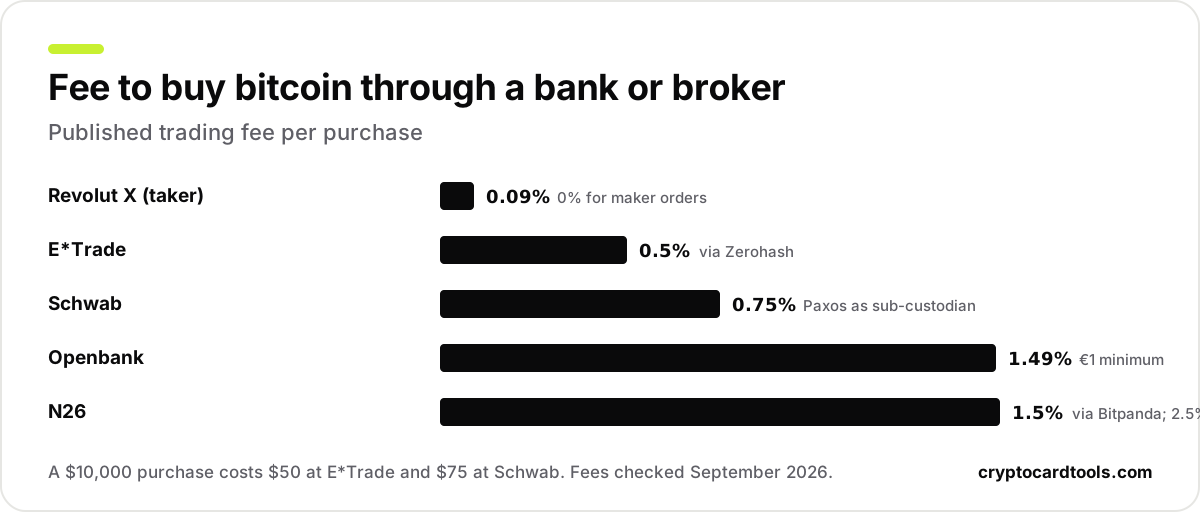
Schwab Crypto began rolling out in May 2026 with bitcoin and ether. Schwab charges 0.75% per trade. Its own bank holds the coins, with Paxos as sub-custodian. It isn't available in New York or Louisiana.
E*Trade finished rolling out bitcoin, ether and Solana trading on July 16, 2026. It charges 0.5% through the crypto provider Zerohash. Morgan Stanley states that these holdings have neither FDIC nor SIPC protection.
On a $10,000 purchase, that's $75 at Schwab and $50 at E*Trade. Both make most sense if you already invest there and want crypto in the same tax records.
PNC also sells bitcoin directly through Coinbase's infrastructure, but only to PNC Private Bank clients so far.
Chase, Citi and other big US banks
The largest US banks don't sell crypto to retail customers yet. Chase publishes no limit on checking-account transfers to exchanges and announced a Coinbase partnership in July 2025. We could not confirm that its card funding and direct bank linking features are live.
Credit cards treat crypto as a cash advance
Chase and Citi both treat crypto purchases as cash advances. Citi charges $10 or 5% of the amount, whichever is greater, with interest from day one.
Cash App: easy bitcoin, but not a bank
Cash App is the simplest way to buy small amounts of bitcoin in the US. It supports Lightning payments and withdrawals to your own wallet. It also cut its bitcoin fees in February 2026.
It only sells bitcoin, though. Cash App is a payments app run by Block rather than a bank, so it works best alongside a real bank account.
Revolut: the most crypto-friendly bank in the UK
Revolut Bank UK became fully licensed on March 11, 2026. Customers are moving to the new bank in phases. Their eligible deposits are protected up to £120,000.
Crypto runs through a separate company, Revolut Ltd, which is registered with the FCA for anti-money laundering. You can buy and sell in the main app or trade on Revolut X at 0% for maker orders and 0.09% for taker orders.
Best for UK residents who want crypto and banking in one app
The catch Crypto held with Revolut Ltd sits outside the FSCS scheme, even though your cash is now in a licensed bank
Monzo: fine for regular buyers under £5,000
Monzo lets you pay a range of exchanges, up to £5,000 in any rolling 30 days. Monzo says it can't change that allowance for anyone. Payments to Binance are blocked because of the FCA's warning about the exchange.
For someone buying a few hundred pounds of crypto a month, the cap never bites. For someone moving a house deposit into stablecoins, it rules Monzo out.
Revolut, bunq and N26: the best options in Europe
EU banks work under one rulebook for crypto. The MiCA regulation's transition period ended on July 1, 2026, so every crypto provider in the EU now needs an authorisation.
Revolut sells crypto in the EEA under a MiCA licence from Cyprus. You can buy, sell, stake and withdraw coins to your own wallet. Its bank has held a full Lithuanian licence since 2021 and added a French licence in August 2026.
bunq added crypto in April 2025 through Kraken, whose Irish entity holds the licence. It now covers 31 EEA countries, starts at €1 and includes staking.
N26 sells crypto through Bitpanda in Germany, France, Spain, Austria, Belgium, Ireland and Portugal. It charges 1.5% on bitcoin, 2.5% on most other coins and 3.5% on less liquid ones.
Buying more than a few hundred euros?
Those fees suit small monthly purchases. For larger amounts, our guide to the cheapest crypto onramp shows how much a SEPA transfer to an exchange saves.
BBVA and Openbank: Spain's big banks sell bitcoin
BBVA opened bitcoin and ether trading to all adult retail customers in Spain on July 4, 2025. Openbank, Santander's digital bank, followed in Germany and Spain, charging 1.49% per trade with a €1 minimum.
Both suit customers who already bank there and want a small crypto position without opening an exchange account.
Best Crypto-Friendly Banks for Business
Business banking for crypto is harder because the bank takes on your customers' risk as well as yours. Banks ask what your company does with crypto, where its income comes from and which licences it holds.
Mercury: the default for US crypto startups
Mercury supports crypto and Web3 startups, DAOs and funds. Eligible businesses can send money to crypto exchanges from their account.
The limits are clear. Mercury holds dollars only, so your treasury crypto has to sit elsewhere. It won't open accounts for exchanges or money services businesses.
Mercury is still a fintech, with deposits held at Choice Financial Group and Column N.A. The OCC gave conditional approval for Mercury Bank, N.A. in April 2026. It becomes a bank in its own right once the remaining approvals arrive.
Best for US crypto startups, DAOs and funds
The catch Dollars only, and no accounts for exchanges or money services businesses
Cross River, Lead Bank and Customers Bank: for stablecoin and payments firms
Larger crypto companies need a bank that moves stablecoins, not just dollars. Cross River launched stablecoin payments in November 2025 and counts Circle, Coinbase and Gemini among its clients. It also issues the US version of the MetaMask Card.
Cross River and Lead Bank became the first US banks to settle card payments with Visa in USDC on Solana in December 2025. Customers Bank runs cubiX, a 24/7 payments network that grew out of its service for digital asset firms.
These banks usually work with established companies through direct sales rather than an app sign-up. They suit card issuers, payment firms and exchanges that Mercury won't take.
For custody alone, Anchorage Digital Bank serves institutions under a federal charter it has held since 2021. U.S. Bank resumed bitcoin custody for institutional fund managers in September 2025.
Revolut Business: crypto treasury and stablecoin payments
Revolut Business lets companies invest in 279 tokens, including bitcoin and ether. Businesses can also send and receive USDT and USDC to and from customers and suppliers.
Revolut's help centre adds a limit: businesses can't pay in funds that come from dealing or trading crypto. That makes Revolut Business a fit for a company holding crypto or paying suppliers in stablecoins, not for a trading firm.
Wise is stricter
Its policy rules out businesses that exchange or trade crypto. It also bans buying or selling crypto for the business or its customers.
Bank Frick, Sygnum and AMINA: for licensed crypto companies
Licensed crypto firms in Europe usually end up at specialist banks. Bank Frick in Liechtenstein received MiCA authorisation in January 2026 and serves professional clients and crypto companies across the EEA.
Sygnum is regulated in Switzerland and Singapore, with a MiCA licence for its Liechtenstein arm since June 30, 2026. AMINA, formerly SEBA Bank, holds a Swiss banking licence and serves professional investors through a MiCA licence in Austria.
These banks expect a licence before they expect a deposit. A company still waiting for its MiCA authorisation will struggle to open an account anywhere in the EU.
Xapo Bank: A Crypto Bank for Large Bitcoin Holders
Xapo Bank is the rare crypto bank that ordinary people can join. It is a licensed credit institution in Gibraltar, with USD, EUR and GBP accounts. You can deposit bitcoin, USDT and USDC, with stablecoins converted to dollars.
At that price, Xapo makes sense for someone holding a meaningful bitcoin balance who wants bank-grade custody and a card. Our Xapo Card page lists its spending fees and limits.
Sygnum and AMINA also offer private banking with crypto, but Sygnum's Swiss private clients need at least CHF 500,000 in liquid assets.
UK Banks That Limit or Block Crypto
Outside Revolut and Monzo, most UK high-street banks restrict crypto. Every figure below comes from the bank's own policy page unless noted.
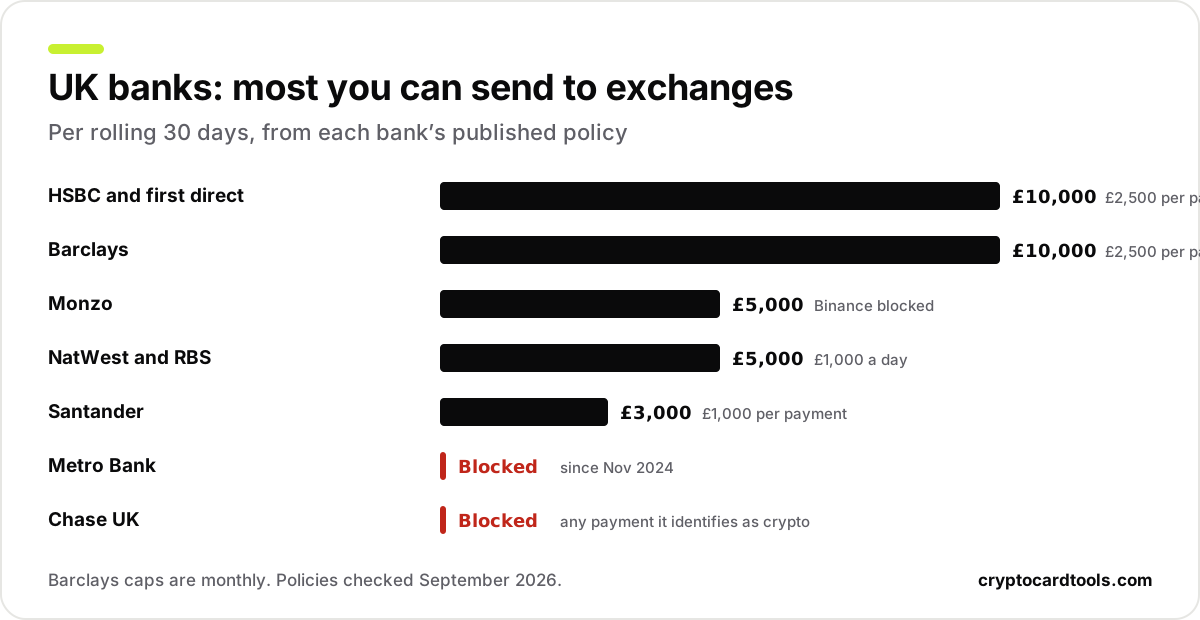
- CappedNatWest and RBS: £1,000 a day and £5,000 in any 30 days to exchanges. Credit cards can't be used for crypto.
- CappedHSBC and first direct: £2,500 per payment and £10,000 per rolling 30 days. Credit card crypto payments are refused.
- CappedSantander: £1,000 per payment and £3,000 per rolling 30 days. Payments to Binance are blocked.
- CappedNationwide: £1,000 a day by debit card and £1,000 a day by bank transfer. Credit cards can't be used for crypto.
- CappedBarclays: Barclaycard blocked crypto purchases from June 27, 2025. Barclays told customers that exchange transfers would be capped at £2,500 per payment and £10,000 a month from December 2, 2025.
- Cards blockedLloyds, Halifax and Bank of Scotland: credit card crypto purchases have been banned since 2018. We found no published limit for debit cards or transfers.
- BlockedChase UK: blocks any payment it identifies as a crypto transaction.
- BlockedMetro Bank: has stopped all outgoing payments to known crypto exchanges since November 2024.
- RestrictedStarling: has restricted crypto card payments and transfers in both directions since 2022, according to Sifted and CoinDesk.
UK banks tie these limits to scams. Investment fraud losses rose 40% in 2025 to £221.5 million, according to UK Finance.
No scam refund after the exchange
Payments to your own exchange account fall outside the UK's scam refund rules, so a loss after that point usually stays with you.
Most of these banks still accept money coming back from an exchange, so cashing out is easier than buying. Our guide to the best crypto offramp compares each route to your bank, and the cash-out calculator shows what each one costs at live rates.
Is Your Money Protected at a Crypto-Friendly Bank?
Deposit insurance covers cash in a licensed bank. The FDIC covers $250,000 per depositor, per bank, per ownership category in the US. The UK's FSCS limit rose to £120,000 on December 1, 2025. EU schemes cover €100,000.
Crypto is never part of that cover, even when a bank sells and holds it for you. The FSCS states that it can't protect you if a platform holding crypto fails.
What protects your coins is the custodian. Schwab holds them at its own bank with Paxos, while N26 relies on Bitpanda's cold storage. Knowing who holds your crypto tells you more about your risk than the bank's brand.
Fintech accounts add one more layer. Apps like Mercury and Cash App depend on partner banks keeping accurate records of each customer's money. When the middleware firm Synapse went bankrupt in April 2024, customers of the apps built on it waited months for their cash.
The same custody question applies to crypto cards, which we cover in crypto debit card risks. Our card safety check scores each card's licensing, custody and reserves.
What to Do If Your Bank Blocks a Crypto Payment
A declined payment is usually an automated rule, not a judgement about you. How you respond decides whether it stays a one-off or becomes a closed account.
Steps that usually work
- A quick call confirming the payment was yours often releases it. Some banks can't help even then, since Monzo's allowance and NatWest's caps apply to every customer.
- Records help more than persuasion. Exchange statements, payslips or a property sale contract answer the "where did this money come from" question faster than any explanation.
- Relabelling a payment or splitting it to stay under a limit tends to backfire. Banks treat both as attempts to hide the activity, which is a common reason for closures.
If a bank closes your account without a reason, you can complain. In the UK, the Financial Ombudsman Service takes cases after the bank's final response or eight weeks. In the US, you can file with the Consumer Financial Protection Bureau.
If you mainly want to spend crypto, a card can take the pressure off your bank entirely. Our best crypto cards guide and the card finder show which cards work in your country.
Frequently asked questions
Which banks are the most crypto-friendly in 2026?
What is the best bank for a crypto business?
Which banks block crypto transactions?
Can I buy crypto directly from my bank?
Can a business hold crypto in a bank account?
Is Chase crypto-friendly?
Are US banks allowed to offer crypto now?
Is crypto held at a bank FDIC or FSCS insured?
Do Indian banks allow crypto?
Can a bank close my account for buying crypto?
Do I pay tax when I move money between my bank and an exchange?
What happened to Silvergate and Signature Bank?
Sources
Related tools
Keep reading
OKX Card Review 2026: Fees, Cashback, Countries and Limits
OKX Card review for 2026: 0.1% spread, 2% to 10% USDG cashback and its real monthly caps, every country it works in, and who should skip it.
Visa Mastercard Alternative Crypto Card: What Works in 2026
A visa mastercard alternative crypto card runs on UnionPay, Amex, Discover, or stablecoin rails. Compare 2026 availability, fees, and KYC before you apply.
Cold Wallet Guide: Secure Crypto Storage in 2026
Learn how to set up a cold wallet, back up a seed phrase, and use cold storage with crypto cards. Practical security steps, no fluff.