Tria Card Review 2026: Fees, Cashback, Access Code and a Real Sign-Up
Contents
- Quick answer
- What Is the Tria Card?
- My Experience Signing Up for Tria
- How to Sign Up for Tria
- Tria Access Code: How to Get One
- Tria Card Fees
- Tria Card Cashback
- How the Tria Credit Line Works Day to Day
- Tria Card Limits
- Tria Card Top-Up: Networks and Assets
- Futures and Earn: Putting Idle Money to Use
- The Tria Username
- Is Tria Available in My Country?
- Is the Tria Card Safe?
- Tria vs Other Crypto Cards
- Tria Card Review Verdict: Who Should Get It?
Some links in this article are affiliate links. We may earn a commission if you sign up through them, at no extra cost to you. How we handle affiliate links.
Crypto cards let you spend stablecoins and other crypto anywhere Visa is accepted, without selling on an exchange first and waiting for a bank transfer. Self-custody cards go a step further and keep your crypto in your own wallet instead of a company's account.
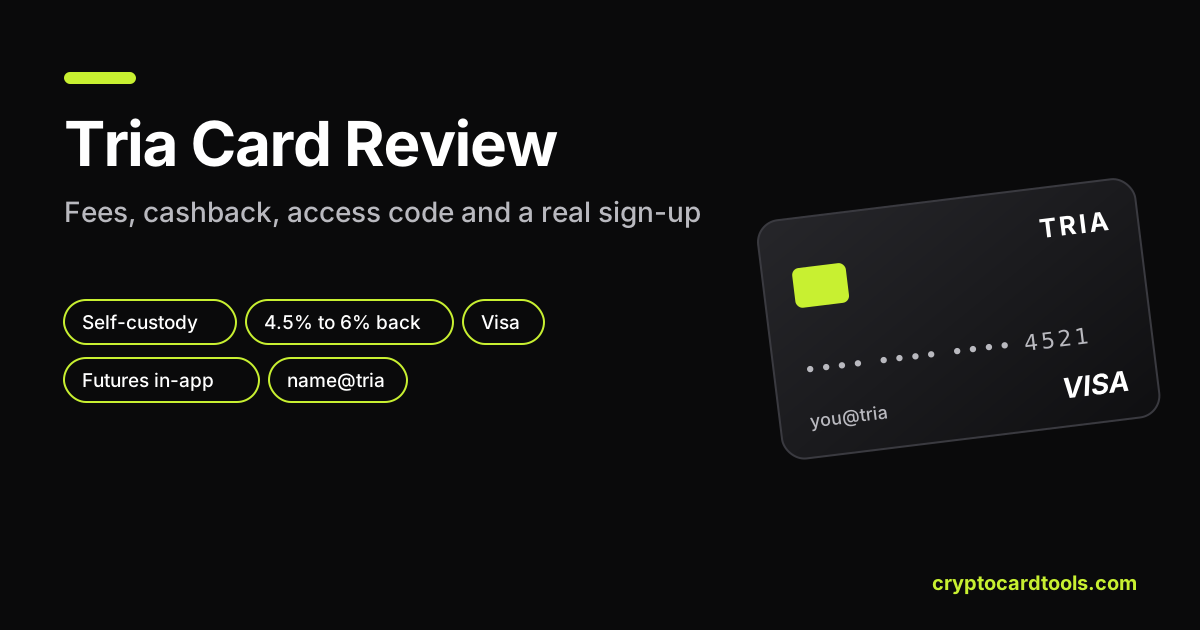
Tria is a self-custody Visa card with cashback of up to 6%, a username other users can pay, and futures trading inside the same app. Tria says the card is available in over 200 regions.
If you have searched for the card, you have probably seen pages promising a Tria access code that unlocks a guaranteed 6%.
But no code changes your rate. Tria's own documents also quote different fees in places, while the full list of supported countries only appears inside the app.
I signed up, went through KYC, used the 4.5% tier and asked Tria's support team what the help centre doesn't cover. I checked each finding against Tria's terms and help pages in October 2026, so this Tria card review rests on a real account and Tria's own documents.
Quick answer
- What it is: a self-custody Visa card. Your crypto backs the card as collateral for a 0% APR credit line.
- Cashback: 1.5% on the Lite virtual card, 4.5% on the $109-a-year Pro card and 6% on the $250-a-year Max metal card, each up to a monthly cap. Paid in USDT.
- Fees: no Tria FX or deposit fee. ATM withdrawals cost $1 plus 1%.
- Limits: a $1 million daily transaction limit, with ATM cash capped at $750 a day.
- Availability: over 200 regions, including Indonesia and the US, but not India (Tria's support confirmed this to me).
- Sign-up: an access code from a referral link or the waitlist, then full KYC. My application also needed proof of residence.
- Best for: people who keep crypto in their own wallet and spend at least $200 a month on a card.
What Is the Tria Card?
Tria is a self-custody crypto app with a Visa card attached. Threely Dimensions, Inc., the company behind Tria, builds the app and provides the card technology.
Nimbus, LLC issues the international card under licence from Visa. US cards come from a different issuer, Third National.
The card comes in three membership tiers. Lite is a virtual card, Pro adds a plastic card, and Max adds a metal one. Tria's April 2026 blog called the same tiers Virtual, Signature and Premium, so you may still see those names.
Unlike a typical crypto debit card, this one doesn't hand your crypto to Tria. The card terms treat your balance as collateral for a credit line from the issuer at 0% APR. Our guide to how a crypto debit card works explains the custodial model that most other cards use.
Our Tria card page lists the fees, limits and sources for this card in one place.
My Experience Signing Up for Tria
KYC was the strictest part of joining. Tria's help centre asks for an ID document and a live selfie in the mobile app. You also need to be physically in your chosen country, without a VPN.
My application also required proof of residence, which made KYC stricter than the help centre suggests.
Proof of residence was required
Tria's KYC articles list an ID and a selfie but no address document. Having a recent proof of address ready before you start can save a second round of checks.
When I had questions the help centre didn't answer, including whether India is supported, I contacted Tria's support team. They replied within 24 hours.
Once approved, I found the app easy to use and intriguing to explore. Card spending, cashback tracking, the Earn vaults and the futures account all sit in the same app.
How to Sign Up for Tria
Sign-up has two gates, an access code and KYC, with the card purchase between them.
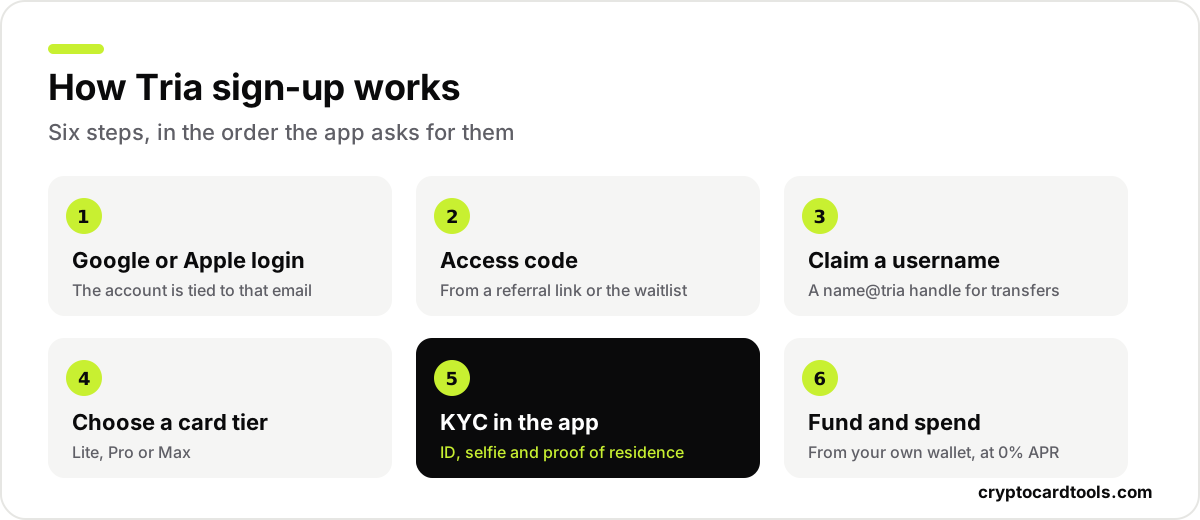
- Get the app. Download Tria from your app store or open the web app. KYC only works on mobile.
- Sign in with Google or Apple. Tria ties the account to that email. Signing in later with a different email creates a new, empty account.
- Enter an access code. A referral link fills it in for you. Without one, join the waitlist in the app and wait for Tria's email.
- Claim your Tria Name. Pick a username in the form name@tria. It can't be changed later, so check the spelling.
- Choose a tier and your country. Select your real country of residence, then pay in crypto or by credit or debit card. Card payments trigger an email with a 10-digit promo code to enter in the app.
- Complete KYC. Enter your details, upload an ID and take a live selfie. Have proof of residence ready as well.
- Fund the card and start spending. Pro and Max buyers get a Lite virtual card right after verification, with the same benefits. The physical card ships later in batches.
Tria Access Code: How to Get One
Tria still requires an access code to join during its phased rollout. A referral link from an existing user or ambassador applies one for you.
Without a link, you join the waitlist inside the app. Tria's sign-up guide says codes reach waitlisted users by email automatically, so there is no need to ask support for one.
You can use our Tria referral link to skip the waitlist. Tria's refer-and-earn page says both of us get $5 in USDT once you make four card purchases of $5 or more within 14 days of getting the card.
Transfers, ATM cash, wallet top-ups and gambling don't count toward those four purchases. Tria credits the $5 automatically once they settle.
No code unlocks a guaranteed 6%
Some pages promise an access code that unlocks 6% cashback. No code changes your rate. Every user picks from the same tiers, and 6% belongs to the $250-a-year Max metal card on its first $2,000 of monthly spending.
Tria Card Fees
Apart from ATM cash, the yearly membership is the main cost of a Tria card. For the Lite card, Tria's cashback guide and its card terms disagree on the price.
Tria card fees at a glance
- Lite virtual card: free, according to Tria's cashback guide. The card terms still list $25 a year.
- Pro plastic card: $109 a year.
- Max metal card: $250 a year.
- Deposits and top-ups: no Tria fee. Network fees and an in-app Provider Fee for swaps can apply.
- Foreign exchange: no Tria FX fee. Visa's own conversion still applies abroad.
- ATM withdrawals: $1 plus 1% of the amount.
- Monthly fee: none.
The card terms set higher ceilings than the fees Tria charges today, such as "up to 3%" for FX and "up to $2 + 3%" for ATM withdrawals. The issuer can change fees with 30 days' notice, so the fee screen in the app is worth a yearly look.
Pro and Max also add Visa Airport Companion lounge entry. Tria's blog notes that lounge usage fees are still payable by the cardholder, so entry alone isn't a free visit.
The membership fee decides which card makes sense, because cashback has to earn it back before the card pays you anything.
Tria Card Cashback
Cashback is the main reason to pay for a higher tier. I used the 4.5% tier for everyday spending and found it very useful.
Season 3 rates have applied since June 1, 2026. Each tier earns its top rate up to a monthly spending cap, then a lower flat rate:
- 1.5%Lite virtual card: on the first $1,000 of spending a month, then 0.5%.
- 4.5%Pro plastic, $109 a year: on the first $2,000 a month, then 1%.
- 6%Max metal, $250 a year: on the first $2,000 a month, then 1%.
The cap belongs to your account rather than to each card, and it resets on the first day of every month. A Pro or Max member earns the higher rate on the Lite virtual card too.
Upgrading mid-month only raises the rate on purchases made after the upgrade.
When Tria pays cashback, and what earns nothing
Cashback only counts once a purchase settles, not while it shows as pending. Tria pays it in USDT on Arbitrum in periodic batches, after a waiting period of up to 90 days that covers settlement and chargebacks.
Cash withdrawals, money transfers, wallet and prepaid funding, gambling and vouchers earn nothing. Tria Travel bookings sit in a separate rewards programme.
A refund claws back the cashback on the returned item. Tria has also described a staking badge that adds a boost within the cap. The current Season 3 guide doesn't detail it, so the app is the place to confirm it.
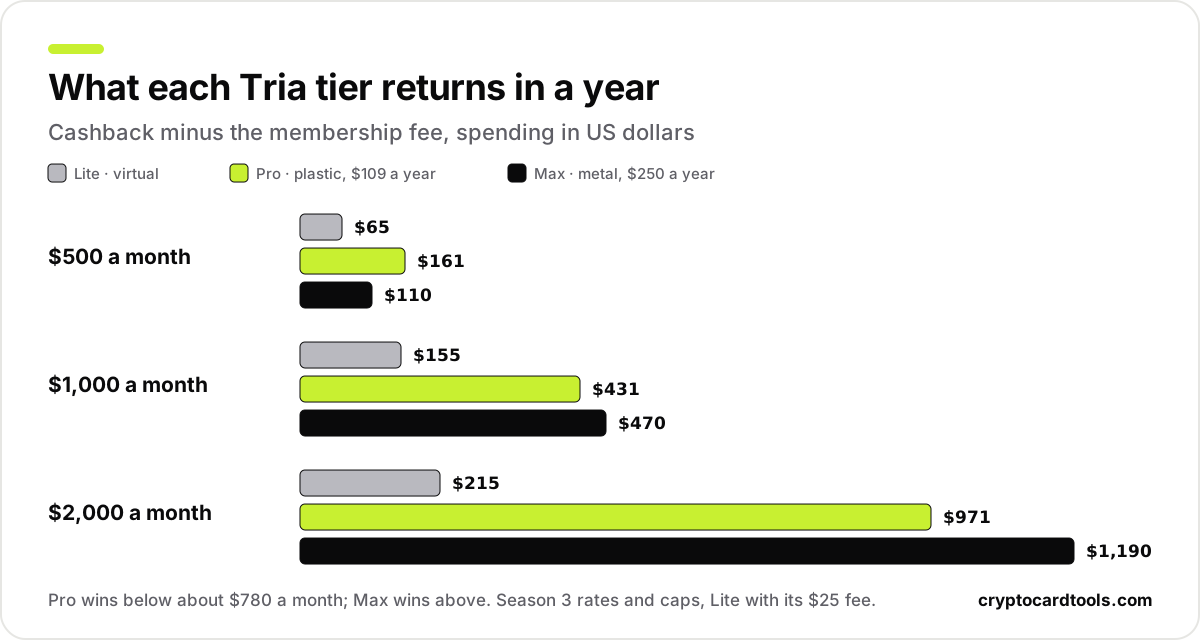
After its membership fee, the Pro card leaves you about $161 ahead over a year at $500 of monthly spending in US dollars. At $1,000 a month it returns about $431, while Max edges ahead at about $470.
The crossover sits at roughly $780 a month. Below that, the $109 Pro card returns more than the $250 Max card. Above it, Max's extra 1.5 points cover its higher fee.
From $2,000 a month the gap holds at about $219 a year, since both cards drop to 1% above the shared cap.
Lite still pays 1.5% on up to $1,000 a month, worth up to $180 a year before any fee. Pro overtakes it from roughly $250 to $300 of monthly spending, depending on whether Lite carries the $25 fee.
Spending in another currency changes the picture slightly, since Visa's conversion rate applies even though Tria adds no fee. The card cost calculator runs your own monthly spend through Tria's published rates.
Tria Season 3 points
Season 3 also runs a points programme alongside cashback. Points can't be bought, sold or cashed out, and they reset to zero when a new season starts.
Lite card spending earns 1 point per dollar, while Pro and Max earn 1.5. Hyperliquid futures earn 1 point per $100 of position size, with Decibel futures at 1.05.
One-time bonuses add 2,500 points for your first card purchase of the season and 2,500 for holding Pro or Max. Another 5,000 arrive once your futures volume reaches $10,000.
Points unlock Mystery Boxes, starting at 5,000 points with surprise rewards such as cashback or travel credits. The top published boxes sit at 1 million and 5 million points, paying $5,000 and $20,000 in cash plus an entry into a Tria equity draw.
How the Tria Credit Line Works Day to Day
Every Tria purchase is a charge on a credit line backed by your collateral. The card terms say each dollar charged needs a dollar of collateral at market value, so $100 of collateral gives you $100 of spending power.
Topping up from the Tria wallet or an external wallet adds to that balance. Tria's top-up guide says most deposits are converted and credited almost instantly, though network congestion can stretch that to 2 to 4 hours.
Some merchants place a hold before they know the final amount, such as hotels, car rentals and fuel pumps. That hold reduces your spending limit until the final charge posts.
A card transaction can take from 48 hours to a few days to settle fully. The terms authorise repayment straight from your linked wallet whenever you use the card.
Under the card terms, a balance left unpaid for one calendar day triggers a Liquidation Event. So does collateral whose market value falls below your charges while you add nothing.
In a liquidation, the issuer sells only enough collateral to clear what you owe, leaving the rest with you. If the sale falls short, you still owe the difference. Any grace period is at the issuer's discretion.
What to keep as collateral
Stablecoins such as USDC or USDT are designed to hold their dollar value, so a market drop is unlikely to push them below your charges. Keeping a little more than you plan to spend also covers hotel or fuel holds.
Tria Card Limits
Tria advertises a $1 million daily transaction limit on every tier, including Lite. Your real ceiling is lower, because the card terms tie spending power to the collateral you hold.
The issuer can also raise, lower or cut limits to zero at any time, with or without notice.
ATM cash has tighter rules: Tria's card pages cap withdrawals at $750 a day on Pro and Max, while Lite gets only limited ATM access. Its ATM guide also allows at most three withdrawals in 24 hours.
A $100 withdrawal needs $102 in your balance once the $1 and 1% fees are added. When an ATM asks for an account type, Tria's guide says "Credit" works, while "Savings" or "Checking" usually fail.
Apple Pay and Google Pay
Tria's membership page lists Apple Pay and Google Pay on every tier. The help centre adds "where supported", so availability can vary by country.
Pro and Max members can spend through the Lite virtual card on their phone while the physical card ships. Tria says it earns the same higher cashback rate.
Tria Card Top-Up: Networks and Assets
Tria says the card accepts more than 1,000 tokens, converted when you top up. Its pages name BTC, ETH, USDC and USDT among them.
The top-up guide lists nine networks: Bitcoin, Ethereum, Polygon, Base, Arbitrum, Optimism, BNB Chain, Aptos and Solana. Avalanche is not supported for card top-ups.
Minimums are $50 for Bitcoin and $10 for every other token. Most chains offer gasless deposits, so you don't need the network's own gas token.
Solana works differently: direct SOL deposits aren't supported, while USDC or USDT deposits on Solana need some SOL in your wallet for gas.
The cheapest route is usually a stablecoin on a layer-2 network. Tria's help centre recommends USDC or USDT on Optimism, Arbitrum, Base or Polygon, because they need the fewest conversion steps and typically carry the lowest Provider Fee.
Merchant refunds return to the card balance. Tria says that money can be spent with the card but not withdrawn.
Futures and Earn: Putting Idle Money to Use
Tria describes itself as an app to trade, earn and spend crypto. Futures trading inside the app lets money that would otherwise sit idle do some work, which set Tria apart from other cards I have used.
The Futures tab runs perpetual contracts, which track a coin's price without expiring. Tria's help centre lists a $10 minimum deposit, USDC on Arbitrum as the settlement currency and a 0.1% fee on opening and closing a trade.
Withdrawals from that account carry a flat $1 fee from Hyperliquid, Tria's infrastructure provider.
Decibel, a fully on-chain perpetuals exchange on Aptos, sits in the same tab as a separate account. Tria's April 2026 announcement lists up to 40x leverage, a $10 minimum deposit and a fee made up of Decibel's charge plus a Tria fee. Tria covers the gas.
Tria's own example shows a 10x long on Bitcoin liquidated by a 10% price drop, and a 50x position by just 2%. The help centre says you can't lose more than your margin, though high leverage can wipe that margin out fast.
Our guide to the top perp exchanges explains funding, liquidation and how on-chain venues compare.
Trading money and card money
Leverage magnifies losses as fast as gains. Keeping your card collateral in stablecoins and moving only what you can afford to lose into the futures account limits the damage from a bad trade.
Tria Earn
For idle money without leverage, Tria's Earn feature is the closer fit. It places supported tokens into yield vaults for wBTC and USDC on Ethereum and AUSD on Monad, converting your token automatically.
Earnings are added every 7 days. Standard vaults have no lock-in.
Tria advertises up to 6% APY on Lite, 10% on Pro and 15% on Max, though rates move with the market. The tier boosts are paid in Tria tokens after its token launch and need a 3-month lock.
Strategy fees of around 20% of profits and a platform fee of 0.2% to 1% a year are already built into the displayed APY. Withdrawals are free if you wait about 96 hours, or cost 0.2% for an instant exit of up to $628.75.
Tria's help centre states that returns aren't guaranteed and that smart contract risk applies. The August 2026 exploit of Tria's card contract, covered below, is a recent example of that risk.
The Tria Username
Every Tria account claims a username in the form name@tria during sign-up. I claimed mine when I opened my account.
Other Tria users can send you crypto by typing that name instead of a long wallet address. That removes the copy-paste step, where one wrong character can send funds to the wrong address.
Tria describes the name as a single address that works across its supported chains. Sharing it gives nobody access to your account.
Tria says a name can't be changed once confirmed, so a short spelling you can read out easily is worth the extra thought.
Is Tria Available in My Country?
Tria says the card covers over 200 regions. Its published prohibited list blocks sanctioned countries such as Cuba, Iran, North Korea and Syria, plus a set of high-risk countries including Afghanistan, Myanmar, Russia, Venezuela and Yemen.
The full list of supported countries only appears in the app's country menu.
Is Tria available in India?
No. India isn't on Tria's published blocked list, but Tria's support team confirmed to me in October 2026 that the card isn't offered there. Readers in India can use our card finder, which filters every card by country.
Does Tria work in Indonesia?
Yes. Indonesia is supported, so residents can apply through the app and complete the same KYC as other countries.
Is Tria available in the US?
Yes. Tria's KYC guide lists the United States among its supported countries, with US cards issued by Third National rather than Nimbus.
Wherever you live, Tria requires you to be physically in the country you select during KYC, and it does not allow a VPN. Our Tria availability check for the UK is an example of how we track country coverage for each card.
Is the Tria Card Safe?
Because Tria never holds your funds, a company failure or a frozen account is less likely to trap your balance.
Self-custody also moves responsibility to you. Tria's sign-up guide describes a 12- or 24-word seed phrase that restores your wallet if you lose your login. Tria says it cannot recover a lost phrase.
Liquidation is the other risk, since the issuer can sell collateral if a balance goes unpaid or its value falls.
The August 2026 Rain contract exploit
Tria's cards ran on an older version of Rain's Solana card contract. In late August 2026 an attacker used a flaw in it to make $431,945 of unauthorized withdrawals from 636 Tria customers. Tria reimbursed every affected user in full plus an extra 10%, and Rain says it upgraded every programme that used the vulnerable contract.
The same exploit hit Avici, with about $1.1 million taken across Rain-powered card programmes. Our Avici vs Tria comparison sets the two cards side by side.
The losses came from card collateral held in Rain's contract, which shows that self-custody cards still depend on the code they connect to.
The app's store ratings were mixed in late September 2026, at 2.1 on Google Play from about 3,900 reviews and 3.5 on the US App Store from 40. Our Tria safety check scores licensing, custody, reserves and incidents with sources for each.
Who issues the Tria card?
Nimbus, LLC, a Delaware company, issues international cards and sets your credit limit. Tria's card terms describe Tria as the technology provider, not the issuer, creditor or lender.
The card terms name no regulator for Nimbus and mention no deposit insurance. Tria states that it is not a bank or a money services business. The terms also send disputes with the issuer to individual arbitration and waive class actions.
Card network rules still give you a route for a bad purchase. The terms allow a chargeback through the app within 60 days of a disputed charge posting.
Tria's membership page also lists price protection of up to $2,000 and purchase protection of up to $10,000 per account on every tier.
Tria vs Other Crypto Cards
The closest alternatives are other self-custody cards and stablecoin cards.
- Self-custodyether.fi Cash: also self-custody, with 3% cashback paid in its own ETHFI token (4% for invitation-only VIP) and a Borrow mode that uses your crypto as collateral. See ether.fi Cash vs Tria.
- Self-custodyMetaMask Card: spends straight from a MetaMask wallet in a list of countries across Europe and Latin America, with 1% back in mUSD on the free card. See MetaMask Card vs Tria.
- CustodialKAST: a stablecoin card with 1.5% back in dollars on its free Standard tier. See KAST vs Tria.
- CustodialRedotPay: a custodial card that excludes a published list of countries, with cashback only on its paid Pro plan. See RedotPay vs Tria.
Our Tria alternatives page ranks more options, and the crypto card comparison puts every card side by side on fees, cashback, availability and safety.
Tria Card Review Verdict: Who Should Get It?
Get it if You keep crypto in your own wallet, spend at least $200 a month and want 4.5% to 6% back without handing your crypto to anyone
Skip it if You live in India, can't provide proof of residence, or want instant cashback rather than USDT paid in batches up to 90 days later
Pro is the better buy below about $780 of monthly spending, with Max paying more above it. The futures account, Earn vaults and username make Tria closer to a full crypto app than a card. The full KYC and the access code slow the start.
Spending crypto can count as a taxable sale in many countries, which our crypto card tax guide explains. If Tria fits, our Tria referral link skips the waitlist.
Frequently asked questions
Is the Tria card worth it?
What are the Tria card fees?
How much cashback does the Tria card give?
How do I get a Tria access code?
How do I sign up for Tria?
Is Tria available in India?
Does the Tria card work in Indonesia?
Is Tria available in the US?
What are the Tria card limits?
Does the Tria card work with Apple Pay and Google Pay?
What documents does Tria KYC require?
Is the Tria card self-custodial?
Can I trade futures on Tria?
Does Tria have an Earn feature?
What is a Tria username?
Is the Tria card safe?
Does Tria have a referral bonus?
Sources
- Tria card terms (international)
- Tria Season 3 cashback guide
- Tria prohibited countries list
- Tria KYC help article
- Tria: futures trading with Decibel
- Tria: refer and earn
- Tria cashback general information
- Tria Season 3 points and Mystery Boxes
- Tria membership plans
- Tria: what are Tria cards?
- Tria card top-up guide
- Tria ATM withdrawals
- How do I sign up for Tria?
- Tria Futures help guide
- What is Earn on Tria?
- Tria Earn: boosted rewards, APY and fees
- Tria: your Tria card does more than you think
Related tools
Keep reading
OKX Card Review 2026: Fees, Cashback, Countries and Limits
OKX Card review for 2026: 0.1% spread, 2% to 10% USDG cashback and its real monthly caps, every country it works in, and who should skip it.
Bybit Card Review 2026: Fees, Cashback, and Availability
Read our Bybit Card review for 2026. See cashback tiers, fees, and the countries where it's actually available. Get the facts before you apply.
Binance Card Review 2026: Fees, Cashback and the Countries That Can Still Get It
Binance Card review for 2026: 0.9% conversion and 2% to 3% FX fees, 1.5% to 3% cashback capped at $100, where it works, and who should skip it.