OKX Card Review 2026: Fees, Cashback, Countries and Limits
Contents
- What the OKX Card Is and How It Works
- Where the OKX Card Is Available in 2026
- OKX Card Fees
- OKX Card Cashback: What You Will Actually Earn
- What Is USDG?
- Limits, ATM Access and Physical Cards
- How to Get the OKX Card
- Is the OKX Card Safe?
- OKX Card vs Other Crypto Cards
- OKX Card Pros and Cons
- Who Should Get the OKX Card
- Final Verdict
OKX is one of the largest crypto exchanges in the world. In 2026 it turned its stablecoin wallet into a payment card that works at millions of Mastercard and Visa merchants.
The card launched in Europe on January 28, 2026. It then reached Singapore, Australia, Brazil, five African countries and Pakistan. It spends stablecoins from your OKX Pay balance and converts them to local currency at checkout for a 0.1% spread.
If you keep USDC or USDT on OKX, you have probably wished you could pay for dinner or a flight with it. Moving money to a bank first takes days and costs fees at every step.
But the OKX Card is really several regional products sharing one name. The card network, the coins you can spend and the cashback caps all change with where you live. The 10% headline rate applies to very few people.
Quick answer: The OKX Card is a free virtual crypto card that spends stablecoins from your OKX Pay account. OKX charges no card fee and no FX fee, only a 0.1% conversion spread.
Cashback runs from 2% to 10%, but only on USDG purchases. Regular users are capped at €50 a month in Europe and $5 a month in Africa and Pakistan.
It’s available in the EU (except Iceland and Liechtenstein), Norway, Singapore, Australia, Brazil, Ghana, Nigeria, Rwanda, South Africa, Uganda and Pakistan. It isn’t available in the US, the UK, Canada or India, and it offers no ATM cash withdrawals in Europe.
What the OKX Card Is and How It Works
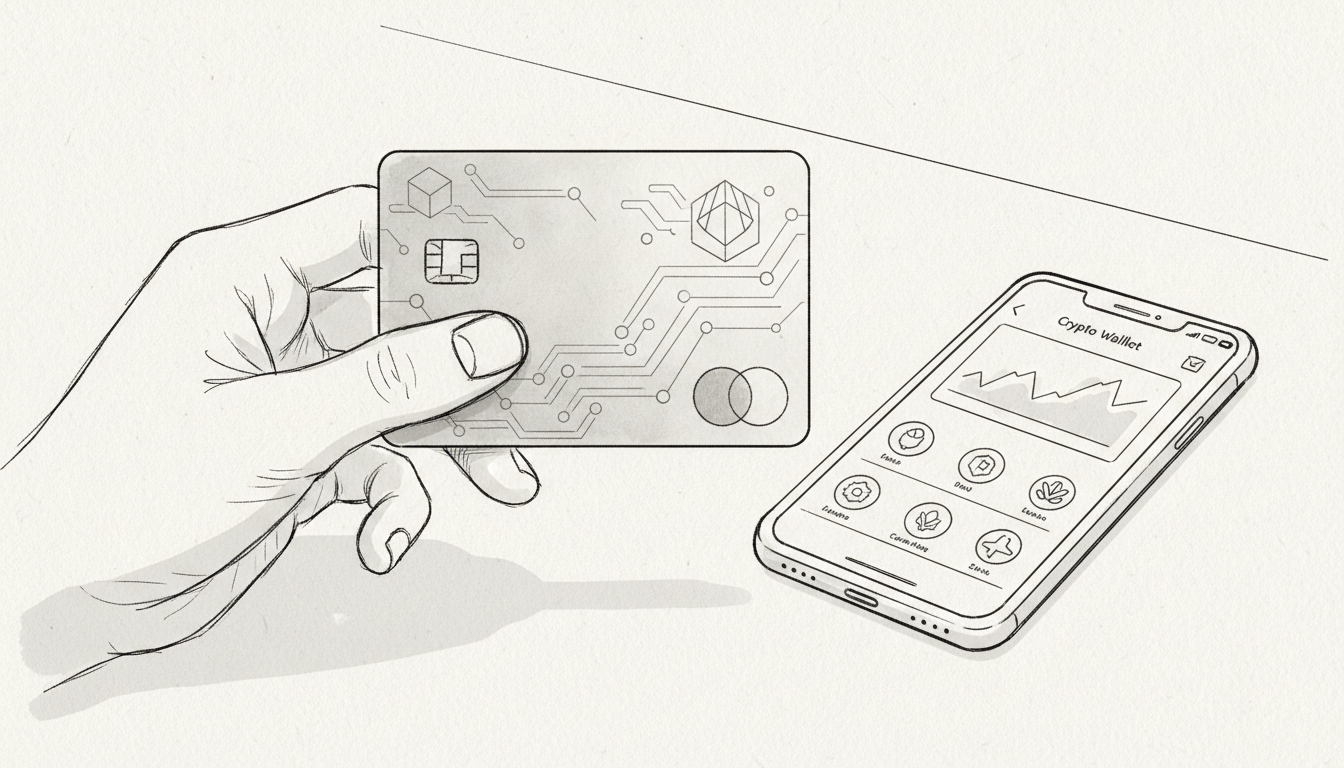
The OKX Card is a debit card linked to OKX Pay, the stablecoin wallet inside the OKX app. Your stablecoins stay in that wallet until you pay. At the moment of purchase, OKX converts them to the local currency and the merchant receives normal fiat.
There is no separate top-up step. If your OKX Pay balance holds USDC or USDG, the card can spend it.
In most regions the card is virtual. You add it to Apple Pay or Google Pay and pay by tapping your phone. OKX’s Brazil help page states plainly that it doesn’t issue physical cards there, and the European card is virtual-only too.
The design makes the OKX Card closer to a stablecoin spending account than a classic crypto card. It won’t sell your Bitcoin at checkout. You’d need to swap it to a supported stablecoin first.
That keeps costs low and avoids a taxable sale of a volatile coin at every purchase. It also means the card suits people who already think in dollars, not people who want to spend their altcoins.
Where the OKX Card Is Available in 2026
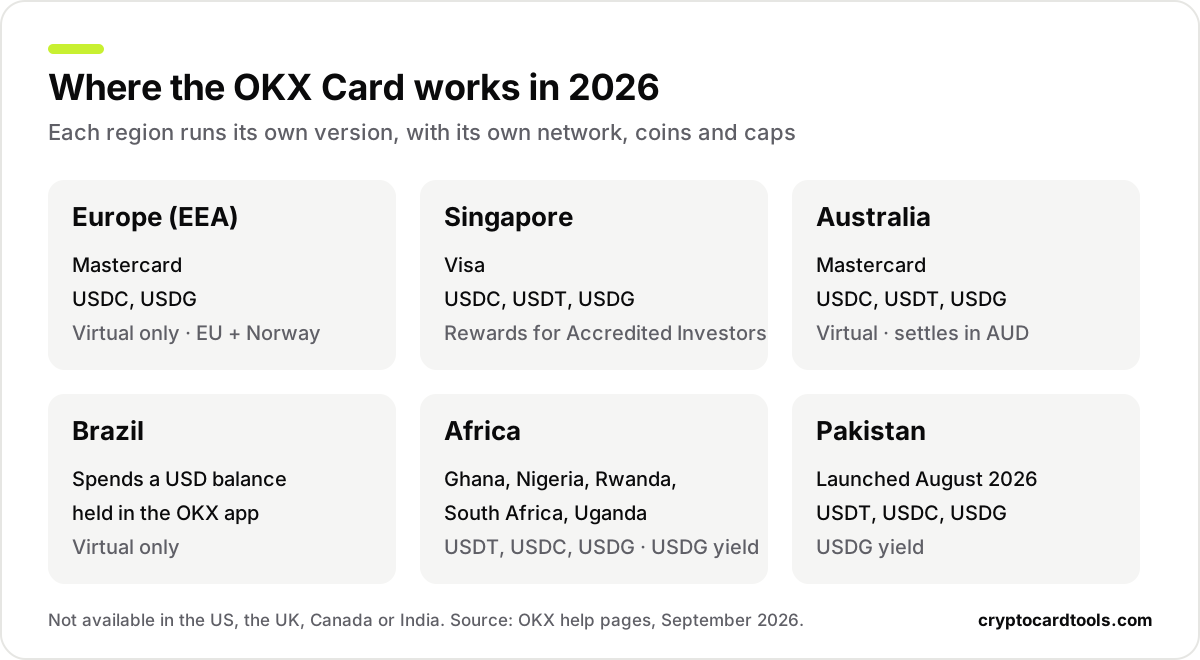
Each region runs its own version of the card, with its own network, coins and cashback caps.
Europe (EEA)
The European card launched on January 28, 2026. It covers every EU country plus Norway, and excludes Iceland and Liechtenstein.
OKX Europe runs it on the Mastercard network. It spends USDC and USDG only, because USDT isn’t supported under the EU’s MiCA rules.
Singapore
The Singapore card runs on Visa and spends USDC, USDT and USDG. Anyone eligible can use it, but cashback, subscription rebates and yield only go to Accredited Investors.
Australia
The Australian card is a virtual Mastercard that settles in Australian dollars. It spends USDC, USDT and USDG, with no issuance, monthly, annual or inactivity fees.
Brazil
OKX brought OKX Pay and its card to Brazil in late 2025. The card spends from a USD balance in the app, and it is virtual-only.
Africa and Pakistan
OKX launched the card in Ghana, Nigeria, Rwanda, South Africa and Uganda on July 22, 2026. Pakistan followed in August 2026.
These versions spend USDT, USDC and USDG. They also pay yield on USDG balances, which the European card doesn’t.
Where You Can’t Get It
The OKX Card isn’t available in the US, the UK or Canada. It also isn’t available in India, Indonesia or the rest of South Asia apart from Pakistan.
If you live in one of those countries, our crypto card finder shows the cards you can actually get. For Europe specifically, our best crypto card in Europe guide compares the main options.
OKX Card Fees
Fees are where the OKX Card is strongest. OKX charges no issuance fee, no monthly or annual fee and no foreign transaction fee.
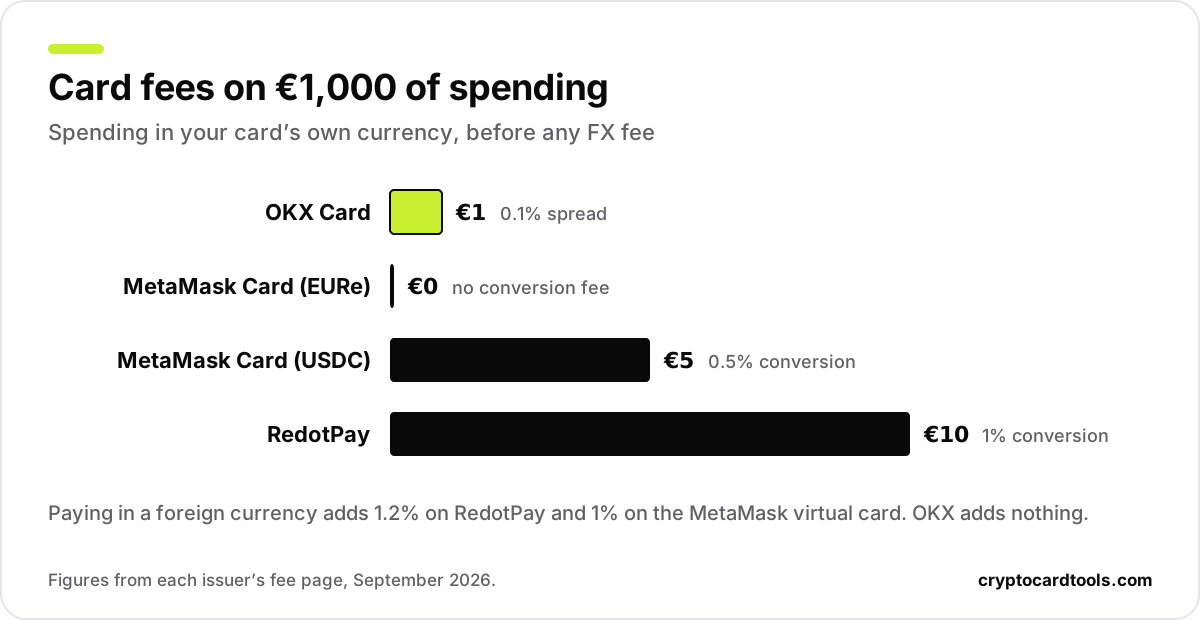
The only OKX charge is a 0.1% market spread when your stablecoin converts to fiat at checkout. On €1,000 of spending, that is about €1.
Paying in a foreign currency adds Mastercard’s or Visa’s own exchange rate for that conversion. OKX adds nothing on top.
A few regional details change the math slightly:
- Singapore: the 0.1% applies to every USDT payment, and to USDC or USDG only when you pay in Singapore dollars.
- Australia: the 0.1% applies when USDC, USDT or USDG converts to Australian dollars.
- Brazil: OKX says spending from the USD balance carries no additional markup.
For comparison, RedotPay charges a 1% conversion fee plus 1.2% on foreign-currency purchases. The OKX Card’s 0.1% is among the lowest conversion costs of any crypto card we track.
You can check what that difference means at your own spending level in our card cost calculator.
OKX Card Cashback: What You Will Actually Earn
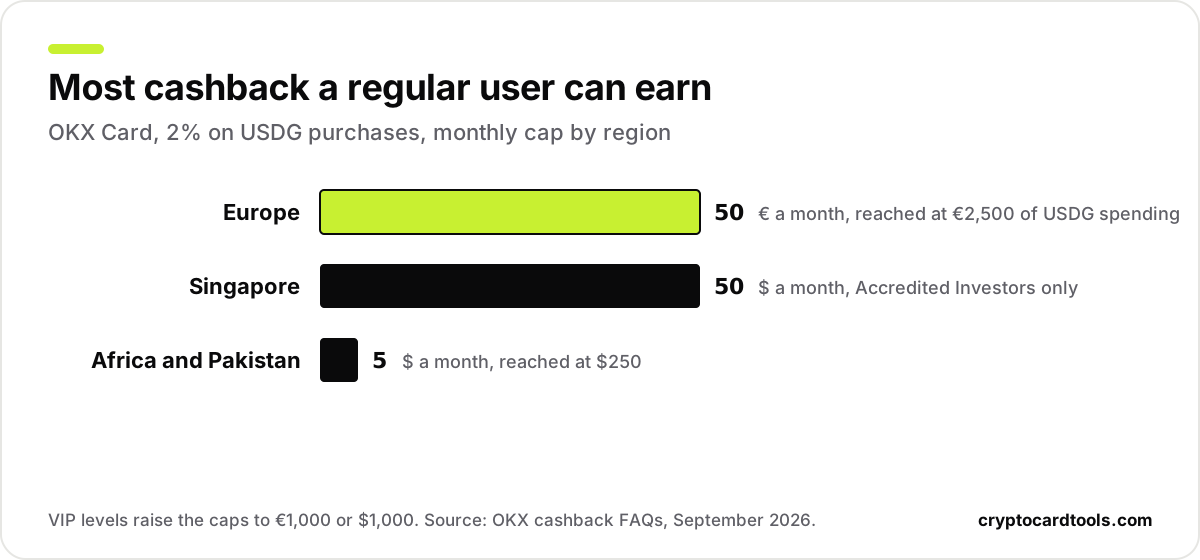
OKX advertises up to 10% cashback, and that figure is real. It is also tied to OKX’s VIP program and to monthly caps, so the rate regular users get is 2%.
Three rules shape every payout:
- Cashback is earned only on purchases paid with USDG. Paying with USDC or USDT earns nothing.
- It’s paid in USDG to your OKX Pay account, within 72 hours of settlement in Europe and 24 hours in Singapore.
- Each month has a cap, and once you hit it you stop earning until the next calendar month.
Europe Cashback Rates
The ongoing European program took effect on September 1, 2026:
- Regular users: 2%, capped at €50 a month
- VIP 1: 4%, capped at €300
- VIP 2: 4.5%, capped at €450
- VIP 3: 5%, capped at €1,000
- VIP 4 and above: 10%, capped at €1,000
A regular user reaches the €50 cap at €2,500 of monthly USDG spending. That makes the most a regular user can earn about €600 a year.
The “up to 20% cashback” you may have seen was a launch-period offer in Europe. It no longer applies.
Africa and Pakistan Cashback Rates
The caps here are much lower for regular users:
- Regular users: 2%, capped at $5 a month
- VIP 1: 4%, capped at $100
- VIP 2: 4.5%, capped at $200
- VIP 3: 8%, capped at $800
- VIP 4 and above: 10%, capped at $800
A regular user maxes out at $250 of monthly spending, so the cashback tops out at $60 a year.
The yield on USDG matters more here. OKX pays 4% APY to regular users and up to 10% for VIP 3 and above, on balances up to $10,000.
Singapore Cashback Rates
Singapore rewards only go to Accredited Investors:
- Regular: 2%, capped at $50 a month
- VIP 1: 4%, capped at $400
- VIP 2: 4.5%, capped at $600
- VIP 3: 5%, capped at $800
- VIP 4 and above: 10%, capped at $1,000
Accredited Investors can also get up to $20 a month back on eligible entertainment and lifestyle subscriptions.
Who Actually Gets VIP Rates
OKX VIP levels depend on your assets or trading volume, not on your card spending. Under OKX’s standard VIP rules, VIP 1 needs about $100,000 in assets or $1 million in 30-day spot trading volume.
VIP 3 needs about $2 million in assets, and VIP 4 about $5 million. The exact thresholds can differ between OKX’s regional entities.
For almost everyone reading this, the OKX Card is a 2% card with a monthly cap. That is still a good deal in Europe, where the cap covers €2,500 of spending. In Africa and Pakistan, the $5 cap makes the cashback close to symbolic.
What Doesn’t Earn Cashback
OKX excludes several merchant categories. In Europe the list includes cash withdrawals, money transfers, gambling, insurance, tax payments and donations.
Singapore adds top-ups, government payments, education, PayPal payments for trading, NETS and EZ-Link. Refunded purchases lose their cashback.
What Is USDG?
USDG (Global Dollar) is a US dollar stablecoin issued by Paxos. OKX promotes it heavily across OKX Pay.
That explains why cashback only applies to USDG purchases. OKX wants users to hold and spend USDG rather than USDC or USDT.
You can swap USDC or USDT to USDG inside the app before spending. For most users, that swap is the easiest way to switch cashback on.
Limits, ATM Access and Physical Cards
OKX doesn’t publish fixed spending limits for the European card. Its Singapore help page says you can spend your full available balance, while OKX’s risk review can reject a transaction.
ATM access is the clearest gap. The European, Australian and Brazilian cards are virtual-only, so there is no cash withdrawal at all. OKX’s African and Pakistani pages don’t mention ATM access either.
If you need cash in hand, a card with a physical version fits better. The RedotPay physical card and the MetaMask Metal card both allow ATM withdrawals.
How to Get the OKX Card
The process takes place entirely in the OKX app:
- Download the OKX app and create an account.
- Complete advanced identity verification with a valid ID and proof of address.
- Open OKX Pay and check the Card section. If your country is eligible, you’ll see the option to create a card.
- Create the virtual card and add it to Apple Pay or Google Pay.
- Move USDC or USDG into OKX Pay, or USDT where your region supports it.
- Swap to USDG if you want cashback, then pay by tapping your phone.
The card works anywhere the network accepts it, online or in shops. In Europe that means Mastercard, and in Singapore it means Visa.
Is the OKX Card Safe?
In Europe, the card is issued by UAB Monavate, an e-money institution authorised by the Bank of Lithuania. OKX Europe runs the card program and the Pay wallet behind it.
OKX Europe received a MiCA licence from Malta’s regulator in January 2025. In February 2026 it added a Malta payment institution licence that covers OKX Pay and the OKX Card.
OKX describes the Pay wallet as a self-custodial smart wallet. Your stablecoins stay under your control until a card payment settles, when OKX Europe converts the amount you spent and pays the card issuer.
The exchange’s history is mixed. In February 2025, OKX pleaded guilty in the US to operating an unlicensed money transmitting business and agreed to pay about $504 million in penalties.
In 2025 Malta’s financial intelligence unit also fined OKX about €1.1 million for anti-money-laundering failures in 2023. Both cases help explain why OKX now runs strict KYC on every card user.
On the positive side, OKX publishes monthly proof-of-reserves reports for customer assets.
The card itself still depends on OKX. You authorise OKX Europe to settle card payments from your Pay wallet, and a compliance review can suspend the card while it runs.
Keeping only spending money in OKX Pay limits that risk. Our card safety check scores the OKX Card on licensing, custody and incident history. The guide to crypto debit card risks covers the wider checks.
OKX Card vs Other Crypto Cards
OKX Card vs RedotPay
The OKX Card is cheaper to use. It has no card fee and a 0.1% spread, while RedotPay charges $10 for a virtual card, 1% conversion and 1.2% on foreign-currency spending.
OKX also pays 2% cashback for free, while RedotPay needs a $12.90 a month Pro plan for its 3%.
RedotPay wins on reach and cash. It works in 100+ countries, offers a physical card with ATM access and spends BTC and ETH directly. The full breakdown is in RedotPay vs OKX Card, and my RedotPay review covers it in depth.
OKX Card vs MetaMask Card
Both cards work in Europe, so this is a real choice for EU users. The MetaMask Card spends from your own MetaMask wallet, with no exchange account involved.
MetaMask pays 1% cashback in mUSD without caps on its free card. OKX pays 2% up to €50 a month.
MetaMask charges 0.5% when your stablecoin doesn’t match the spending currency and 1% on cross-border purchases, so OKX is cheaper per transaction. See MetaMask Card vs OKX Card.
OKX Card vs Crypto.com Visa Card
Crypto.com’s free prepaid tier pays 0% cashback, and its entry Midnight card in Europe charges 2% on non-EUR spending outside the EU and the UK. Better rates need a 12-month CRO lockup.
OKX needs no lockup for its 2%, and its FX cost is far lower. Crypto.com wins if you live in the US or want a physical card. The comparison is in Crypto.com Visa Card vs OKX Card.
OKX Card vs KAST
KAST’s free tier pays 1.5% on the first $2,000 a month, and KAST says it works in 170+ countries, including the US. Its FX fee ranges from 0.5% to 1.75%.
OKX is cheaper per purchase and pays more on its capped amount. KAST wins on coverage and has a physical card option. See KAST Card vs OKX Card.
OKX Card Pros and Cons
Pros
- No card, monthly, annual or foreign transaction fees from OKX
- A 0.1% conversion spread, among the lowest of any crypto card
- 2% USDG cashback for regular users, with no staking or lockup
- Instant virtual card with Apple Pay and Google Pay
- Issued in Europe by an EU e-money institution, with OKX Europe licensed under MiCA
- Stablecoins stay in a self-custodial Pay wallet until you pay
- Yield on USDG balances in Africa and Pakistan
Cons
- Cashback only on USDG purchases, with a €50 monthly cap in Europe and $5 in Africa and Pakistan
- The 10% rate needs VIP status, which starts around $100,000 in assets
- No ATM withdrawals in Europe, Australia or Brazil
- No USDT spending in Europe
- Not available in the US, the UK, Canada or India
- A compliance review can suspend the card
- Singapore rewards are limited to Accredited Investors
Who Should Get the OKX Card
The OKX Card fits European stablecoin holders best. You pay almost nothing to spend, and €2,500 of monthly USDG spending earns the full €50 cashback.
Existing OKX users anywhere the card is live have an easy reason to try it. It costs nothing to create, and your balance is already in the app.
People who need cash withdrawals, a physical card or US availability should look elsewhere. So should anyone who wants to spend BTC or ETH directly.
In Africa and Pakistan, the card is a low-cost way to spend dollars. The main attraction there is the USDG yield, not the capped cashback.
Final Verdict
The OKX Card is one of the cheapest ways to spend stablecoins in 2026. A 0.1% spread with no card or FX fee beats almost every competitor on cost.
The cashback story is weaker than the marketing suggests. For regular users it is a capped 2%, and only on USDG.
If you live in Europe and hold stablecoins, it is worth adding to your phone today. If you need cash, plastic or coverage outside its regions, RedotPay, MetaMask or KAST will serve you better.
Get the OKX Card
If you live in a supported country, you can create the virtual card from OKX Pay in the OKX app. Our OKX Card page keeps the full fee table, cashback tiers and country list up to date.
Get the OKX Card OKX Card fees and limits
The crypto card finder lists every card offered in your country if the OKX Card isn’t available there.
Frequently asked questions
Is the OKX Card available in the USA?
Is the OKX Card available in India?
Is the OKX Card free?
What is the OKX Card cashback limit?
Does the OKX Card still offer 20% cashback?
Which crypto can I spend with the OKX Card?
Can I withdraw cash from an ATM with the OKX Card?
Does the OKX Card work with Apple Pay and Google Pay?
Is the OKX Card a debit or credit card?
Is the OKX Card safe?
Sources
Related tools
Keep reading
Bybit Card Review 2026: Fees, Cashback, and Availability
Read our Bybit Card review for 2026. See cashback tiers, staking requirements, fees, and where it's available. Get the facts before you apply.
The Complete Guide to Binance Card: Features, Benefits, and How to Get Started in 2025
Important Notice: As of the recent update, the Binance Card is temporarily unavailable. According to latest sources, Binance has stated they will be resuming

MetaMask Card Review 2026: Fees, Cashback, Countries and Limits
Honest MetaMask Card review: 2026 fees, 1% to 3% mUSD cashback, the 45 countries where it works, the US and UK sign-up pause, limits and self-custody risks.
