Bybit Card Review 2026: Fees, Cashback, and Availability
Contents
- What is the Bybit Card and How It Works
- Bybit Card Availability and Eligibility in 2026
- Card Tiers, Cashback, and Spending Requirements
- Bybit Card Fees: The Complete Breakdown
- Supported Cryptocurrencies and Conversion Mechanics
- Security and Risks of the Bybit Card
- How to Apply, Activate, and Top Up Your Bybit Card
- Bybit Card vs. Binance Card
- Frequently asked questions
Quick answer
The Bybit card is a Mastercard debit card that spends your cryptocurrency, converting it to fiat automatically at the point of sale. The virtual card is free, carries no annual fee, and pays 2% to 10% cashback in USDT with monthly caps on the reward. It charges a 0.9% crypto conversion fee and 2% on foreign transactions. Bybit's own card page says the card is not offered to EEA residents, so it is not available in the EU, the US, or the UK. Its fee schedule covers Australia, Georgia, Kazakhstan, Mexico, and an unlisted set of other Asia Pacific markets, while Argentina, Brazil, and Peru run separate fee schedules. It suits existing Bybit users in those markets best.
Key takeaways
- As of 2026, the Bybit card is not offered in the EEA, the US, or the UK. It is available in Australia, Georgia, Kazakhstan, Mexico, and other unspecified Asia Pacific markets, with separate programs in Argentina, Brazil, and Peru. KYC is required everywhere it operates.
- Cashback runs from 2% to 10% in USDT, but the monthly reward caps range from just $5 on the base tier to $600 on the highest.
- There is no annual fee, but crypto conversion costs 0.9%, foreign transactions cost 2%, and ATM withdrawals beyond $100 a month cost 2%.
- Your crypto stays in Bybit's custody, the same exchange that lost roughly $1.5 billion in ETH to a 2025 hack.
What is the Bybit Card and How It Works
The Bybit card is a crypto debit card issued by Bybit on the Mastercard network. It links to your Bybit exchange account, not a separate wallet. That is the same account you would use for Bybit’s derivatives, which we cover in our guide to the top perp exchanges. When you pay at a shop or online, the card sells the crypto you select and sends fiat to the merchant. The process is automatic and takes seconds.
You hold assets on the Bybit exchange, and the card pulls from that balance when you pay. There is no separate card wallet. You manage everything from the Bybit app: freeze the card, set limits, and see each spend. Cashback lands in USDT after the transaction settles. The card has no annual fee. This model is standard for exchange-linked cards. You can check Bybit's official card page for current terms.
Bybit Card Availability and Eligibility in 2026
Bybit's own card page states that the card is not offered to residents of the European Economic Area. That rules out the EU, Iceland, Liechtenstein, and Norway. It is also not available in the US or the UK.
Bybit's help center fee table lists the same fees for Australia, Georgia, Kazakhstan (through the AIFC), Mexico, and an "Asia Pacific" card whose eligible countries Bybit does not publish. Argentina, Brazil, and Peru run their own fee schedules that this review does not cover. If your country isn't named here, the Bybit app's own eligibility check is the only reliable way to confirm access.
To order the card, you need KYC Level 2 verification on Bybit. That means submitting a government ID and proof of address. Level 1 is not enough. If you want a card without identity checks, look at no-KYC crypto debit cards. Expect higher fees and lower limits there. Regulatory pressure has pushed most exchange-linked cards into strict KYC territory, and Bybit is no exception.
Card Tiers, Cashback, and Spending Requirements
Bybit's reward program runs six tiers, paid in USDT. Each tier carries its own rate and its own monthly reward cap, and the higher tiers require a minimum monthly spend rather than staking BYBIT.
- Tier 1 (Base): 2% cashback, capped at $5 a month. No minimum spend.
- Tier 2 (Beta): 2% cashback, capped at $50 a month, from $500 in monthly spend.
- Tier 3 (Alpha): 4% cashback, capped at $150 a month, from $3,500 in monthly spend.
- Tier 4 (Apex): 6% cashback, capped at $250 a month, from $9,500 in monthly spend.
- Tier 5 (Omega): 8% cashback, capped at $400 a month, from $12,500 in monthly spend.
- Tier 6 (Infinite): 10% cashback, capped at $600 a month, from $25,000 in monthly spend.
The advertised 10% rate only applies once you spend tens of thousands of dollars a month. On the base tier, the $5 monthly cap makes the cashback close to symbolic.
For a typical user, the 0.9% conversion fee and the 2% foreign transaction fee outweigh the rewards. The card pays off mainly if you already use Bybit and spend enough to climb the tiers.
Bybit Card Fees: The Complete Breakdown
There is no annual or monthly fee. That part is true. But you will pay other fees, listed on Bybit's official card fee schedule for Mexico and the rest of the Asia Pacific region.
- Issuance fee: the virtual card is free. The physical card costs $5.
- Crypto conversion: 0.9% when the card sells your crypto to pay.
- Foreign transaction fee: 2% on every purchase in a currency other than your card's base currency.
- ATM withdrawals: the first $100 a month is free. After that, a 2% fee applies.
If you spend $1,000 in a foreign currency, you pay about $9 in conversion plus $20 in foreign transaction fees, roughly $29 total. The same purchase in your own currency costs about $9. For a clear fee ranking, see the best crypto cards ranked by fees.
Supported Cryptocurrencies and Conversion Mechanics
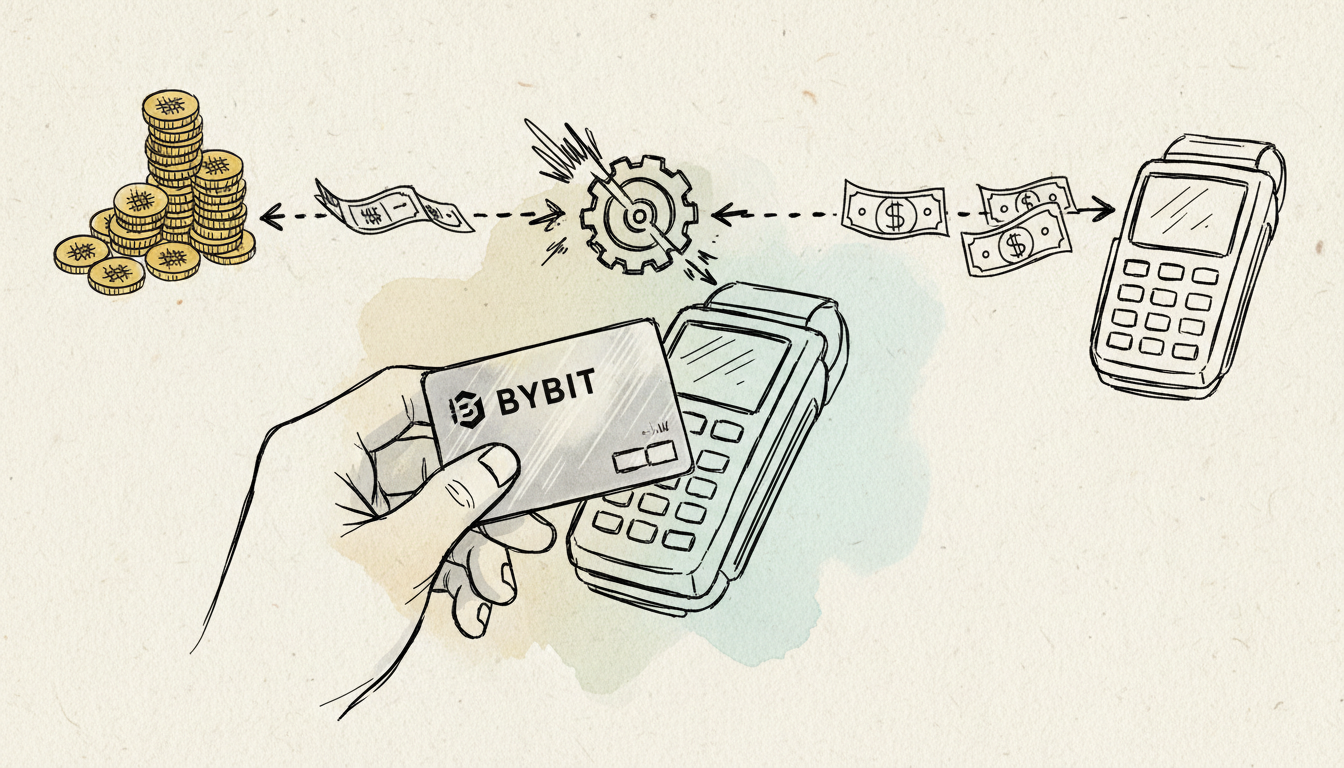
The Bybit card supports BTC, ETH, USDT, USDC, and several other assets, with the full list and networks shown in the app. You choose which asset the card spends from, and you can change it anytime.
When you make a purchase, the card automatically sells that asset for fiat at the point of sale. You do not pick the exact conversion moment. Bybit executes the trade when the merchant authorizes the payment, which may be seconds or minutes after you tap. That means you are exposed to price movement between authorization and settlement. Most card programs handle this the same way. If you spend a volatile asset like BTC, the fiat amount charged may differ slightly from the tapped value.
Security and Risks of the Bybit Card
The card has basic security features: you can freeze it instantly from the app, and 3D Secure is enabled for online purchases. A virtual card is available for safer online spending. Those are good baseline controls.
The bigger risk is where your funds sit. Your crypto is held on the Bybit exchange, not in a segregated card wallet. If Bybit is hacked or becomes insolvent, your card balance is at risk. This isn't a hypothetical. In February 2025, about $1.5 billion in ETH was stolen from a Bybit cold wallet, and the FBI attributed the theft to North Korean actors. There is no deposit insurance for crypto held on an exchange.
These funds are not protected like a bank deposit. The exchange can freeze or lose them without government deposit insurance.
Bybit's public help pages also don't name the issuer of the Asia Pacific card. In my work with DeFi and privacy projects, the principle is clear: not your keys, not your coins. RedotPay, which I cover in my ReDotPay card review, is custodial too, but it does publish its licensing. If you want funds in a self-custodial wallet instead, the MetaMask Card accepts sign-ups in Mexico, one of the few markets where the Bybit card also operates.
How to Apply, Activate, and Top Up Your Bybit Card
- Download the Bybit app and create an account.
- Complete KYC Level 2 verification with a government ID and proof of address.
- Go to the Card section and order a virtual card. It is available instantly.
- Order a physical card if you need one. It costs $5.
- To top up, convert crypto from your spot balance to the card balance using the app.
There is no separate top-up step for most users. The card draws directly from your spot account, so you just need to hold crypto there. If you want to set a spending limit, do it in the app before your first purchase.
Bybit Card vs. Binance Card
Neither card is offered in the EU, where Binance stopped offering new crypto services on July 1, 2026. In markets where both operate, such as Mexico, the basic fees look similar: both charge a 0.9% crypto conversion fee and 2% on foreign transactions.
The difference shows up in cashback and ATM terms. Binance Card pays 1.5% to 3% without staking, capped at $100 a month, and charges 0.1% to convert USDC. Bybit pays 2% on its base tier, but caps the reward at just $5 a month. On ATM access, Binance gives two free withdrawals a month, while Bybit gives $100 free a month. Where both cards exist, the decision often comes down to which exchange you already trust with your funds. Our Binance Card review covers its fees and countries, and our Bybit vs. Binance comparison lines up both cards side by side.
Frequently asked questions
How do I get a Bybit card?
Download the Bybit app, complete KYC Level 2 verification, then order the card from the Card section. A virtual card is issued instantly. The physical card costs $5 and arrives within a few weeks.
What are the fees for the Bybit card?
There is no annual or monthly fee. Crypto conversion costs 0.9%, and foreign transactions cost 2%. ATM withdrawals are free up to $100 a month, then cost 2%.
In which countries is the Bybit card available?
Bybit's fee table covers Australia, Georgia, Kazakhstan, Mexico, and an Asia Pacific card whose countries it does not list. Argentina, Brazil, and Peru have their own fee schedules. It is not offered to EEA residents, and it is not available in the US or the UK.
What cryptocurrencies can I spend with the Bybit card?
You can spend BTC, ETH, USDT, USDC, and several other assets. The full list is in the app. You choose one asset as the spending source and can change it anytime.
Does the Bybit card offer cashback or rewards?
Yes. Cashback ranges from 2% to 10% in USDT depending on your tier, with monthly reward caps from $5 on the base tier up to $600 on the highest.
Is the Bybit card safe to use?
The card has freezing and 3D Secure features, but your crypto sits on the Bybit exchange, which lost about $1.5 billion in a 2025 hack. If the exchange is hacked or fails, your card balance is at risk. There is no deposit insurance.
Frequently asked questions
How do I get a Bybit card?
What are the fees for the Bybit card?
In which countries is the Bybit card available?
What cryptocurrencies can I spend with the Bybit card?
Does the Bybit card offer cashback or rewards?
Is the Bybit card safe to use?
Related tools
Keep reading
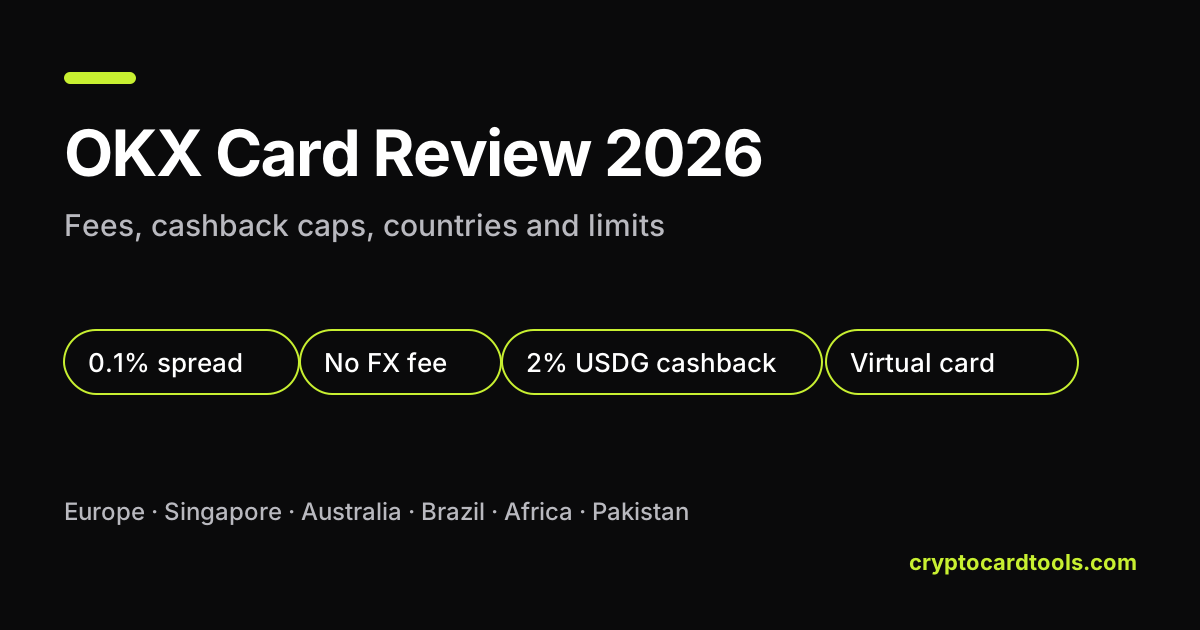
OKX Card Review 2026: Fees, Cashback, Countries and Limits
OKX Card review for 2026: 0.1% spread, 2% to 10% USDG cashback and its real monthly caps, every country it works in, and who should skip it.
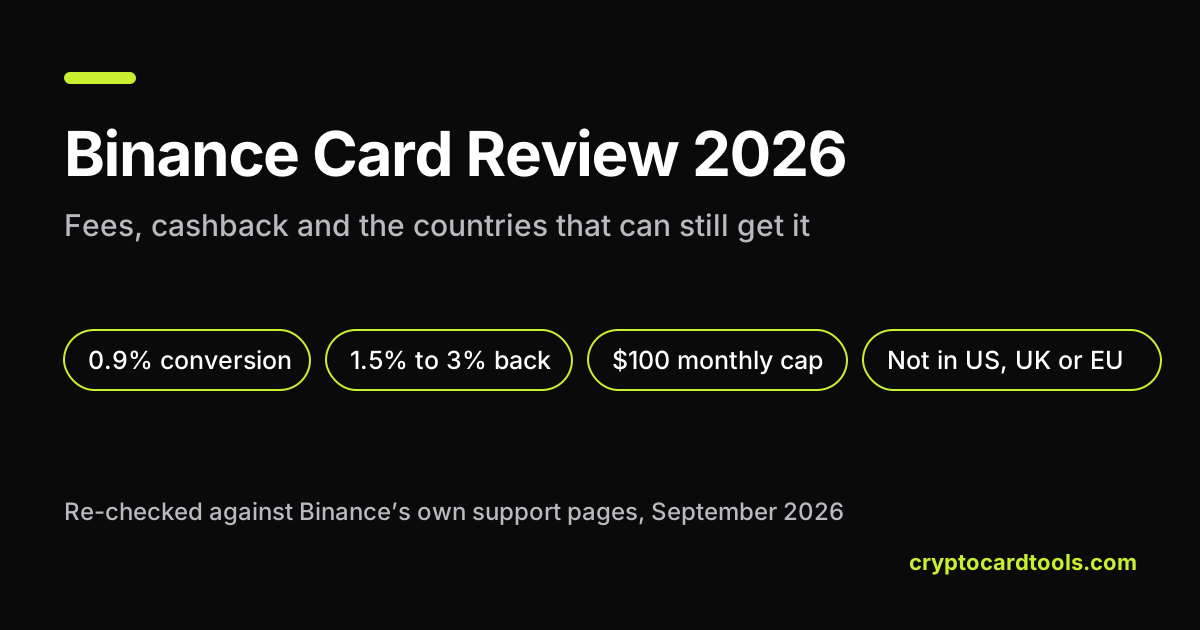
Binance Card Review 2026: Fees, Cashback and the Countries That Can Still Get It
Binance Card review for 2026: 0.9% conversion and 2% to 3% FX fees, 1.5% to 3% cashback capped at $100, where it works, and who should skip it.
MetaMask Card Review 2026: Fees, Cashback, Countries and Limits
Honest MetaMask Card review: 2026 fees, 1% to 3% mUSD cashback, the 45 countries where it works, the US and UK sign-up pause, limits and self-custody risks.
