Top No-KYC Crypto Cards, Brutally Reviewed
Contents
- What “No KYC” Actually Means on a Crypto Card
- Why Truly Anonymous Crypto Cards Disappeared
- No-KYC Crypto Cards That Still Exist in 2026
- What a No-KYC Card Really Costs
- The Real Risks of No-KYC Crypto Cards
- Red Flags of a No-KYC Crypto Card Scam
- Privacy vs Anonymity: What KYC Actually Exposes
- Better Options If You Want Privacy
- If You Can’t Complete KYC at All
- What Happens Next for No-KYC Cards
Crypto debit cards let you spend stablecoins and bitcoin at more than 100 million merchants that accept Visa or Mastercard. For people paid in crypto, they are often the fastest way to turn a wallet balance into groceries, rent or a flight.
Getting one usually means handing over a passport scan, a selfie and sometimes proof of address. That identity check is called KYC (know your customer). Your documents then sit with the card company, its verification vendor and its card issuer, and a leak at any of them exposes the same personal data.
If you care about financial privacy, that trade can feel wrong. The same goes if you live in a country most issuers refuse to serve, or simply don’t have the documents they ask for. Looking for a crypto card without KYC is a reasonable place to start.
But the no-KYC crypto debit card market in 2026 is small, expensive and fragile. The few cards that still open without ID cap you at low spending limits and charge heavy top-up fees. They can also demand full verification at any point, sometimes while your money is sitting on the card.
In February 2026, Mastercard shut down most of the cards run by UnCash, one of the best-known anonymous crypto card services. The EU will ban anonymous crypto accounts outright from July 2027.
I first wrote this guide in April 2025. For this update, I checked each provider’s own pages and the regulations behind them in September 2026.
Quick answer: Fully anonymous crypto debit cards no longer exist at useful limits, and no no-KYC card we checked in September 2026 cleared our bar for a real operating company, published terms and a clean track record. A few, such as SolCard, Kripicard and BingCard, still issue a virtual card without a photo ID, but each fails one of those checks.
Deposit and transaction fees on the ones that still work run a percent or more, spending caps stay low, and there is a real risk of frozen funds or forced verification later. Physical cards, higher limits and ATM access almost always require full KYC.
For most people, a fast-KYC card or a self-custody card protects privacy better than a no-KYC card that can close without warning.
What “No KYC” Actually Means on a Crypto Card
A crypto debit card is a normal Visa or Mastercard payment card with a crypto balance behind it. Every one of them runs through a licensed card issuer, and that issuer is legally responsible for knowing who its customers are. Our guide on how a crypto debit card works explains that chain in detail.
So when a card company advertises “no KYC”, it rarely means the issuer has no idea who you are. The label usually covers one of four setups:
- Email-only onboarding. You sign up with an email address and get a virtual card, but only up to a low monthly limit. Providers often market this as tiered or minimal verification.
- Deferred verification. The card works at first, then asks for ID once you hit a spending threshold, order a physical card or request a refund.
- Verification by a partner. The app collects nothing, but a partner bank or program manager checks you behind the scenes.
- Resold cards. The operator passes out cards that were issued in its own company’s name. This is the model that tends to collapse.
Only the first one is a real no-KYC crypto card, and only within tight limits. The line between “no KYC” and “full KYC” is really a question of how much you want to spend.
That distinction also separates two different searches. Buying crypto with a card without KYC is an on-ramp question, which our guide to the cheapest crypto onramp covers. Spending crypto through a no-KYC card is a card question, and it is the subject of this guide.
Why Truly Anonymous Crypto Cards Disappeared
Anonymous cards didn’t vanish because issuers lost interest. They were regulated out of existence, one threshold at a time.
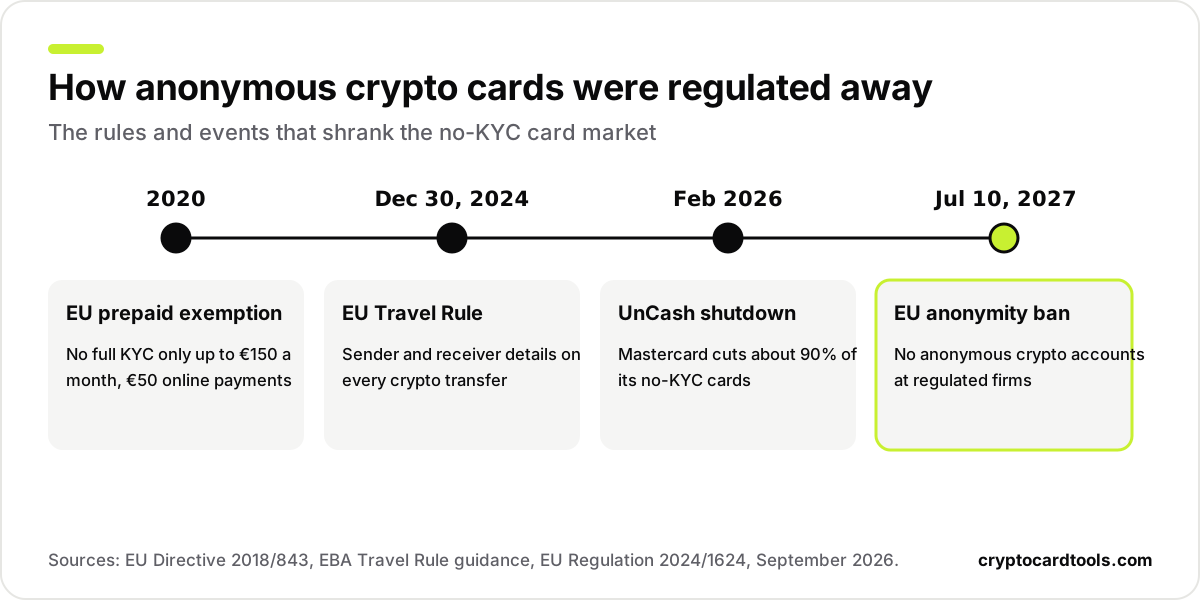
In the EU, anti-money-laundering law has allowed a narrow exemption for prepaid cards since 2020. An issuer can skip full identity checks only if the card is non-reloadable or limited to €150 of payments a month. Cash withdrawals and online payments above €50 are excluded from that exemption.
That €150 ceiling is why EU prepaid cards with email-only onboarding can exist, and why their limits are so small. It also means a no-KYC card promising thousands of euros a month is not using the exemption.
Crypto transfers themselves are now traced too. Since December 30, 2024, EU crypto service providers must attach sender and receiver details to every crypto transfer, with no minimum amount. Transfers above €1,000 to or from a self-hosted wallet trigger extra checks.
In the US, prepaid card providers must collect a customer’s name, date of birth, address and ID number. The exemptions are narrow: low-value cards of up to $1,000 a day that can’t send money abroad, transfer between users or reload from non-bank sources. Crypto top-ups are hard to fit within those conditions.
That is why nearly every no-KYC crypto card excludes US residents entirely.
Visa and Mastercard add their own layer. They can trace any card back to its issuing bank through the first digits of the card number. When they find a program handing out cards to unverified users, they can switch it off.
No-KYC Crypto Cards That Still Exist in 2026
On September 29, 2026, we checked 27 providers that advertise a no-KYC crypto card against a minimum bar: a working site with published fees and terms of service, an identifiable operating company, a virtual card that genuinely issues without a photo ID, roughly a year or more of operating history, and no credible reports of frozen balances or exit scams.
None of them cleared that bar well enough for us to list here as a working no-KYC card. Below is what stopped the closest attempts, rather than a recommendation we can’t stand behind.
SolCard
Established press (The Defiant) reported that unverified users lost access to their virtual cards once SolCard tightened its KYC policy. Its pricing page no longer shows a numeric fee for any tier, so there is nothing current to verify a top-up cost or monthly limit against.
Kripicard
Kripicard doesn’t name an operating company anywhere on its site. Without a legal entity behind the card, there’s no one to hold accountable if a balance gets frozen or the service disappears.
BingCard
BingCard’s site names only “Bingcard, Inc.”, with no jurisdiction or registration number attached to that name.
LinkPay
LinkPay came closest to passing. Its terms name Avior Financial Holdings Limited, registered in Richmond, British Columbia, with a Canadian money-services-business registration. Its free plan charges 1% on deposits and 2% per transaction, with a $2 minimum. But its terms don’t name the card network or the issuing bank, and route some services through a separate company registered in Seychelles.
Most of the rest fall into a handful of patterns: virtual-card resellers built for ad accounts, cards issued through Telegram bots, sites only a few months old, mirror domains of an earlier shut-down service, or a “no-KYC” pitch that the provider’s own anti-money-laundering policy contradicts by demanding full ID anyway.
Where the No-KYC Path Usually Ends
Across the providers we checked, the same events tend to trigger a request for ID:
- Ordering a physical card
- Asking for a higher spending limit
- Adding the card to Apple Pay or Google Pay on some programs
- Requesting a refund or withdrawing an unused balance
- Unusual activity that sets off an automated compliance review
A no-KYC crypto card is best treated as a starting condition, not a permanent one. If you can’t verify when the request comes, the balance on the card is the money at risk.
What a No-KYC Card Really Costs
Skipping KYC is rarely free. The fees on no-KYC virtual cards are higher because the issuer carries more risk and serves fewer users.
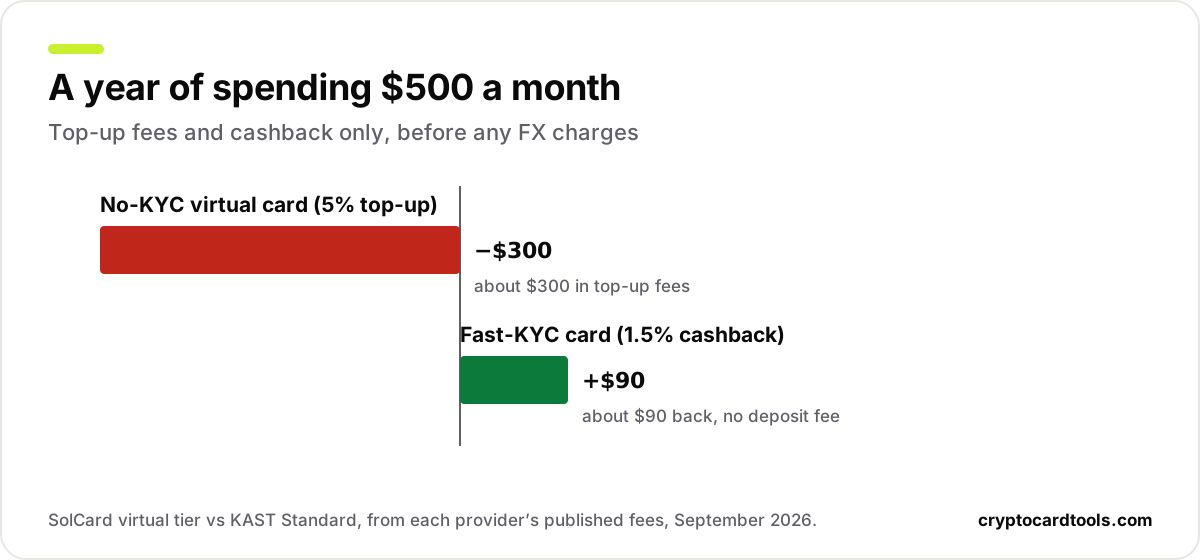
Take $500 a month of spending, split into ten $50 purchases. On LinkPay’s free plan, the closest provider to passing our checks, loading the card costs 1%, or $5. Each purchase then costs 2% with a $2 minimum, which adds $20. That comes to $25 a month, or $300 a year, before any FX charges.
The same $500 on KAST, which verifies you in a couple of minutes, deposits stablecoins with no fee and pays 1.5% cashback. That is roughly $90 a year back instead of $300 out, a gap of about $390.
You can run your own numbers in our card cost calculator. Our ranking of the best crypto cards shows what fully verified cards cost at $1,000 a month.
The Real Risks of No-KYC Crypto Cards
Fees are the visible cost. The bigger risks show up only when something goes wrong.
Frozen funds and forced KYC. An automated flag for suspicious activity can freeze a no-KYC account and demand documents. If you can’t provide them, the balance can stay locked until the issuer decides how to return it. Users who skip KYC to protect their privacy can end up sending more documents during a review than they would have at sign-up.
Sudden shutdowns. No-KYC operators don’t own the payment rails they use. When a card network or sponsor bank pulls a program, every card on it stops at once. UnCash, which sold no-KYC virtual cards funded with crypto, lost about 90% of its cards when Mastercard cut them off in February 2026. It told users that cards would close immediately and balances would be refunded on its own timeline.
Weak fraud protection. Chargebacks and fraud claims depend on the issuer confirming who you are. On an unverified account, a stolen card number can be very hard to dispute.
Legal exposure. Using a card isn’t illegal because it skipped KYC. But a card that exists by breaking card network rules can disappear, and your tax obligations don’t change either way. Our crypto card tax guide covers what you owe when you spend.
Our guide to crypto debit card risks covers these checks for every type of card, and our card safety check scores individual cards on licensing and custody.
Red Flags of a No-KYC Crypto Card Scam
The same pressure that shut down real no-KYC cards has created fake ones. These signs point to a scam rather than a thin but genuine service:
- Support only through Telegram or Discord, with no company name, address or registration details
- Claims to “bypass” Visa or Mastercard rules
- High limits, such as $50,000 a month, with no ID at all
- Payment required upfront in crypto before a card exists
- No named card issuer, card program or track record you can check
- Small first withdrawals that work, followed by a freeze once you deposit more
If a provider shows two or more of these, keeping your money away from it is the safer choice.
Privacy vs Anonymity: What KYC Actually Exposes
Privacy and anonymity are different goals, and a no-KYC card delivers less of either than it seems.
A card never shows merchants your wallet address or your identity documents. The merchant sees a card number and a name field, just as with any bank card. Your ID stays with the issuer and its verification partners.
The blockchain trail is the bigger leak. If you bought your crypto on an exchange that verified you, the transfer from that exchange to a card top-up address is public. Anyone who links the two can connect your identity to your card spending, whatever the card asked for at sign-up.
For most people, the real privacy question is how many companies hold their documents and their money. A no-KYC card reduces the first but increases the risk around the second, which is why the custody model matters as much as the KYC level.
Better Options If You Want Privacy
If you want to share less data and control more of your money, these routes tend to work better than a no-KYC card.
A self-custody card. The MetaMask Card and ether.fi Cash still require KYC, but your funds stay in your own wallet until you pay. Neither company can freeze your wallet, and there is no custodial balance to lose if the provider fails. Our self-custody cards guide covers more of these, and our cold wallet guide covers keeping the rest of your crypto offline.
A fast, light KYC card. KAST verifies users in a couple of minutes. RedotPay asks only for an ID and a face scan, with no proof of address. Both keep the paperwork short without the shutdown risk of an unverified program.
Crypto gift cards for specific merchants. Buying a merchant gift card with crypto keeps your card details and documents away from that merchant entirely. It works for planned purchases such as groceries, travel or app stores, within each seller’s own limits.
A separate wallet for card top-ups. You can fund your card from a dedicated wallet instead of straight from an exchange. That keeps the rest of your holdings off the card provider’s radar.
None of these makes you anonymous, but together they limit how much of your financial life any single company can see. The crypto card comparison puts the KYC level, custody model and fees of each card side by side.
If You Can’t Complete KYC at All
Some readers aren’t avoiding KYC by choice. Their country is excluded, or the issuer doesn’t accept their documents.
Others don’t have a bank account, which many verified cards don’t need anyway. RedotPay and KAST, for example, ask for an ID but no bank details.
Country exclusions change often, so a card that rejected you last year may accept you now. Our crypto card finder filters cards by the country you live in. The best crypto cards list includes picks for India, Pakistan, the UAE and Nigeria.
If no card works where you live, cashing out through a regulated exchange or P2P market may be the more practical route. Our guide to the best crypto offramp compares those options by cost.
What Happens Next for No-KYC Cards
The space for no-KYC crypto cards will keep shrinking, and one date now shapes it.
From July 10, 2027, the EU’s Anti-Money Laundering Regulation bans banks, payment firms and crypto service providers from keeping anonymous accounts, including anonymous crypto accounts. It also stops regulated platforms from handling privacy coins such as Monero and Zcash. Shielded Zcash can still be held in a self-custody wallet, and our guide to the best ZEC wallets covers which ones work after the 2026 upgrade.
The EU’s current prepaid exemption comes from the Fifth Anti-Money Laundering Directive, which set the €150 monthly and €50 online-payment limits. The EBA’s Travel Rule guidance explains how crypto transfers are traced.
In the US, the rules come from FinCEN’s prepaid access rule. Card networks are also watching the resale model more closely after the UnCash shutdown.
The more likely future is less data rather than no data: verification that proves you passed a check without handing every company your passport. Until that arrives, a short KYC with a trustworthy issuer is the most durable way to spend crypto privately.
Frequently asked questions
Is there a crypto debit card with no KYC?
Are no-KYC crypto cards legal?
What is the best no-KYC crypto card?
Can I get a no-KYC crypto card with Apple Pay?
Can I get a physical crypto card without KYC?
Is there a no-KYC crypto card in the USA?
Is there a no-KYC crypto card in Europe or the UK?
Is there a no-KYC crypto card in India?
Does RedotPay require KYC?
Does Crypto.com require KYC?
Will no-KYC crypto cards come back?
Sources
Related tools
Keep reading
OKX Card Review 2026: Fees, Cashback, Countries and Limits
OKX Card review for 2026: 0.1% spread, 2% to 10% USDG cashback and its real monthly caps, every country it works in, and who should skip it.
Bybit Card Review 2026: Fees, Cashback, and Availability
Read our Bybit Card review for 2026. See cashback tiers, fees, and the countries where it's actually available. Get the facts before you apply.
Binance Card Review 2026: Fees, Cashback and the Countries That Can Still Get It
Binance Card review for 2026: 0.9% conversion and 2% to 3% FX fees, 1.5% to 3% cashback capped at $100, where it works, and who should skip it.