Best Crypto Card for Travel in 2026: 12 Cards Priced on One Trip
Contents
- Quick Answer: The Best Crypto Card for Travel
- The Best Crypto Cards for Travel in 2026
- What a Two-Week Trip Costs on Each Card
- Wirex One: Best Overall for Travel
- Bleap: 0% FX and €400 of Free ATM Cash a Month
- Tria: Best for Cashback While Abroad
- OKX Card: Best Phone-Only Card in the EU
- Gemini Credit Card: Best for US Travellers
- Kosh and RedotPay: When Cheaper Cards Aren't Available
- Crypto Cards That Look Cheap but Cost More Abroad
- Crypto Cards With Airport Lounge Access
- Dynamic Currency Conversion: Always Pay in the Local Currency
- Visa or Mastercard for Travel Abroad?
- Crypto Card Hotel Deposits and Car Rental Holds
- Crypto Card ATM Fees Abroad: Two Fees, Not One
- Using a Crypto Card Abroad: Your Residence Decides the Card
- Funding the Card Before You Fly
- Before You Fly: A Crypto Card Checklist
- Which Card for Which Trip
- Best Crypto Card for Travel: The Verdict
Crypto cards let you pay abroad with stablecoins or other crypto you already hold, without selling on an exchange and waiting for a bank transfer first. Visa and Mastercard both operate in more than 200 countries and territories, so one card can cover most of a trip.
Paying abroad usually triggers a currency conversion. The card network sets a daily exchange rate, the card company may add a markup, and the shop or ATM may offer its own conversion. Cash withdrawals add the card's fee and sometimes the ATM operator's.
If you have paid with a card on holiday, you may have opened the statement afterwards and found a total higher than the prices you remember.
But a "0% FX" label doesn't tell you what a trip will cost. A card can drop the exchange markup and still charge you when it converts your crypto or when you withdraw cash.
We priced 12 active crypto cards on the same trip, using each company's own fee schedule from our database, checked in September and October 2026.
Quick Answer: The Best Crypto Card for Travel
- Best overall: Wirex One. No foreign transaction fee and fee-free ATM withdrawals, for residents of 73 countries and territories across Europe, Asia-Pacific, Africa, the Middle East and Latin America.
- Best second card for the EEA and Latin America: Bleap. 0% FX and the first €400 of ATM withdrawals free each month.
- Best for cashback abroad: Tria. No Tria FX fee and 4.5% back on the Pro card.
- Best for US travellers: the Gemini Credit Card. No foreign transaction fee, and a real credit card for hotel and car rental deposits.
- Most expensive on our trip: RedotPay ($61), the Ledger CL Card ($60), and Crypto.com Basic and Nexo ($52 each).
The Best Crypto Cards for Travel in 2026
Each pick wins on a different kind of trip, and the country you live in narrows the list first.
- $0 tripWirex One: best overall. 0% FX and fee-free ATM withdrawals.
- $0 tripBleap: best second card for EEA and Latin American residents, with €400 a month of free ATM cash.
- $6 tripTria: best for cashback while abroad, and a zero-markup option for US residents.
- $2 tripOKX Card: best phone-only card for EU residents, with no FX fee but no ATM access.
- $20 tripGemini Credit Card: best for US residents who need a credit card at the hotel desk.
- $18 to $61Kosh and RedotPay: fallbacks for countries the cheaper cards don't serve.
Every card with a 0% FX markup is listed in one place, and the crypto card comparison filters all of them by your country.
What a Two-Week Trip Costs on Each Card
The model trip has $2,000 of card payments in a foreign currency and two ATM withdrawals of $200 each. The card is funded with a stablecoin, so crypto price moves don't affect the result. Totals ran from $0 to $61.
Each total adds the card's published FX markup, which applies to the cash as well as the purchases, any crypto conversion fee, and the ATM fee. Membership fees, ATM operators' own charges and cashback are left out and covered in the card sections.
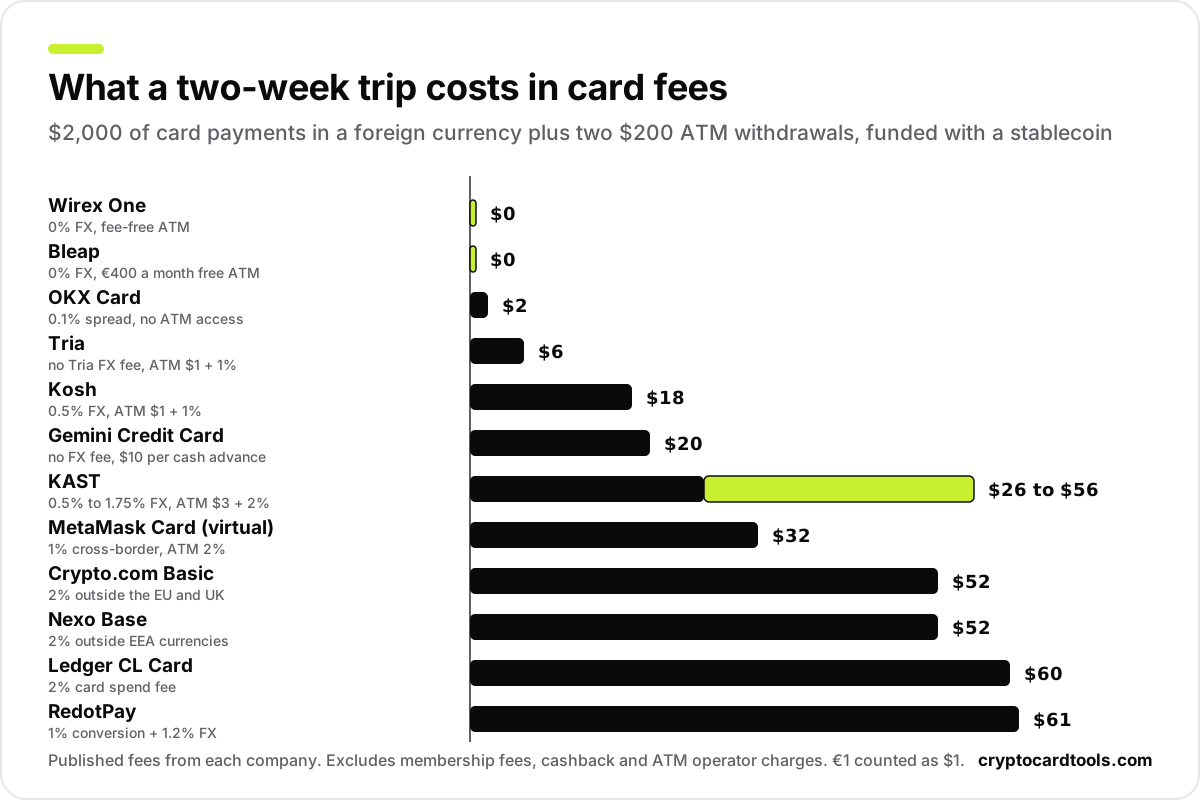
Euro-priced cards are counted at €1 to $1 to keep the sums simple. Crypto.com and Nexo are priced for payments in currencies outside Europe, where both charge a 2% markup, and Nexo's weekend surcharge is left out. The OKX Card's $2 covers purchases only, because it can't withdraw cash.
A card can charge a markup on every payment, a conversion fee when it turns crypto into money, and a fee on each ATM withdrawal. RedotPay charges all three, which lands it at about $61.
The card cost calculator reruns the same sums with your own spend and withdrawals.
Wirex One: Best Overall for Travel
Wirex One charges no foreign transaction fee and lists "fee-free ATM withdrawals worldwide" on its card limits page. Our two-week trip cost nothing in card fees.
The card is open to residents of 73 countries and territories. They include the EEA, the UK, Switzerland, Australia, Japan, Thailand, the Philippines, the UAE, South Africa, Nigeria, Brazil and Mexico. US residents are not on the list.
The base tier is virtual only. A plastic card starts at the Premium tier. That tier needs a portfolio of at least $500 with 1% or more held in Wirex's WPAY token, and Wirex doesn't publish its delivery fee.
In 2026 Wirex moved its app to Wirex One, a self-custody wallet with the card as an add-on. You can top up with USDC, USDT, EURC, Bitcoin or Ether.
ATM cash is capped at €750 a day and €5,000 a month on physical cards. An older Wirex fee page still lists free withdrawals up to €200 a month and 2% after that, which would add about $4 to our trip. The in-app fee screen shows which rule applies before a large withdrawal.
Cashback runs from 0.5% to 8%, depending on your portfolio size and how much of it sits in WPAY, so the base tier earns little. The case for Wirex rests on fees, which is also why it is the low-fee pick in our ranking of the best crypto card for Europe.
Bleap: 0% FX and €400 of Free ATM Cash a Month
Bleap is a self-custody Mastercard that spends USDC from your own wallet. It charges "0% FX markup on all international transactions" and no issuance, monthly or maintenance fee.
The first €400 of ATM withdrawals each month are free, which covers both withdrawals in our model. Bleap doesn't publish the fee above that, so a cash-heavy trip can't be priced in advance.
Bleap says it serves residents of the European Economic Area and Latin America without publishing a country list. That makes it a natural second card in the regions Wirex One covers, and its free-cash terms are stated more plainly than Wirex's, whose fee pages disagree.
Bleap holds no balance for you, so a payment only goes through if your wallet holds enough USDC. A top-up the day before a long-haul flight avoids a declined card at arrivals.
Tria: Best for Cashback While Abroad
Tria charges no foreign exchange fee of its own, although its help centre notes that "Visa foreign exchange fees may still apply."
The Pro card returns 4.5% in USDT on the first $2,000 of monthly spending. Membership costs $109 a year. The virtual Lite card returns 1.5% on the first $1,000. Cash withdrawals earn nothing, and payouts arrive in batches that can take up to 90 days.
Our trip would earn about $90 on the Pro card, less than the $109 membership, so Pro pays off mainly if you also use it at home. ATM withdrawals cost $1 plus 1%, with a $750 daily limit.
Tria says the card covers over 200 regions, including the US and Indonesia, but its support team confirmed to us that India is not supported.
Our own application needed an access code, full KYC and proof of residence, and the Tria card review walks through each step and the 2026 cashback caps.
In August 2026 an exploit in a card contract that Tria used took $431,945 from 636 customers. Tria reimbursed them in full plus 10%.
OKX Card: Best Phone-Only Card in the EU
The OKX Card has no FX fee and a 0.1% spread when it converts stablecoins to euros. That kept our trip's purchases to about $2 on $2,000.
It is virtual only, so it works through Apple Pay and Google Pay but can't take cash from an ATM. For a city break where you pay by phone, that rarely matters.
The card is open in the EU and Norway, excluding Iceland and Liechtenstein. A second card for cash makes sense on trips outside big cities. The OKX Card review covers its cashback caps and eligibility.
Gemini Credit Card: Best for US Travellers
US residents have fewer options, because Wirex One, Bleap and the OKX Card don't serve them. The Gemini Credit Card has no foreign transaction fee and pays crypto rewards on purchases.
It is a credit card in the full sense, with a credit check and a limit. Hotels and car rental desks handle it like any other Mastercard credit card, which suits deposit holds better than a prepaid crypto card does.
A cash advance costs $10 or 3%, whichever is greater, and interest at the cash advance rate (29.74% in September 2026) starts on the day you withdraw. Our trip's two withdrawals cost $20 before interest, so a debit card is the cheaper source of cash.
Tria is the other zero-markup option for US residents, and more cards appear on the page for crypto cards in the United States.
Kosh and RedotPay: When Cheaper Cards Aren't Available
Kosh charges a 0.5% FX markup and $1 plus 1% per ATM withdrawal, with up to three $250 withdrawals a day. Our trip came to about $18, and the virtual card costs $8 a year.
Kosh says it onboards users in more than 90 countries. That makes it a candidate where neither Wirex One nor Tria accepts residents, though it publishes no country list to check against.
RedotPay adds a 1% crypto conversion fee and a 1.2% markup on non-default currencies, then 2% on ATM withdrawals.
Its daily ATM limit of $3,750 is the highest in this article, which helps on cash-only trips. RedotPay doesn't issue cards to residents of the US, India, Indonesia, Singapore, China, Turkey or Ukraine, among others, as our RedotPay review lists.
Crypto Cards That Look Cheap but Cost More Abroad
A low rate on a fee page often applies only to euro-area currencies. A 0% FX line can also sit beside a separate fee on every payment.
- 2% + weekendsNexo: 0.2% on EEA, UK and Swiss currencies, 2% on all others, plus 0.5% at weekends.
- 2% outside EuropeCrypto.com Basic: 0.2% on payments in the EU and UK, 2% outside them, for European residents.
- 0% FX, 2% spendLedger CL Card: no FX fee, but a 2% fee on every card payment and €3 plus 1.5% per ATM withdrawal abroad.
- 0.5% to 1.75%KAST: the markup depends on the country, and each ATM withdrawal costs $3 plus 2%.
- 1% cross-borderMetaMask Card virtual: a 1% cross-border fee that only the Metal card removes, and Metal orders have been paused since 2 June 2026.
- 1.5% + 4% ATMTangem Pay: the Visa rate plus 1.5%, and 4% on ATM withdrawals on the free plan, at contactless ATMs only.
Ledger's 2% applies when the card converts your crypto into the currency of the payment, a step that how a crypto debit card works breaks down.
Crypto Cards With Airport Lounge Access
Among the cards in this article, Crypto.com is the one with airport lounge access, through Priority Pass. Only the Level Up Pro and Private plans include it, and only with an active CRO lockup, stake or annual subscription.
The benefit shrank in 2026. According to Crypto.com's Priority Pass page, Pro drops from four visits a year to two. The change applies from 1 October in the EU, the UK and Latin America, and from 1 September elsewhere.
Private keeps unlimited visits for you, but guests are no longer included. Each guest costs US$35 or US$38, depending on the lounge.
Two visits a year rarely justify a subscription on their own, so the decision usually rests on card rewards, which the Crypto.com Visa Card review works through.
Dynamic Currency Conversion: Always Pay in the Local Currency
Card terminals and ATMs abroad often offer to charge you in your home currency. This is dynamic currency conversion, and the merchant's payment provider sets the exchange rate, which usually includes its own margin.
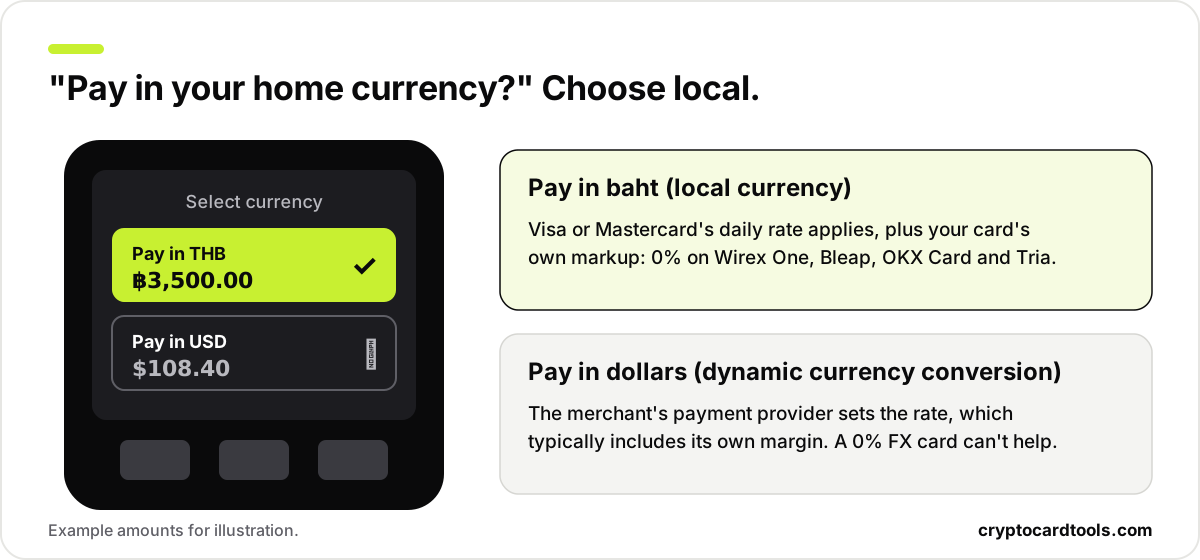
Choosing the local currency applies your card network's rate plus your card's own markup. On a 0% FX card, accepting the merchant's conversion gives away the main reason you chose it.
Visa says merchants and ATMs "must not choose on your behalf", and that declining "will not affect your ability to make purchases or withdraw cash internationally." Visa recommends declining when the required details aren't shown or you feel pressured, and reporting the incident to your card issuer.
Visa or Mastercard for Travel Abroad?
Both networks publish a daily exchange rate and apply it to foreign payments. We found no evidence that either is consistently cheaper.
The card company's markup, which ranges from 0% to 2% among the cards here, matters far more than the network.
Acceptance is where the network can matter, because some merchants take only one of the two. Wirex One, Bleap and the OKX Card run on Mastercard, while Tria, Kosh and RedotPay run on Visa.
Crypto Card Hotel Deposits and Car Rental Holds
Hotels and car rental companies place a hold on your card at check-in, often above the final bill. On a debit or prepaid crypto card, that hold locks part of your balance until the merchant releases it.
The US Federal Trade Commission says most rental companies hold more than the rental cost. A low balance when the hold is placed can get later purchases declined, and the held amount isn't processed if you return the car as agreed.
Some rental desks refuse prepaid and virtual cards outright. A physical credit card, such as the Gemini Credit Card for US residents, avoids that problem. A physical crypto card with an extra buffer for the hold is the next-safest route.
Crypto Card ATM Fees Abroad: Two Fees, Not One
An ATM withdrawal abroad can carry two charges. The first is your card's fee, which runs from nothing on Wirex One to $3 plus 2% on KAST.
The second is the ATM operator's fee, which the machine shows on screen before you confirm. None of the fee schedules in our database lists a refund of it. In some countries, Thailand among them, local ATMs add a flat fee for foreign cards.
Fewer, larger withdrawals keep the fixed part of both fees down. Daily limits cap how far that goes, from €750 on Wirex One and $750 on Tria and Kosh to $3,750 on RedotPay.
Each card's ATM fee appears on the page for crypto cards with ATM withdrawals. Moving larger sums to a bank account runs through a crypto offramp.
Using a Crypto Card Abroad: Your Residence Decides the Card
Crypto cards are issued to residents of specific countries after KYC on your ID and address. Travelling to a country doesn't make you eligible for a card offered there.
Applying from abroad can fail too. Tria requires you to be physically in your selected country during KYC, without a VPN, and with location access switched on.
Once issued, a card generally works in any country its network reaches, apart from sanctioned ones. Applying a few weeks before departure leaves time for a physical card to arrive and for KYC to clear.
Long stays are a grey area. Card terms tie the account to your country of residence. Gemini, for example, requires you to live in the US for as long as the account is open. Moving abroad for good usually means applying for a card in the new country.
Funding the Card Before You Fly
A stablecoin balance keeps the value of your travel money steady. A card that sells Bitcoin or Ether at each payment turns every coffee into a small market trade and, in many countries, a taxable sale.
Network choice also matters. Sending USDC on a cheap network such as Base, Arbitrum, Polygon or Solana usually costs cents, while Ethereum mainnet can cost dollars per top-up.
Topping up the expected trip budget before leaving avoids depending on hotel Wi-Fi and a blockchain confirmation at a checkout. Whether each payment counts as a sale depends on your country, and the crypto card tax guide explains the usual treatment.
Before You Fly: A Crypto Card Checklist
- Add the card to Apple Pay or Google Pay at home. Some apps send a one-time code by SMS, which can fail on a foreign SIM.
- Keep two-factor and 3-D Secure working. Online bookings abroad often need an in-app approval or a text message.
- Carry a second card from a different company. Ideally put it on the other network.
- Top up in a stablecoin on a cheap network. Leave a buffer above the trip budget for hotel holds.
- Check the ATM allowance. Know where free withdrawals end, and plan fewer, larger ones.
- Decline the home-currency offer. At every terminal and ATM, choose the local currency.
A frozen card abroad is the real risk
Card companies can freeze accounts for compliance reviews, and some crypto card programmes have shut down with little notice. A second card from a different company is cheaper insurance than any fee saving. Crypto debit card risks covers the checks worth running before you rely on one.
Which Card for Which Trip
A European resident on a week in Asia can lean on Wirex One for everything. For a trip inside the eurozone, a card denominated in euros avoids currency conversion altogether, so the markup barely matters.
A US resident on a road trip abroad does best with the Gemini Credit Card at the rental desk and Tria for daily spending and cash. Both charge no markup on foreign payments.
On a cash-heavy trip through South America, Wirex One's fee-free withdrawals suit residents of the countries it lists, and Bleap's €400 a month is the documented fallback. Residents of countries Wirex doesn't list can look at Tria first, then Kosh and RedotPay.
A frequent flyer who wants lounge access has a narrower choice. Crypto.com Private keeps unlimited visits but needs a CRO stake of €45,000, and the Basic plan carries the 2% markup outside Europe.
Best Crypto Card for Travel: The Verdict
Best overall Wirex One, with no FX fee and fee-free ATM withdrawals
Best second card Bleap, with €400 of free ATM withdrawals a month for EEA and Latin American residents
Best for rewards Tria Pro, with no Tria FX fee and 4.5% back on the first $2,000 a month
Best in the US the Gemini Credit Card for deposits, paired with Tria for cash
Fees on foreign payments and cash decide most of a travel card's cost, and they ranged from $0 to $61 on the same trip.
The crypto card comparison shows which of these cards accept residents of your country, with each one's FX and ATM fees side by side.
Frequently asked questions
What is the best crypto card for travel?
Which crypto card has no foreign transaction fees?
Can I use a crypto card abroad?
Should I pay in local currency or my home currency with a crypto card?
Can I use a crypto card for a hotel deposit or car rental?
How much do crypto card ATM fees cost abroad?
Do crypto cards work with Apple Pay and Google Pay abroad?
Is a virtual crypto card enough for travel?
Do crypto cards give airport lounge access?
Do crypto cards charge more at weekends?
Should I fund a travel card with stablecoins or Bitcoin?
Is Visa or Mastercard better for travel?
What is the best crypto card for travel in the US?
Can I get a crypto card while travelling?
Sources
Related tools
Keep reading
Revolut vs Crypto Cards: Is Revolut Enough to Spend Your Crypto in 2026?
Revolut now has a physical crypto card. Its spread, custody and limits compared with KAST, RedotPay, MetaMask and Crypto.com, and who still needs a separate card.
Best USDC Wallets in 2026: Where to Hold, Spend and Earn on USDC
The best USDC wallets in 2026: physical vs digital, the best USDC network, yield rules in the US, EU and Australia, and the wallets hit by recent hacks.
OKX Card Review 2026: Fees, Cashback, Countries and Limits
OKX Card review for 2026: 0.1% spread, 2% to 10% USDG cashback and its real monthly caps, every country it works in, and who should skip it.