Revolut vs Crypto Cards: Is Revolut Enough to Spend Your Crypto in 2026?
Contents
Revolut is the app most people in the UK and Europe already use for everything that touches money. It passed 68 million customers in 2025 and became a fully licensed UK bank in March 2026. It now sells more than 300 cryptocurrencies next to your salary account.
In May 2026 it added the piece that crypto card companies built their whole business on: a physical card that spends straight from your crypto balance. When you tap it at a shop, Revolut sells the right amount of Bitcoin, Ether or USDC at that moment to pay the merchant in pounds or euros.
If you hold crypto on Revolut, you already have the card, the app and the balance. Why would you send money to a separate crypto card company, pass another identity check and learn another fee table?
But the Revolut vs crypto cards comparison is closer than the convenience suggests, and in a few situations Revolut is the wrong answer. Its price is hidden in a spread rather than a fee. Its crypto sits with a company that no deposit scheme covers. It can't spend coins you hold in your own wallet. It has dropped USDT across the EEA and switched crypto off entirely in one EU country.
We compared Revolut's crypto card against KAST, RedotPay, MetaMask Card, Crypto.com and Bybit's European card as of October 6, 2026, using each company's published fees. Each one beats Revolut for a particular kind of user. For the rest, Revolut is now enough.
Quick answer
- Revolut is enough if you already hold crypto on Revolut, spend in pounds or euros, and stay under £1,000 a month of crypto spending on the free plan (or pay for Premium). You also have to accept Revolut holding the coins.
- Get KAST if you want cashback. It pays 1.5% to 3% in dollars on stablecoin spending, which Revolut doesn't match.
- Get the MetaMask Card if your crypto lives in your own wallet. It spends from self-custody and is open across the EEA, though UK sign-ups are closed.
- Get Crypto.com if you'll stake CRO for tiered rewards and want 0.2% FX across the EU and UK.
- Get RedotPay if Revolut doesn't serve your country or has suspended crypto there.
- Skip Gnosis Pay. Its consumer card closes on December 20, 2026.
What Revolut's Crypto Card Does
The crypto card is a Visa or Mastercard debit card linked to your Revolut crypto holdings. You can create a virtual version for free on any plan or order a physical one. Revolut launched the physical card on May 18, 2026 with a Dogecoin design and an LED that lights up when you tap.
You choose what it spends from. Link it to one coin, or choose "All crypto" and Revolut deducts from your largest holding first. If the balance can't cover a payment, the card declines rather than falling back to your fiat account.
At checkout, Revolut converts the crypto at its real-time rate and pays the merchant in the local currency. Revolut's help pages state that no exchange fee is charged on these payments. What you pay instead is not zero.
The card works wherever Visa and Mastercard do, with a £3,000 daily ATM limit and a £100,000 per-transaction cap. It is available on every Revolut plan in the UK and the EEA, with Hungary, Switzerland and Portugal excluded at launch. Hungary is the country where Revolut suspended crypto services in July 2025 after local law changed.
Revolut Crypto Card Fees: What You Pay
Revolut's crypto card has no fee line, which is different from having no cost. Three things decide what a payment costs you.
The three costs
- Spread: 0% to 3% built into the rate, not itemised.
- Fair usage fee: 1% above £1,000 a month on Standard, 0.5% above £3,000 on Plus, none on Premium and above.
- Trading fee when you buy: 1.49% on Standard and Plus, or 0.09% taker on Revolut X.
The spread. Revolut's fee schedule describes the market spread as "already included in the price quoted to you". Its legal documents put it at typically between 0% and 3%. A spread is the gap between the rate you get and the mid-market rate. On a £100 coffee run paid in Bitcoin, a 1% spread is £1 you never see itemised. Revolut doesn't publish the live spread, so the only way to measure it is to compare your deducted crypto against the market price at that minute.
Fair usage fees. Standard plan customers get £1,000 of fee-free exchanges a month, with 1% charged above that. Plus gets £3,000 and 0.5%. Premium, Metal and Ultra have no limit. Revolut's help page confirms the allowance covers crypto exchanges. A card payment is an exchange. A Standard customer who spends £1,500 of crypto in a month therefore pays £5 on the excess.
Trading fees when you buy. Spending is one side of the trade. Getting the crypto onto Revolut costs 1.49% on Standard and Plus, 0.99% on Premium and Metal, and 0.49% or less on Ultra, each with a minimum fee. Revolut X, its separate exchange app, charges 0% maker and 0.09% taker, which is where anyone buying regularly should do it.
Revolut's own documents disagree
Its EEA legal fee schedule still says exchanges made via the card "incur normal exchange fees". Its UK schedule and help pages say no percentage fee applies to card spending, and its product pages follow the no-fee version. If you're in the EEA and the amounts matter, a line to Revolut support settles it.
On cashback, Revolut ran a 1% crypto cashback promotion for UK Standard customers from October 2022 under terms that remain online. Its 2026 card launch didn't mention a cashback rate. Treat any cashback as a bonus to check in the app, not a reason to choose the card.
What You Give Up by Staying on Revolut
Four limits don't show up in the fee schedule.
- CustodialYour crypto is custodial and uninsured. Revolut Bank UK's deposits carry FSCS protection to £120,000, which is why it leads our guide to crypto-friendly banks. Crypto is held separately by Revolut Ltd in the UK and Revolut Digital Assets Europe in the EEA. Revolut's own pages say it isn't covered by investor protection schemes. That's true of KAST, RedotPay and Crypto.com too. It's not true of the MetaMask Card, which only takes crypto from your wallet at the moment you pay.
- Revolut onlyYou can only spend what Revolut holds. If your Bitcoin is on a hardware wallet or your USDC is on Base, it has to go to Revolut first. Deposits are free. Withdrawals back out cost £1 or £3 plus the network fee, and Revolut caps them per address based on its own risk assessment.
- EEAUSDT is gone in the EEA. Revolut removed Tether for EEA and Swiss customers in stages through summer 2026. The delisting completed on August 31, with remaining balances converted to the base currency. UK customers still have it. Anyone paid in USDT who lives in the EU can't spend it through Revolut.
- Switched offRevolut can switch crypto off. Hungary lost Revolut crypto in July 2025. Portugal is excluded from the card. A dedicated crypto card company serves crypto users as its only business and has more reason to keep serving them.
Revolut vs Crypto Cards: The Five That Compete
Five cards cover the realistic alternatives for someone in the UK or EU. Each wins on something Revolut doesn't offer.
KAST: the cashback card
KAST pays cashback in dollars: 1.5% on its free Standard tier, 2% on Premium ($1,000 a year) and 3% on Private ($10,000 a year), on stablecoin spending up to a monthly cap. The free tier comes with two virtual cards and no annual fee.
The catch for a European is currency. KAST is a US dollar card, so every pound or euro purchase carries a foreign exchange fee that KAST publishes as 0.5% to 1.75% depending on country. At the upper end, that cancels most of the Standard cashback. KAST shows its supported countries only during sign-up, so UK and EEA availability has to be checked in the app.
KAST holds your stablecoins through licensed partners, so custody is the same trade-off as Revolut. Our KAST Card page lists its full fee and limit data.
Beats Revolut When you spend in dollars, or you hold USDT and USDC and want to be paid for spending them
MetaMask Card: the self-custody card
The MetaMask Card is the only card in this comparison that never holds your crypto. Funds stay in your MetaMask wallet until the second you pay, when the card pulls exactly what's needed.
It's available across most of the EEA plus Switzerland, and sign-ups in the UK are temporarily closed. Spending a stablecoin that matches your currency costs nothing. GBPe and EURe are supported for that reason. Spending USDC as a euro cardholder costs 0.5% and spending wrapped Ether costs 0.875%. The free tier adds a 1% cross-border fee that the $199-a-year Metal tier removes.
Cashback is 1% in MetaMask's own mUSD stablecoin on the free tier, and 3% on the first $10,000 of Metal spending. Our MetaMask Card review covers the setup and the Linea network it runs on.
Beats Revolut When you refuse to hand custody to anyone and your crypto already lives in a wallet
Crypto.com Visa: the tiered rewards card
Crypto.com's European card has a free Midnight tier and paid tiers unlocked by a monthly subscription or by staking CRO for twelve months, from €450 for Ruby up to €450,000 for Obsidian. Cashback runs from nothing on Midnight to 4.5% on Obsidian, paid in CRO.
From October 1, 2026, Crypto.com charges 0.2% FX within the EU and UK on its lower tiers and 2% outside, with the top tiers exempt. Topping the card up with crypto costs 1%. Free ATM withdrawals run from €200 a month on Midnight to €1,000 on the top tiers.
Crypto.com publishes fewer of its European reward rates than it should, which is why our Crypto.com card review models the free tier most carefully.
Beats Revolut When you're prepared to lock CRO for a year and want rewards that scale with the stake
RedotPay: the widest availability
RedotPay issues a Visa card for a one-off $10 virtual fee, with a 1% conversion fee when you top up, 1.2% FX on non-USD spending and 2% on ATM withdrawals. The standard card pays no cashback. Its Pro plan at $12.90 a month pays 3% on Apple Pay and Google Pay purchases, capped at 18 USDs a month. The reward is a credit that can only be spent on future card payments.
Its strength is reach. RedotPay serves the UK and nearly all of the EEA, excluding only Croatia and Slovenia. It accepts USDT, USDC, BTC and ETH top-ups. For someone in Portugal or Hungary, where Revolut's crypto card isn't offered, it's the straightforward alternative. Our RedotPay review covers its limits and the risks of a Hong Kong-based issuer.
Beats Revolut When Revolut doesn't offer crypto spending where you live
Bybit EU Card: the European exchange card
Bybit issues a separate card for EEA residents through Bybit EU, its Austrian-licensed entity, after moving its European card customers there. It is available across most of the EEA, with eligibility confirmed at sign-up. There's no annual fee and the physical card is free.
Bybit's own pages put ongoing cashback at 1% for regular users with no monthly cap, and 2% to 10% for VIP levels, subject to monthly caps. New users get 10% in their first month, up to €150.
Bybit hasn't published a Europe-specific fee table for FX, ATM or conversion. Its global table lists 2% FX and 0.9% conversion, and until Bybit publishes European figures, those are the numbers to assume. Our Bybit Card review covers the Asia-Pacific card whose fees are published.
Beats Revolut When you trade on Bybit and want spending rewards tied to that balance
Gnosis Pay: closing
Gnosis Pay was the self-custody card for Europe, paying GNO cashback from a Safe wallet. It stopped new sign-ups on September 4, 2026, ended cashback on September 30 and will switch off cards on December 20, 2026. Existing users are being pointed to Rebind for euro accounts. It no longer belongs on a comparison list.
What £500 a Month Costs on Each Card
Fee tables hide the answer. A UK Standard-plan customer spending £500 a month in pounds shows it, with the EEA equivalent spending €500.
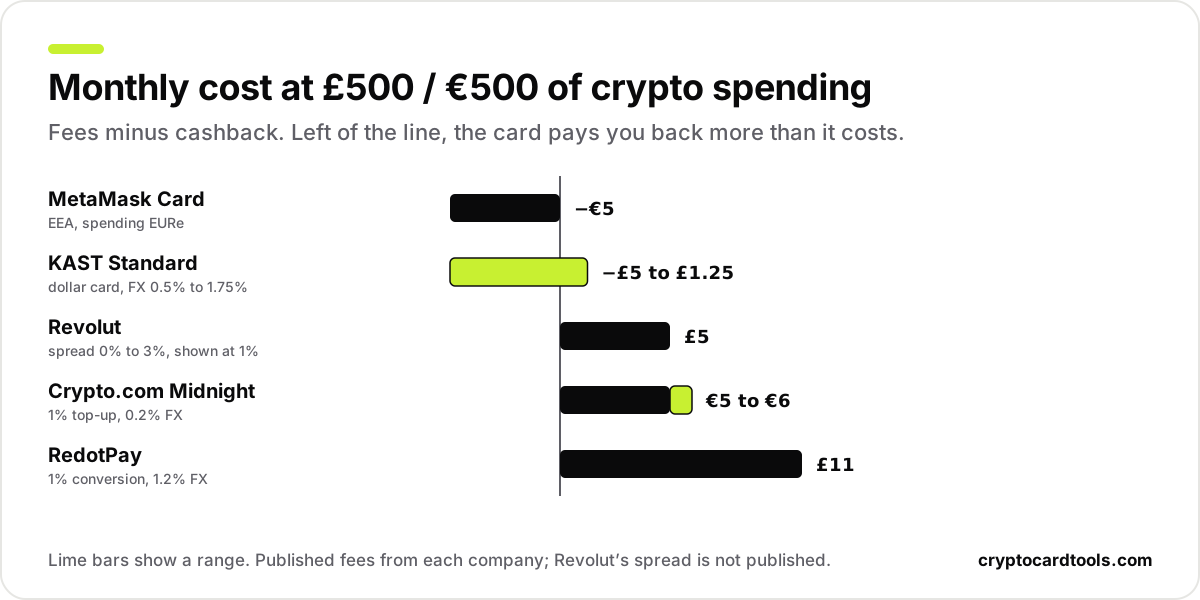
- £5Revolut: no fee and no cashback. The cost is the spread, which Revolut puts at 0% to 3%. At 1%, that's £5. The £1,000 fair-usage allowance isn't reached.
- −£5 to £1.25KAST Standard: 1.5% cashback returns £7.50, but FX on a pound purchase from a dollar card takes 0.5% to 1.75%, so £2.50 to £8.75. Net result: between a £5 gain and a £1.25 loss.
- −€5MetaMask Card (EEA, EURe): no spending fee on a matching stablecoin, 1% cashback in mUSD. Net result: €5 gained. UK residents can't currently sign up.
- €5 to €6Crypto.com Midnight: 1% top-up fee costs €5, 0.2% FX adds €1 if the purchase crosses a currency, no cashback. Net result: €5 to €6 lost.
- £11RedotPay: 1% conversion plus 1.2% FX on pound spending costs £11. Net result: £11 lost.
At £500 a month, Revolut and MetaMask Card come out ahead, and KAST ties them if its FX sits at the low end. The picture changes for a Standard customer above £1,000 a month. Revolut's 1% fair-usage fee starts there, which is when a paid plan or a rewards card starts to make sense.
Running your own figure through the card cost calculator takes a minute and uses each card's published fees. Our crypto card comparison puts every card side by side.
Who Should Stay With Revolut
Revolut is enough for more people than crypto card companies would like.
If your crypto is already on Revolut and you spend in pounds or euros under the fair-usage allowance, no card here saves you money. You also get one app, one identity check and a bank that regulators have already licensed.
If you're on Premium or Metal, the fair-usage limit disappears and the trading fee falls to 0.99%. The spread remains as the one cost to watch.
If you buy crypto only to spend it, Revolut X at 0.09% and then the card is the cheapest path from fiat to a crypto purchase at the till. Routing through crypto at all then needs a reason, since the same card spends fiat with no spread.
Who Needs a Dedicated Crypto Card
Four kinds of user should look past Revolut.
Look past Revolut if you are
- A self-custody holder: the MetaMask Card is the only option that keeps coins in your wallet.
- A stablecoin earner: KAST turns USDT and USDC income into 1.5% to 3% cashback.
- A rewards optimiser: Crypto.com's staked tiers and Bybit's exchange-linked tiers both pay.
- Somewhere Revolut doesn't serve: RedotPay covers Hungary, Portugal and Switzerland.
Self-custody holders. If your coins sit in a wallet you control, the MetaMask Card is the only option that keeps them there. Sending them to Revolut hands custody over and costs £3 plus network fees to reverse.
Stablecoin earners. If you're paid in USDT or USDC, KAST turns that income into 1.5% to 3% cashback in dollars. It also keeps USDT, which Revolut has dropped in the EEA. Our guide to getting paid in stablecoins and cashing out covers the routes, and our ranking of USDC cards lists every card that spends it.
Rewards optimisers. Revolut's card earns nothing by default. Crypto.com's staked tiers and Bybit's exchange-linked tiers both pay, with strings attached. Our guide to the best crypto cards ranks them on the full cost.
People Revolut doesn't serve. Hungary, Portugal and Switzerland are excluded from the crypto card. RedotPay covers all three.
Whichever you pick, spending crypto is a sale in the eyes of most tax authorities. Revolut's own help page says paying with crypto "is just like selling crypto". Our crypto card tax guide explains how the UK, Germany and Portugal treat each payment.
How Revolut's Card Changes the Market
Revolut's launch reaches beyond its own customers. A regulated bank with 68 million users now offers what RedotPay and KAST offer, with no sign-up friction and a known brand. Daily crypto card transactions across the industry passed 100,000 on several days in 2026, according to The Block. Revolut will take a share of that growth from the specialists.
The specialists' answer is to be better at the thing Revolut won't do. KAST pays cashback, MetaMask keeps custody with you, RedotPay serves the countries Revolut leaves out and Crypto.com rewards those who stake.
Revolut's crypto card page and its crypto fee schedule are the documents to read before deciding. Crypto.com's European fee page shows how the October 2026 FX change affects its tiers. Lyra Terminal's MiCA licence guide and FCA registration guide explain what each company's European and UK licence does and doesn't cover.
For most UK and EU crypto holders, the Revolut vs crypto cards decision now comes down to one question. If the answer to "where is my crypto" is "on Revolut", you already have the card you need. If the answer is "in my wallet", "in USDT" or "in a country Revolut left out", one of the five cards above still earns the extra sign-up.
Frequently asked questions
Does Revolut have a crypto card?
What are Revolut crypto card fees?
Does the Revolut crypto card pay cashback?
Is Revolut enough for spending crypto?
Revolut vs Crypto.com card: which is better?
Is crypto on Revolut protected by the FSCS?
Can I spend USDT with Revolut?
Can I spend crypto from my own wallet with Revolut?
Which countries can't get the Revolut crypto card?
Is paying with the Revolut crypto card taxable?
Is Revolut X cheaper than the Revolut app for crypto?
Does Bybit have a card in Europe?
Is Gnosis Pay still available?
Sources
Related tools
Keep reading
Best USDC Wallets in 2026: Where to Hold, Spend and Earn on USDC
The best USDC wallets in 2026: physical vs digital, the best USDC network, yield rules in the US, EU and Australia, and the wallets hit by recent hacks.
OKX Card Review 2026: Fees, Cashback, Countries and Limits
OKX Card review for 2026: 0.1% spread, 2% to 10% USDG cashback and its real monthly caps, every country it works in, and who should skip it.
Best Crypto Card Europe: 7 Options Compared for 2026
Discover the best crypto card Europe offers in 2026. We compared fees, rewards, and KYC for 7 cards to find your ideal match.