Best Self-Custody Crypto Cards in 2026: Who Really Controls Your Money
Contents
- Quick Answer: The Best Self-Custody Crypto Cards
- The Best Self-Custody Crypto Cards in 2026
- How Self-Custody Crypto Cards Work: Wallet or Collateral
- Who Holds the Keys: Seed Phrase, Passkey or Key Provider
- MetaMask Card: Best for Spending Straight From a Wallet
- Tria: Best for Cashback
- ether.fi Cash: Best for Ethereum Holders
- Bleap: Best With No FX Fee in Europe and Latin America
- Bitget Wallet Card: Cashback in Bitcoin, Gold or Stocks
- Wirex One: Self-Custody With Managed Keys
- OKX Card: 0% FX in the EU and Norway
- Tangem Pay, Avici and Exa: Collateral Cards for Specific Needs
- The 2026 Exploits: What Self-Custody Did and Didn't Protect
- Gnosis Pay Is Closing: Your Funds and the Alternatives
- Can a Self-Custody Crypto Card Be Frozen?
- Self-Custody Cards Still Need KYC
- Self-Custody Card Fees: FX Markups and Cashback Compared
- Self-Custody Crypto Cards in the US
- Tax: Every Payment Can Count as a Sale
- How to Pick a Self-Custody Card
- Best Self-Custody Crypto Cards: The Verdict
A Visa or Mastercard that spends crypto from your own wallet is one of the more practical ways to use crypto day to day. You pay in shops, online and at ATMs while the balance never sits on an exchange.
Interest in these cards grew after exchange failures such as FTX in 2022 froze customer withdrawals. Several issuers now offer cards that leave your crypto in your own wallet or in a smart contract tied to your account.
If you moved your crypto off an exchange so no company could lock it, you probably don't want a card that puts it back in someone else's hands.
But "self-custody" on a card page can mean very different things. In 2026 a contract exploit drained card balances at Tria and Avici, and Gnosis Pay announced the end of its consumer card. The label alone doesn't tell you who can move your money.
We compared 10 self-custody crypto cards using their card terms, help centres and fee pages, checked in September and October 2026.
Quick Answer: The Best Self-Custody Crypto Cards
- Best for spending straight from a wallet: MetaMask Card. Funds stay in your MetaMask wallet until each payment, behind a spending cap you can revoke.
- Best for cashback: Tria. 4.5% back on the Pro card, with your crypto held as collateral in a contract tied to your account.
- Best for Ethereum holders: ether.fi Cash. 3% cashback and the option to borrow against your crypto instead of selling it.
- Best for Europe and Latin America with 0% FX: Bleap. Its cardholder terms put the private keys with you, and ATM withdrawals are free up to €400 a month.
- Closing: Gnosis Pay's consumer card shuts in December 2026, and funds in its Safe accounts stay withdrawable.
The Best Self-Custody Crypto Cards in 2026
Every card below keeps your crypto in a wallet or smart contract tied to you instead of in a company's account.
- WalletMetaMask Card: pulls each payment from your MetaMask wallet. 1% back on the free virtual card.
- CollateralTria: up to 6% cashback and no Tria FX fee. Sign-up currently needs an access code.
- Collateralether.fi Cash: 3% cashback and a borrow mode for people who don't want to sell their ETH.
- WalletBleap: 0% FX and free ATM withdrawals up to €400 a month in the EEA and Latin America.
- WalletBitget Wallet Card: 2% to 3% back in Bitcoin, gold, USDC or tokenized stocks, applied for inside the Bitget Wallet app.
- WalletOKX Card: 0% FX in the EU and Norway, as a virtual card linked to a smart wallet.
- WalletWirex One: 0% FX in 73 countries and territories, with keys managed through Privy.
- CollateralTangem Pay, Avici and Exa Card: a Tangem hardware-wallet card, a card with Visa Signature perks, and a card with instalment payments.
The self-custody crypto cards list shows every card in this group with its fees and countries. The crypto card comparison filters them by where you live.
How Self-Custody Crypto Cards Work: Wallet or Collateral
Card networks settle in fiat money, so a company converts your crypto at some point. The cards differ in where the crypto sits until then.
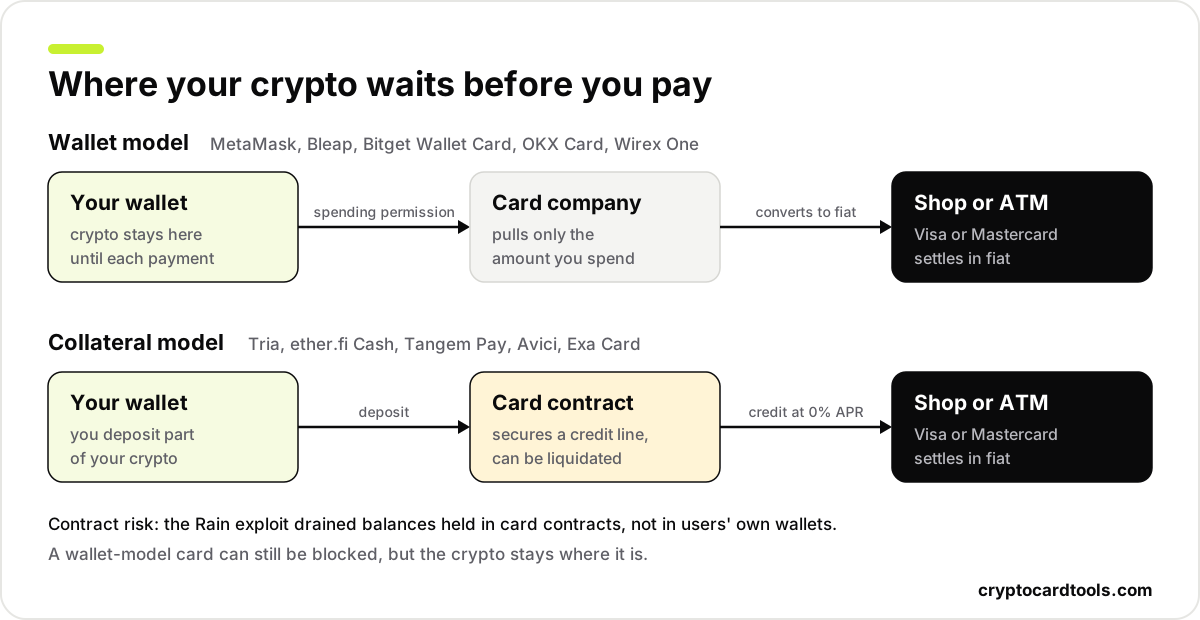
In the wallet model, your crypto stays in your own wallet. You grant the card a spending permission, and the card company pulls the amount of each payment at checkout. MetaMask, Bleap, the Bitget Wallet Card, the OKX Card and Wirex One work this way.
In the collateral model, you move crypto into a smart contract linked to the card. The card is legally a credit or charge card secured by that collateral, and the terms let the company sell collateral to cover unpaid spending. Tria, ether.fi Cash, Tangem Pay, Avici and Exa follow this pattern.
In the wallet model the card company can take only what you approve. In the collateral model it also has rights over the collateral when you owe money, in exchange for credit features and, on Tria and ether.fi, higher cashback.
A custodial crypto debit card works differently: the issuer or exchange holds the balance, and the card spends from that account.
Who Holds the Keys: Seed Phrase, Passkey or Key Provider
MetaMask and Tangem Pay sit on a classic wallet. You hold a seed phrase or a Tangem hardware card, and losing it means losing access, with nobody able to restore it.
Exa uses a passkey stored on your phone or password manager, which removes the seed phrase but ties recovery to that passkey. Wirex One relies on Privy as its key provider, and Bleap on multi-party computation, which splits key material instead of giving you a single seed phrase.
A seed phrase gives the most direct control and the least help if you lose it. Managed keys and passkeys usually recover more easily, but they add a company whose systems must keep working.
MetaMask Card: Best for Spending Straight From a Wallet
The MetaMask Card spends from your MetaMask wallet. You set a spending cap on the tokens the card can use, and MetaMask's support pages say you can revoke it at any time.
The free virtual card pays 1% back in mUSD and charges a 1% cross-border fee. The Metal card ($199 a year) pays 3% on the first $10,000 a year and drops that fee. Metal orders have been paused since 2 June 2026.
The card is listed in much of Europe and Latin America, plus Canada and Switzerland. Sign-ups in the US and the UK are temporarily closed.
It spends USDC, USDT, mUSD, wETH, EURe and GBPe. Paying with a stablecoin that differs from your card or merchant currency adds a 0.5% fee, and wETH adds 0.875%.
Tria: Best for Cashback
The Tria card is a collateral-backed credit line at 0% APR. Your crypto stays in your own wallet as collateral, and the card terms say neither Tria nor the issuer holds custody of it.
Cashback is the highest here among cards that don't tie rates to a large portfolio or an exchange VIP level. The virtual Lite card pays 1.5%, the $109-a-year Pro card 4.5% and the $250-a-year Max card 6%. Rates apply up to a monthly spending cap of $1,000 on Lite and $2,000 on Pro and Max.
Rewards arrive in USDT in periodic batches, with a wait of up to 90 days. Tria's help centre says it charges no FX fee of its own, though its card terms list FX of up to 3%.
The terms allow a "Liquidation Event" if charges go unpaid for one calendar day or your collateral falls below the balance. Stablecoin collateral removes most of the price risk.
Tria says it covers over 200 regions but shows the full list only inside its app. Sign-up currently needs an access code from the waitlist or a referral.
ether.fi Cash: Best for Ethereum Holders
ether.fi Cash is described by ether.fi as a non-custodial account. You can pay from your stablecoin balance or borrow against other crypto in the account, such as ETH, so a purchase doesn't force a sale.
Cashback is 3% on the Core, Luxe and Pinnacle levels, with a monthly spending cap of $2,000 on Core. Invitation-only VIP members get 4%.
The FX markup is about 1.5% on Core and falls on the higher levels. Membership levels also include balance protection against smart contract exploits, from $10,000 to $500,000, which isn't deposit insurance.
Borrowing against volatile crypto carries liquidation risk if prices fall. The card is open in 31 US states, Washington D.C. and a long list of other countries.
Bleap: Best With No FX Fee in Europe and Latin America
Bleap's card terms state that "you control the private keys and assets are not held by Bleap or Unlimit." Unlimit EU, an e-money institution licensed by the Central Bank of Cyprus, issues the card.
Each payment is a direct debit from your Bleap wallet, run through the wallet's smart-account permissions. If you remove those permissions, payments may be declined.
Bleap charges 0% FX and no issuance or monthly fee. ATM withdrawals are free up to €400 a month, and the card pays from USDC or EURe balances.
Cashback of up to 20% applies in selected categories such as streaming and food delivery, but Bleap doesn't publish the rate for each one.
If Bleap or Unlimit fails, the terms say the assets in your wallet "remain under your control and are not part of either party's estate."
Bitget Wallet Card: Cashback in Bitcoin, Gold or Stocks
The Bitget Wallet Card is applied for inside the Bitget Wallet app. Bitget says you "retain non-custodial control over your assets" until the exact moment of payment.
Cashback, which Bitget calls assetback, is 2% and rises to 3% on the Booster level, open to new cardholders or on reaching a monthly spend threshold. You choose whether it arrives in Bitcoin, tokenized gold, USDC or tokenized US stocks.
The card is virtual, issued through Immersve, and offered in the EEA, the UK and 10 Latin American countries. Spending in currencies other than the dollar carries a 1.7% fee, and activation costs $0.10 within 72 hours of KYC approval and $10 after that.
Wirex One: Self-Custody With Managed Keys
Wirex moved its consumer app to Wirex One in 2026. Its terms say Wirex "does not provide custodial services" and that your private keys "are generated and managed by Privy," a wallet infrastructure provider.
That set-up removes the seed phrase, which suits people who don't want to manage one. It also puts a third party's systems between you and your keys, so Wirex One is self-custody in a different sense from MetaMask.
Wirex charges no foreign transaction fee, and the card is open to residents of 73 countries and territories outside the US. Cashback runs from 0.5% to 8%, depending on portfolio size and how much of it sits in Wirex's WPAY token.
OKX Card: 0% FX in the EU and Norway
The OKX Card is connected to a smart wallet, so OKX says "ownership of the crypto remains with the user until the moment of transaction." OKX Europe runs the programme, and UAB Monavate, an e-money institution authorised by the Bank of Lithuania, issues the card.
It is virtual only, works through Apple Pay and Google Pay, and charges no FX fee, though OKX applies a 0.1% market spread on the stablecoin conversion. Purchases paid in USDG earn 2% back, capped at $50 a month for non-VIP users. VIP levels raise both the rate and the cap.
Tangem Pay, Avici and Exa: Collateral Cards for Specific Needs
Tangem Pay links a Visa card to a Tangem wallet and is run by Paera LLC, not Tangem AG. Its terms say your collateral is "owned by you at all times and held in your custody within one or more smart contracts." The programme manager can still liquidate it when a balance goes unpaid.
Those terms list a late fee of up to $40 and a liquidation penalty of up to $35. They also ask for three business days' notice before you withdraw collateral, although the app FAQ says you can withdraw at any time. Cashback is 1% on the free plan, capped at $100 a month.
Avici pays no cashback, but its Signature card adds Visa Signature benefits such as rental car cover. The Platinum virtual card costs $15 to issue, and the physical card $50.
Exa Card is a credit card run on a passkey-secured smart account, with no seed phrase. It has no cashback, but Pay Later splits purchases into up to eight fixed-rate instalments. Each Pay Later purchase is a loan against your deposited crypto, which can be liquidated if its value falls.
The 2026 Exploits: What Self-Custody Did and Didn't Protect
Two incidents in 2026 hit self-custody card designs. In June, attackers exploited a flaw in the modules that controlled Gnosis Pay card Safes. They took about $1.5 million across 5,281 wallets, and Gnosis absorbed the losses and moved every user to a new Safe.
On 28 August, an attacker exploited an outdated version of Rain's card collateral contract on Solana. Security firm Blockaid found that a second signature check pointed back at the first, so one attacker signature passed both. It put total losses at about $1.1 million across Rain-powered programmes.
Tria lost $431,945 across 636 customers, and Avici lost $500,859 across 1,685 users. Both reimbursed everyone in full plus an extra 10%.
Avici reported that users' own self-custodial wallets were not affected, so the losses came from balances already moved into the card contract.
Collateral in a card contract carries contract risk
Money moved into a card's collateral contract depends on that contract's code. Keeping only a few weeks of spending there, and the rest in your own wallet or a cold wallet, limits what a bug can reach.
The card safety check lists each card's incident history, licences and terms.
Gnosis Pay Is Closing: Your Funds and the Alternatives
On 21 September 2026, Gnosis Pay announced that it is ending its consumer card to focus on card programmes for other companies. Its help centre says the card and web app stop on 20 December 2026.
Funds in a Gnosis Pay Safe are unaffected, and there is no deadline for withdrawing them. After the card closes, the web app supports withdrawals only.
Partner apps such as Rebind, Picnic and MiniPay now issue their own cards under their own terms. Gnosis Pay users in the EEA can look at Bleap, MetaMask or the Bitget Wallet Card, all of which keep funds in a wallet the user controls.
In the UK, where MetaMask sign-ups are paused, the Bitget Wallet Card and Wirex One are the wallet-model options here. Swiss residents can look at Wirex One or MetaMask.
Can a Self-Custody Crypto Card Be Frozen?
Yes, the card itself can be. The issuer can block a card, decline payments or close the account after a compliance review, like any other card.
A frozen card doesn't freeze the wallet in the wallet model. Your crypto stays where it was, and you can move it with your own keys.
Collateral cards are different. Terms such as Tria's and Tangem Pay's give the company rights over collateral when you owe money, and Tangem Pay's terms ask for notice before withdrawals.
On an exchange-linked card, the exchange holds the balance, so an account freeze reaches the money itself. That is one of the crypto debit card risks that custodial cards carry.
Self-Custody Cards Still Need KYC
All 10 cards here require full identity verification, typically an ID document and a selfie. Card networks and issuer regulators drive that requirement, and holding your own keys doesn't change it.
Tria also asked for proof of residence in our own application. Our review of no-KYC crypto cards found none that cleared our bar as a working option.
Self-Custody Card Fees: FX Markups and Cashback Compared
FX markups on these cards run from nothing to 1.7%. Base cashback in the chart runs from nothing to 4.5%. Higher rates on Wirex One and the OKX Card depend on portfolio size or exchange VIP level.
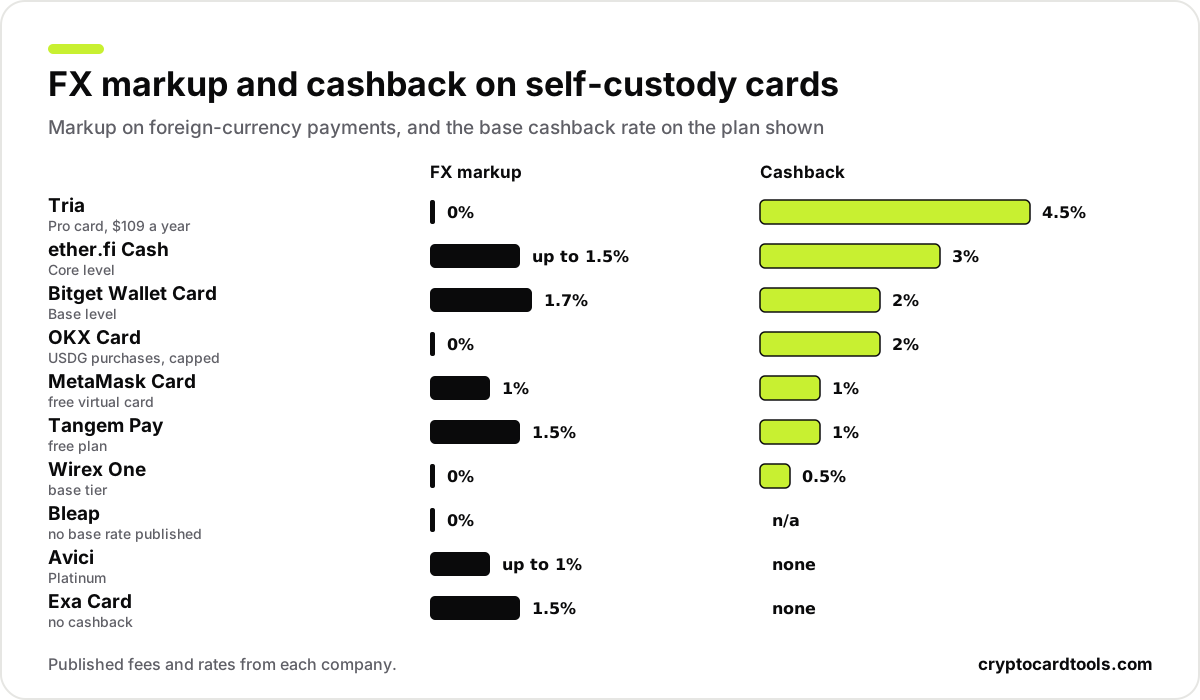
The card cost calculator runs your own monthly spending through each card's fees and cashback. Spending abroad makes the FX column matter most, and our best crypto card for travel ranking prices cards on a two-week trip.
Self-Custody Crypto Cards in the US
US residents have fewer choices. MetaMask has paused US sign-ups, and Bleap, Bitget Wallet, the OKX Card and Wirex One aren't offered in the US.
Tria accepts US residents. ether.fi Cash, Avici and Exa each cover 31 states, so checking your state on the card page avoids a wasted application. Tangem Pay is offered in the US, though not in every state.
Avici's card terms say "non-US citizens only," which conflicts with its US state list. Tangem Pay and Exa also ask US residents for a Social Security number.
The best crypto cards in the United States page ranks these alongside custodial options.
Tax: Every Payment Can Count as a Sale
Paying with crypto is usually a disposal for tax purposes, whether the card is custodial or not. In many countries, each payment in Bitcoin or Ether can create a gain or loss to report.
Spending stablecoins usually keeps those gains close to zero, and borrowing against crypto instead of selling it can delay a sale. The crypto card tax guide explains the rules by country.
How to Pick a Self-Custody Card
- Decide where the money should sit. A wallet-model card keeps it in your wallet. A collateral card needs a deposit into its contract.
- Check who holds the keys. A seed phrase, a passkey or a managed key provider each carry different recovery and access trade-offs.
- Read the liquidation terms. On collateral cards, find out what happens if a payment goes unpaid or prices fall.
- Compare FX markup and cashback caps. Use the currency you spend most, since the same card can be cheap in one currency and costly in another.
- Confirm your country. Several cards cover only part of the US or exclude the UK.
Best Self-Custody Crypto Cards: The Verdict
Best wallet card MetaMask Card in Europe and Latin America, or Bleap for 0% FX
Best for cashback Tria Pro, with 4.5% back and collateral held in your own wallet
Best for ETH holders ether.fi Cash, with 3% back and borrowing against ETH
Moving from Gnosis Pay Bleap, MetaMask or the Bitget Wallet Card before the card closes
A self-custody card removes the exchange as the holder of your balance. It leaves smart contract risk in place, and Gnosis Pay's closure shows a card programme can end even when the funds stay yours.
Frequently asked questions
What is the best self-custody crypto card?
What is a non-custodial crypto card?
Is the MetaMask Card really self-custody?
Can I get a crypto card without an exchange account?
Can a self-custody crypto card be frozen?
Do self-custody crypto cards need KYC?
Is Gnosis Pay shutting down?
What are the best Gnosis Pay alternatives?
Were self-custody cards affected by the Rain exploit?
Can a collateral-backed crypto card liquidate my crypto?
Is there a self-custody crypto card in the US?
Is ether.fi Cash non-custodial?
Which self-custody card has no FX fee?
Can I spend crypto from my own wallet with a card?
Do I pay tax every time I spend crypto with a card?
Sources
Related tools
Keep reading
Tria Card Review 2026: Fees, Cashback, Access Code and a Real Sign-Up
Tria card review from a real sign-up: fees, 4.5% to 6% cashback, limits, strict KYC, India and Indonesia availability, futures, Earn and the access code.
OKX Card Review 2026: Fees, Cashback, Countries and Limits
OKX Card review for 2026: 0.1% spread, 2% to 10% USDG cashback and its real monthly caps, every country it works in, and who should skip it.
Bybit Card Review 2026: Fees, Cashback, and Availability
Read our Bybit Card review for 2026. See cashback tiers, fees, and the countries where it's actually available. Get the facts before you apply.